Prostate
The Cancer Screening Nobody's Talking to You About (Literally)
The talk that decides whether men get tested
Jul 12, 2026 · 5 min read
/cover.webp)
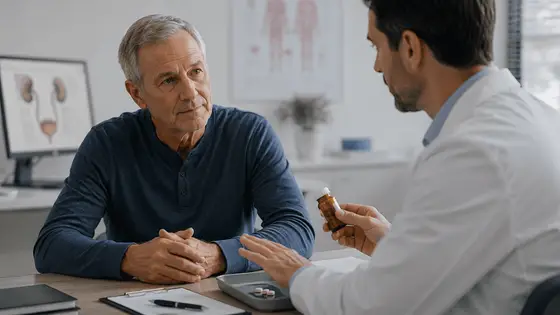
Most cancer screening comes with simple advice. Turn a certain age, get the colonoscopy. Turn another age, get the mammogram. Easy. But prostate cancer screening is the weird one, the test that comes with an asterisk and a required conversation. And a new study found that the conversation is barely happening.
Researchers at the Medical University of South Carolina dug through the records of 600 men and checked how often doctors actually discussed prostate cancer screening. The answer was about 6% of the time. Six percent. That's not a conversation gap, that's a conversation canyon.
Here's the kicker. When the chat did happen, men were much more likely to get screened: about 72% went on to get tested, versus only 36% of men who never had the talk. So the conversation isn't just paperwork. It changes what people actually do.
Wait, Why Does Prostate Screening Need a Conversation at All?
Good question, and it's the whole point. Most screenings are a clear "just do it." Prostate screening is more of a "let's think about this together," because the main tool, a blood test called PSA, is both genuinely helpful and a bit of a drama queen.
PSA stands for prostate-specific antigen, which is just a protein the prostate makes. High levels can be an early warning of cancer, and catching cancer early saves lives. In one big European study, screening men aged 55 to 69 prevented roughly 1.3 prostate cancer deaths for every 1,000 men screened over 13 years.
The problem is that PSA doesn't know why it's high. The prostate naturally grows as men age and pumps out more PSA even when nothing is wrong. When men with a mildly high PSA get retested, the number drops back to normal about 25% to 40% of the time. So a scary result can send a man to a needle biopsy he never needed.
Then there's the sneakiest issue: overdiagnosis. Many prostate cancers are total slowpokes. They grow so lazily they would never cause trouble in a man's lifetime. But once you find one, it's hard to just shrug it off, so some men get surgery or radiation they didn't need, and those treatments can cause real side effects like leaking urine or trouble with erections. Somewhere between 20% and 50% of screen-caught cancers may be these harmless slowpokes.
So screening isn't automatically good or bad. It's a trade-off, which is exactly why experts say to talk it out first.
The Plot Has Changed for the Better
Here's the encouraging part: the tools got smarter.
Doctors now use a special prostate MRI to decide who actually needs a biopsy, and it works well. With the old PSA-only approach, doctors needed about 6 biopsies to find 1 serious cancer. With MRI helping them aim, they need only about 2. Fewer needles, fewer false alarms.
And for the lazy, low-risk cancers, doctors increasingly skip aggressive treatment and simply keep watch, a strategy called active surveillance (regular tests and scans, with treatment only if the cancer wakes up and starts moving). A major trial followed men for 15 years and found no meaningful difference in prostate cancer deaths between men who got immediate surgery, radiation, or careful monitoring. Doctors got the memo: active surveillance for low-risk cancer jumped from about 14% of cases in 2010 to over 60% by 2020.
In short, screening today is less "find it and cut it out at all costs" and more "find out, then decide carefully." That makes the conversation more valuable than ever.
Why This Matters Most for Black Men
This is the part everyone needs to hear.
Black men in the US have the highest prostate cancer rate of any group (about 414.6 per 100,000, compared with 272.6 for White men) and are more than twice as likely to die from it. Their lifetime risk of dying from prostate cancer is 3.8%, two to four times higher than other groups.
Here's the crucial piece: this gap is not about race itself or some built-in difference in the tumors. It's about access to care, being informed, and getting equal treatment. When Black men receive the same quality of care, their outcomes match everyone else's.
Yet research shows Black men are less often told about screening in the first place. That connects to a quiet unfairness in how screening gets offered. If doctors only bring it up when a patient asks, the men who benefit are the ones who already knew to ask, usually the more educated and assertive. Everyone else gets left out.
In the South Carolina study, the conversation gap hit Black men hard, but so did the benefit: when Black men did have the discussion, 85% went on to get screened, versus 36% who didn't. The Prostate Cancer Foundation now recommends that Black men get information about screening and, if they choose it, a baseline PSA test between ages 40 and 45.
So What Should You Actually Do?
A few simple things.
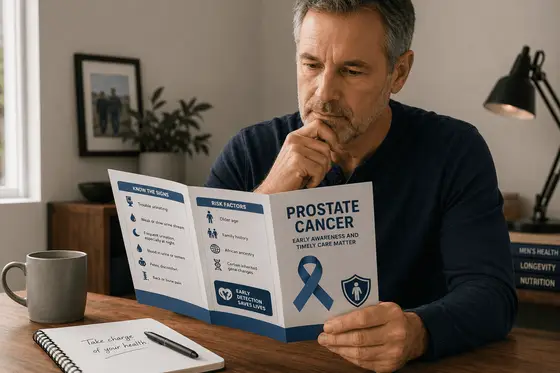
First, know the rough ages. Groups set slightly different starting points, but for average-risk men the conversation generally belongs somewhere around ages 45 to 50, and for higher-risk men (Black men, a strong family history, or certain inherited genes) it starts earlier, around 40 to 45. Most groups advise against routine screening after age 70, since by then the harms tend to outweigh the benefits.
Second, don't wait to be asked. If your doctor doesn't bring up prostate screening, that usually doesn't mean it's unimportant, it means the visit ran out of time. Speak up. "Should I be thinking about prostate cancer screening?" is a perfect sentence.
Third, ask for the trade-offs, not just the test. The goal isn't to screen or skip on autopilot, it's to understand the benefits and the risks and decide what fits you.
The big takeaway is almost funny in its simplicity: one short conversation dramatically changes whether men get screened, and hardly anyone is having it. You can't fix the whole health system, but you can control whether the topic comes up at your next visit.
Be your own best advocate, and start the conversation.
This article is about a screening decision in general, not medical advice for you specifically — and it deliberately does not tell you to get a PSA test. The honest position is that reasonable doctors disagree about routine screening, because the benefit (fewer prostate cancer deaths) and the harm (unnecessary biopsies and treatment for cancers that would never have hurt you) are both real. What isn't in dispute is that the decision should be yours, made with information, and that right now most men aren't being offered the chance to make it at all. If you're Black, have a father or brother with prostate cancer, or carry a known inherited risk, that conversation belongs on the calendar earlier — around 40 to 45. Talk with your doctor about what fits your age and risk. And if you're already on a prostate medication, our piece on deprescribing has a second question worth asking: do I still need this?