Intimacy
Morning Wood, Meet Big Data: What Your Sleep Erections Are Trying to Tell You
Night erections are a blood vessel report card
Jul 11, 2026 · 7 min read
Let's start with a fact that surprises almost everyone: your body runs a quiet nightly health check while you're fast asleep, and the report card is an erection. Actually, several of them.
Healthy men have about three to five erections every night, mostly during REM sleep, and each can last around 25 to 35 minutes. You don't plan them. You don't feel them. You just occasionally wake up to the evidence, a phenomenon the internet affectionately calls "morning wood." Doctors call the whole process nocturnal penile tumescence, which is a very fancy way of saying "nighttime swelling."
For decades, this odd little bodily habit has been one of the most useful clues in men's health. Here's why, plus how the tools to measure it went from "wrapping your privates in postage stamps" to "a smart ring with an app."
The Clever Detective Trick
Here's the key idea. Sleep erections happen on autopilot, with zero input from your conscious brain. No mood, no nerves, no performance anxiety. So they answer a question that daytime can't: is the plumbing itself working?
Think about it. If a man struggles to get an erection during sex but has strong, regular ones while he sleeps, that points toward a psychological cause (stress, anxiety, relationship worries), because the equipment clearly works when the brain gets out of the way. But if the nighttime erections are weak or missing too, that points toward a physical cause, like a problem with blood flow or nerves.
Splitting those two apart is the whole reason these tests exist.
The Gloriously Awkward History of Measuring This
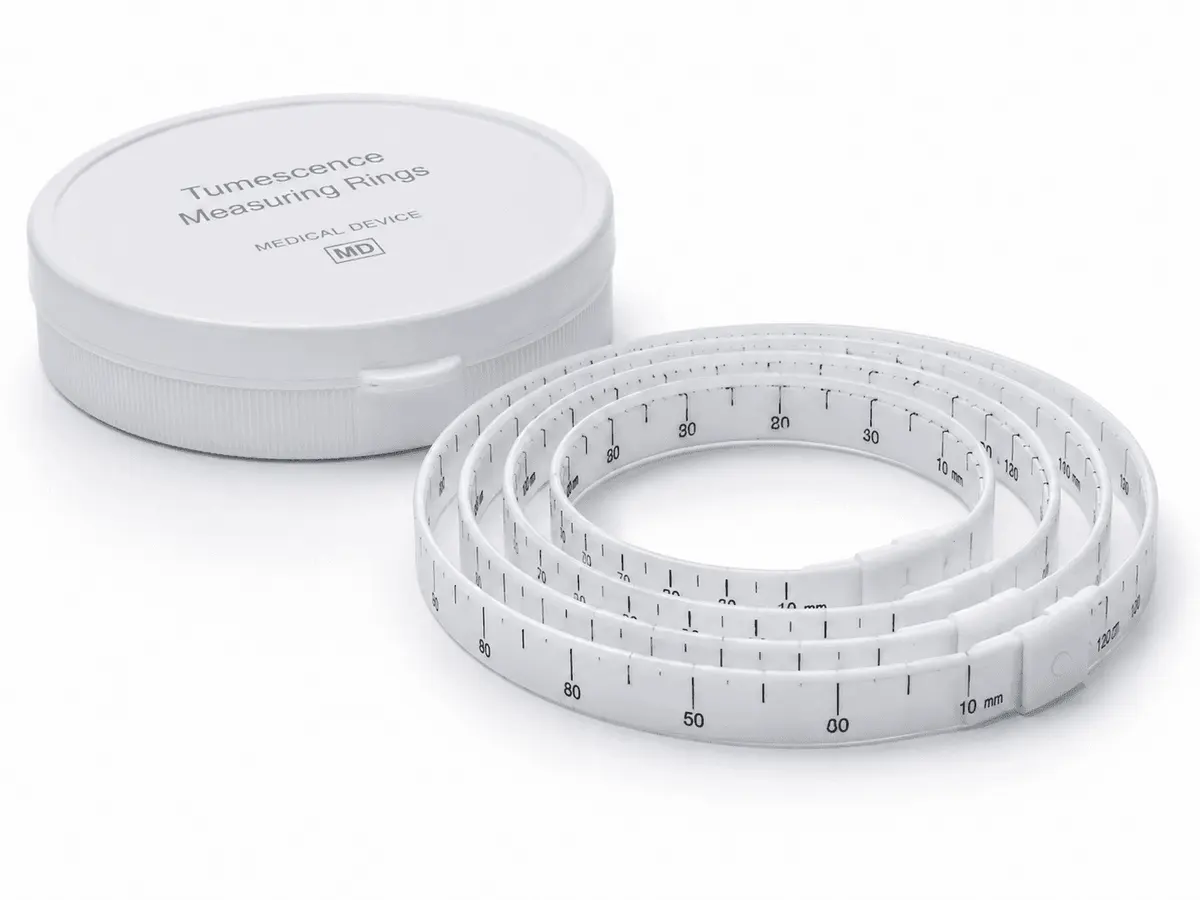
Before fancy electronics, doctors got creative. The "stamp test" was exactly what it sounds like: wrap a ring of postage stamps around the penis at bedtime, and if the perforations tore by morning, an erection happened. That's it. A yes-or-no answer powered by the US Postal Service.
Then came the "snap gauge," a strap with plastic bands of different strengths that would break depending on how firm things got. There was the "erectometer," basically a calibrated felt band with a sliding collar. There was a mercury-filled tube that measured swelling through changes in electrical resistance. And for the full experience, there was the sleep lab, where you'd spend the night wired up while a trained observer checked on your erections, which is exactly as relaxing as it sounds.
The heavyweight champion of this world is the RigiScan, a portable device with two loops (one at the base, one near the tip) that gently squeeze every so often through the night to measure both firmness and swelling. It's the most studied tool of the bunch. It's also bulky, heavy, and can be uncomfortable enough to mess with the very sleep it's trying to measure. A machine that ruins your sleep while measuring your sleep erections has a certain comedic irony to it.
Why These Tests Aren't Perfect
Even the good ones have real weaknesses, and it's worth knowing them.
The biggest is a rigidity mix-up. Most of these devices measure "radial" rigidity, which is how hard the penis pushes outward against a squeezing loop. But the kind of firmness that actually matters for sex is "axial" rigidity, which is resistance to bending or buckling. Those two don't match up perfectly, so a device can misjudge real-world firmness.
They also produce false alarms. Poor sleep throws everything off, and sleep disorders like sleep apnea are extremely common in older men, which can fake a bad result. Depression can flatten nighttime erections all on its own, so a man can look like he has a physical problem when the real issue is his mood. Certain medications and a few drinks the night before can skew the numbers too.
Because of all this, modern clinics often reach for penile ultrasound instead, which looks directly at blood flow. The catch is that ultrasound usually requires an injection to trigger an erection in the office, and, well, getting an injection in a cold exam room tends to summon exactly the performance anxiety that sleep tests were designed to avoid.
The Plot Twist: This Is Really About Your Heart
Here's the part that turns a slightly awkward topic into a genuinely important one. Erection trouble is often an early warning light for heart disease.
The reason is beautifully simple and a little alarming. The arteries feeding the penis are small. The arteries feeding the heart are bigger. When the gunky, artery-narrowing process called atherosclerosis starts, it tends to show up in the penis first, then the heart and brain, and the legs last. So a fading erection can be the body's check-engine light, blinking years before a heart attack.
And this isn't a hunch. Vascular erectile dysfunction is often the very first sign of a change in cardiovascular health and can come 3 to 5 years before a major event like a heart attack. In a Johns Hopkins study that followed roughly 1,900 men, those who reported erectile dysfunction were more than twice as likely to have or die from a heart attack, cardiac arrest, or stroke (6.3% versus 2.6%). As one of the researchers put it, a lot of men who dodge the doctor for years finally show up because of a bedroom problem, which turns out to be a golden chance to catch heart trouble early.
⚠️ A lasting change in your erections is a cardiovascular signal, not just a sex problem.
This is the single most useful thing on this page. Vascular ED can precede a heart attack or stroke by 3 to 5 years, which means a fading pattern is an opening to catch artery disease while it's still quiet and treatable. Do not answer that signal by buying a gadget or ordering pills from a website that skips the medical history — book an appointment and get your blood pressure, blood sugar, and cholesterol looked at. And if you ever have chest tightness, pressure, or shortness of breath, especially with exertion, that's not a "mention it at my next physical" symptom. That's urgent care, now.
Translation: those nightly erections aren't just about sex. They're a running status update on your blood vessels.
Enter the Smart Ring
For most of history, tracking any of this meant a clinic visit and some seriously unglamorous gear. That's the gap a device like the FirmTech TechRing is trying to fill by bringing the measurement home.
The TechRing is a wearable ring you can put on at night (or during sex) that quietly logs data. It has a pressure sensor to measure firmness and a strain gauge to measure girth expansion, and its outer shell is made of medical-grade elastomer chosen to be comfortable enough for overnight wear. It uses a two-loop, hook-and-loop design (one loop around the shaft, one around the scrotum) and connects to a phone app over Bluetooth. The app then counts your nighttime erections and rolls firmness and duration into a single number the company calls an "Erectile Fitness Score," so you can watch your trend week to week instead of squinting at raw data.
In spirit, it's a friendly consumer cousin of those old lab tools, minus the wires, the stamps, and the stranger watching you sleep. It's also been taken seriously enough to get written up in a urology journal, and the makers report a 14-month evaluation with 5,204 recordings that found no cases of priapism or skin reactions, with only two users noting mild discomfort after several hours. It even carries endorsements from sexual medicine physicians. The device is also marketed as being FDA registered, which brings us to the honest part.
The Fine Print (Read This Before You Buy Hype)
A few things are worth keeping straight.
"FDA registered" is not the same as "FDA approved" or "FDA cleared." Registration mostly means a company has listed itself and its product with the agency. It is not a stamp saying the device was proven to diagnose anything. Fair marketing, but easy to misread.
A consumer ring is a tracker, not a diagnosis. It's great for spotting your own patterns over time and for showing a doctor real data instead of guesswork. It is not a substitute for a medical workup. The device makers say as much: it gives you information, not a verdict.
It inherits the old radial-versus-axial limitation. Like the classic strain-gauge tools, it measures swelling and squeezing forces, not true buckling firmness, so treat the numbers as trends, not gospel.
And please, don't spiral over one bad night. A rough sleep, a couple of drinks, stress, or a weird week can all dent the data. One low reading is noise. A steady downward trend over several weeks is the thing actually worth asking a doctor about.
The Practical Takeaway
Your nighttime erections are a low-key health report you've been ignoring your whole life. Paying attention to them, whether through a clinic test or an at-home tracker, can flag not just sexual issues but early heart and blood-vessel trouble, sometimes years ahead of time.
So if your pattern clearly changes and stays changed, don't shrug it off, and definitely don't just order a gadget and call it a day. Book a real appointment. The same visit that sorts out the bedroom question might also check the one organ you really can't replace.
Morning wood, it turns out, is less of a punchline and more of a messenger. Might as well read the message.
This article is general education, not medical advice. A tracker can inform a conversation with a doctor; it cannot replace one, and no consumer score diagnoses anything. Two honest cautions on this whole category: the "registered / cleared / approved" ladder is designed to be confusing, and a device that turns your body into a nightly score can quietly become its own source of anxiety — which, given that anxiety flattens erections, is a genuinely counterproductive loop. If your pattern has changed and stayed changed, the next step is an appointment, not a purchase. Our guides to what actually helps ED and to the prescription pills cover where that appointment usually leads.