Supplements
Creatine: The Little White Powder That Helps You Keep Your Muscle as You Age and Build Larger Muscle With Exercise
It may help you stay stronger, protect muscle while losing weight, and fight some effects of aging. But how much should you take, and which products are worth buying?
Oct 8, 2026 · 13 min read
Getting older comes with a few unpleasant surprises.
Your hair may thin. Your waist may grow. Your knees may start making sounds that belong in a bowl of Rice Krispies.
And your muscles? They may slowly begin disappearing.
Unfortunately, losing muscle isn't just about looking less impressive at the beach.
Muscle helps you move, maintain balance, control blood sugar, and remain independent as you age.
Lose enough muscle, and everyday activities like climbing stairs, carrying groceries, or getting out of a chair can become surprisingly difficult.
That's why scientists are increasingly interested in a supplement that has been sitting on gym shelves for decades.
It's called creatine.
And despite its reputation as something used by bodybuilders who spend more time looking in mirrors than reading books, creatine has some serious science behind it.
First, what exactly is creatine?
Creatine is a natural compound your body makes from amino acids.
Your liver and kidneys help produce it. You also get some from meat and fish.
About 95% of the creatine in your body is stored in your muscles.
Its main job is to help your cells quickly replace energy.
Think of your muscles as rechargeable batteries.
When you lift something heavy, climb stairs, or sprint to catch a bus, your muscles use a molecule called ATP for energy.
Unfortunately, your muscles have only a small supply of ATP ready to use.
Creatine helps recharge that supply.
More specifically, stored phosphocreatine helps turn ADP back into ATP, allowing your muscles to produce energy rapidly during short bursts of intense activity.
Creatine doesn't give you muscles. It helps your muscles work harder.
And when muscles work harder during exercise, they may grow stronger over time.
The new study: What happened when adults took creatine?
Researchers at Texas A&M University recently studied 64 adults between the ages of 45 and 65.
The study lasted 12 weeks.
Some participants followed an exercise and weight-loss program. Others did not.
Within those groups, participants were randomly assigned to receive either 10 grams of creatine monohydrate daily or a placebo.
The exercise program included strength training and aerobic exercise three times a week.
The results were encouraging.
People taking creatine without joining the exercise program gained approximately 2.4 pounds of lean tissue.
They also improved their performance on strength tests involving the legs and chest.
Those who combined creatine with exercise showed additional improvements in strength and exercise endurance.
And among participants trying to lose weight, the creatine group gained approximately three pounds of lean tissue while reducing body fat.
That's potentially important.
When you lose weight, you don't want to lose the muscles holding everything together.
But there's a catch.
Here's what the headlines aren't telling you.
When researchers report an increase in lean tissue, that doesn't necessarily mean someone grew that much new muscle.
Lean tissue includes muscle, but it also includes water and other tissues.
Creatine draws additional water into muscle cells.
That means some of the reported increase in lean tissue may reflect increased water storage rather than new muscle fibers.
This is not necessarily bad. Water inside muscle cells is a normal part of creatine's effects.
But it's scientifically wrong to assume that gaining three pounds of lean tissue means gaining three pounds of actual muscle.
The study also had other limitations.
It was relatively small, lasted only 12 weeks, and allowed participants to choose whether to enter the exercise and diet program.
That means the exercise and non-exercise groups were not fully randomized.
The findings are promising, but they don't prove creatine can prevent age-related muscle loss or disability.
And they certainly don't prove that taking creatine allows you to skip the gym.
Sorry. The couch still doesn't count as resistance training.
Why muscle loss matters more than you think
Starting in middle age, many adults gradually lose muscle mass and strength.
The process often speeds up later in life, especially among people who are inactive.
Severe age-related loss of muscle strength and function is associated with a condition called sarcopenia.
This can increase the risk of falls, disability, hospitalization, and loss of independence.
Muscle also plays an important role in metabolism.
It helps your body remove glucose from the bloodstream and use it for energy.
Maintaining muscle can therefore support metabolic health.
But here's an important distinction:
Having more muscle doesn't automatically mean you will live longer.
Muscle strength and physical function are strongly associated with better health outcomes, but that doesn't prove every intervention that increases muscle mass will extend life.
Creatine has not been proven to increase human lifespan.
Does creatine actually work?
Yes, for certain purposes.
Creatine monohydrate is one of the best-studied sports supplements available.
Decades of clinical trials show that it can improve performance during repeated bursts of intense exercise.
It can also improve strength gains when combined with resistance training.
A meta-analysis of 22 studies involving 721 older adults found that people taking creatine while strength training gained, on average, approximately three additional pounds of lean tissue compared with those taking a placebo.
They also experienced greater improvements in upper- and lower-body strength.
However, newer reviews suggest the extra strength benefit is generally modest, and the evidence for improved daily physical function is less certain.
In other words, creatine can help.
But it isn't going to turn Grandpa into Arnold Schwarzenegger.
At least not without considerable additional effort.
What about losing weight?
This may be one of creatine's most useful roles.
When people cut calories to lose weight, they often lose both fat and muscle.
That becomes particularly concerning as we age.
The goal should be to lose excess fat while preserving as much muscle and strength as possible.
Creatine may help support that goal, especially when combined with resistance exercise.
But let's be clear.
Creatine is not a fat burner.
It doesn't melt belly fat.
It doesn't replace a healthy diet.
And there is no convincing evidence that creatine alone causes meaningful weight loss.
In fact, the scale may initially go up because your muscles store more water.
That doesn't mean you're getting fatter.
It means your bathroom scale doesn't know the difference between fat, muscle, and water.
For people taking weight-loss medications, including GLP-1 drugs, preserving muscle is especially important.
Resistance training and adequate protein intake remain key strategies.
Creatine might provide an additional benefit, but strong clinical evidence that it prevents muscle loss specifically during GLP-1 treatment is still lacking.
Can creatine improve your brain?
Now things get interesting.
Your brain also uses ATP.
And creatine helps maintain the energy supply inside brain cells.
That has led researchers to investigate whether creatine can improve memory, thinking, and mental performance.
Some studies suggest possible benefits, particularly under conditions such as sleep deprivation or in certain populations.
However, findings have been inconsistent.
There is not enough high-quality evidence to conclude that creatine reliably improves memory in healthy adults.
Nor has it been proven to prevent Alzheimer's disease or other forms of dementia.
The biological theory is reasonable.
The clinical proof is still developing.
A promising idea is not the same thing as a proven treatment.
Thinking about trying creatine? Here's where I'd start.
First, buy the right kind.
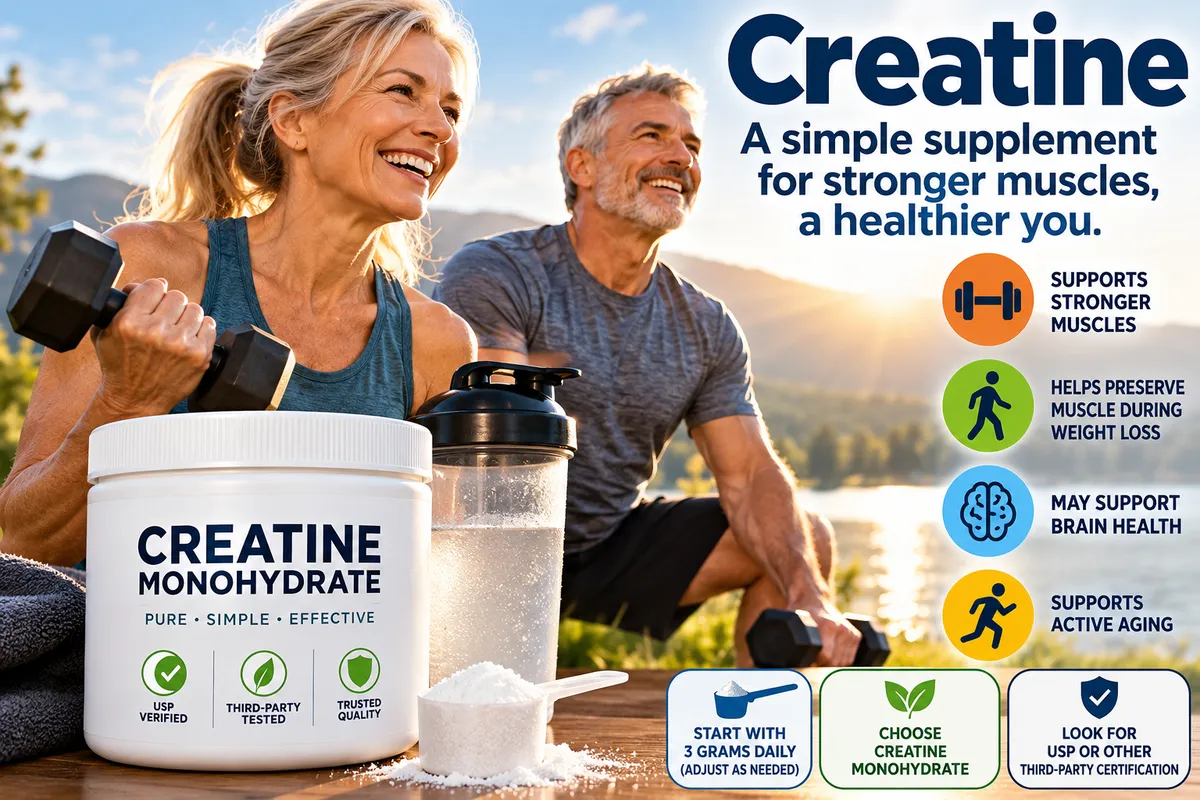
Creatine monohydrate is the clear winner.
It's the form used in most clinical studies. It's effective, generally well tolerated, and usually the least expensive.
You'll find companies selling creatine hydrochloride, buffered creatine, creatine ethyl ester, and other fancy versions.
They may promise faster absorption, greater strength, or fewer side effects.
But there's no convincing clinical evidence that these more expensive forms produce better results than ordinary creatine monohydrate.
Even micronized creatine is simply creatine monohydrate ground into smaller particles. It may mix more easily, but it hasn't been shown to build more muscle.
Don't pay extra for scientific-sounding names. Your muscles aren't impressed by marketing.
How much should you start with?
For a generally healthy adult, I would suggest starting with 3 grams of creatine monohydrate once daily.
That's a practical, research-supported starting dose.
Take it with breakfast, lunch, or dinner. Mix it into water, juice, yogurt, or a protein shake.
The timing isn't particularly important. Taking it consistently is.
After two to four weeks, consider whether increasing to 5 grams daily makes sense for your goals.
Here's how I would tailor the dose:
- If you're smaller, older, or primarily interested in maintaining muscle: Three grams daily is a reasonable choice.
- If you're regularly lifting weights or trying to build strength: Five grams daily is a common, well-studied maintenance dose.
- If you're a larger, heavily muscled athlete: Some research suggests that 5 to 10 grams daily may be needed to maintain muscle creatine stores, although most recreational exercisers don't need that much.
- If you're prone to stomach upset: Start with a smaller amount, such as 2 grams daily, and gradually increase to 3 grams. Taking it with food may help. Two grams is a tolerance strategy, not the best-studied maintenance dose.
- If you have kidney disease, abnormal kidney tests, or another significant medical condition: Discuss supplementation with your healthcare professional before starting.
These are practical guidelines, not precise dosing rules based on age, sex, or weight. Research has not established that every person needs an individualized creatine dose.
Do you need to load up?
Some athletes take approximately 20 grams daily for five to seven days, divided into four doses.
This rapidly fills muscle creatine stores.
But loading isn't necessary for most people.
Taking 3 to 5 grams daily will also increase those stores, generally over three to four weeks.
Loading simply gets you there faster.
And taking larger doses can increase stomach discomfort.
Unless you're preparing for a competition, there's little reason to rush.
Your muscles have waited this long. They can wait another few weeks.
How do you know whether it's working?
Give it eight to twelve weeks, especially if you're combining it with resistance training.
Track something meaningful: how much weight you can lift, how many repetitions you can complete, or whether everyday activities are becoming easier.
Don't judge success by the bathroom scale alone.
An early increase in weight may simply reflect water stored inside your muscles.
If you're trying to lose fat, waist measurements and body composition trends may tell you more than weight alone.
And if you don't notice a benefit, don't automatically double the dose. More creatine isn't necessarily better.
Before buying creatine, look for three important letters: USP.
Here's something many supplement companies would rather you didn't think about.
In the United States, dietary supplements generally do not need FDA approval before they reach store shelves.
That means a product's label is not, by itself, proof that the contents are pure or accurately measured.
This is why independent testing matters.
Look for a legitimate certification mark from organizations such as:
- USP Verified: The United States Pharmacopeia operates a program that verifies supplement quality, including ingredient identity, strength, purity, and manufacturing standards.
- NSF Certified for Sport: This program checks product quality, verifies label claims, and screens for substances banned in competitive sports.
- Informed Sport: Another independent certification program that tests supplements for substances prohibited in sports.
Importantly, a company saying it follows USP standards is not the same as its product being USP Verified.
And a company claiming its product is laboratory tested is not the same as independent certification.
You want the actual certification, not just a reassuring sentence on the package.
Also, don't assume that every product sold by a certified manufacturer has been certified. Check the exact product.
For example, you can search the official NSF Certified for Sport database to verify whether a specific creatine product is listed.
A legitimate certification doesn't guarantee that a supplement will work for you, but it provides greater confidence about what you're swallowing.
My rule: If you're going to put something into your body every day, make sure you know what's actually in it.
Where can you buy quality creatine without spending a fortune?
Here's the good news.
Creatine monohydrate is relatively inexpensive.
And because it is a simple compound, you generally don't need to pay premium prices.
My preference is a plain, unflavored powder containing one ingredient: creatine monohydrate.
Skip the colorful packaging, exotic flavors, gummies, and expensive blends unless you have a specific reason to want them.
You can often find competitively priced products at major retailers such as Walmart, Target, warehouse clubs, and established supplement manufacturers.
For example, recent advertised prices included:
- Walmart: Nutricost creatine monohydrate, 300 grams, approximately $13.73, or 23 cents per 5-gram serving.
- Target: Optimum Nutrition creatine monohydrate, 600 grams, approximately $27.99, or 23 cents per 5-gram serving.
- NOW Sports: Creatine monohydrate powder, 1 kilogram, advertised at approximately $41 to $55 depending on promotions, or roughly 21 to 28 cents per 5-gram serving.
These are examples of advertised prices, not proof that every listed product carries independent certification. Verify the exact product before purchasing.
Prices also change, and the cheapest product isn't necessarily the best choice if its purity hasn't been independently verified.
Here's the trick: Compare the price per 5 grams, not the price per container.
A large container may cost more upfront but provide several months of supplementation.
At 3 grams daily, a 500-gram container lasts approximately 166 days.
At 5 grams daily, it lasts 100 days.
That's more than three months.
For many people, a quality product can cost less than 30 cents daily.
Not bad for something supported by decades of research.
Just remember that a third-party-certified product may cost somewhat more, and that added assurance can be worth paying for.
Is creatine safe?
For most healthy adults, creatine monohydrate appears safe when taken at recommended doses.
A large 2025 review examined hundreds of clinical trials and found no significant overall difference in reported side effects between creatine users and placebo groups.
However, safe for most people does not mean safe for everyone.
Some users experience temporary weight gain, bloating, or stomach discomfort.
Large single doses may increase digestive symptoms.
What about your kidneys?
This is where some confusion begins.
Creatine is naturally converted into creatinine, a substance doctors measure in blood tests to help assess kidney function.
Taking creatine can increase blood creatinine levels without necessarily damaging the kidneys.
That matters because a higher creatinine reading can make kidney function appear worse than it really is.
Research in healthy adults has generally not found evidence that recommended doses damage kidney function.
Still, people with kidney disease should speak with their healthcare professional before taking creatine.
Long-term safety data are less complete for people with significant kidney problems.
Doctors may also consider tests such as cystatin C when interpreting kidney function in someone taking creatine.
And if you're planning to start creatine, tell your doctor before your next set of blood tests.
Otherwise, an unexpected creatinine result might create unnecessary concern.
Does creatine increase testosterone?
Here's another myth worth clearing up.
Creatine is not testosterone.
It is not an anabolic steroid.
And there is no convincing evidence that standard creatine supplementation consistently raises testosterone levels.
Its effects on strength and exercise performance primarily involve cellular energy production.
Creatine also has not been shown to reliably improve erections, sexual desire, or fertility.
Those claims require much stronger clinical evidence.
What actually works best for preserving muscle?
If your goal is to maintain strength as you age, the strongest evidence supports a combination of three approaches.
First, lift something.
Resistance training stimulates your muscles to adapt and become stronger.
You don't need to become a bodybuilder.
Weights, resistance bands, and appropriately challenging bodyweight exercises can all help.
Training major muscle groups at least twice weekly is a reasonable goal for many adults.
Second, eat enough protein.
Protein provides the building blocks your body needs to maintain and repair muscle.
For many healthy older adults, roughly 1.0 to 1.2 grams of protein per kilogram of body weight daily may be appropriate, although needs vary.
People who exercise regularly or are losing weight may benefit from higher amounts.
Those with certain medical conditions, especially kidney disease, may need individualized recommendations.
Third, consider creatine.
For healthy adults interested in improving strength, creatine monohydrate may offer an additional, generally modest advantage.
But think of it as a supporting actor, not the star of the show.
Exercise and nutrition still get top billing.
The bottom line
Creatine is unusual in the supplement industry.
It actually has a substantial body of scientific evidence supporting some of its benefits.
It can improve performance during short, intense activities.
It can help people gain strength when combined with resistance training.
It may also help support lean tissue during weight loss.
But there are limits.
We don't yet know whether creatine alone can meaningfully prevent age-related disability, improve long-term brain health, or extend lifespan.
And some of the apparent gains in muscle size may simply reflect additional water inside muscle cells.
The latest Texas A&M study adds an interesting piece to the puzzle, but it doesn't settle every question.
My practical advice?
If you're a generally healthy adult interested in trying creatine, consider starting with 3 grams of plain creatine monohydrate daily.
If you're regularly strength training, 5 grams daily may be appropriate.
Choose a product with credible independent purity certification, compare prices per serving, and avoid paying extra for fancy formulations that haven't demonstrated better results.
Give it time, track your progress, and remember that creatine works best when paired with regular exercise and adequate protein.
Most importantly, don't confuse taking a supplement with taking care of yourself.
The best way to protect your muscles still involves using them.
Because the goal isn't to look 25 when you're 75.
It's to be strong enough at 75 to keep doing the things you loved at 25.
And perhaps get out of your favorite chair without making sound effects.


-truth-what-your-daily-pill-can-and-cannot-do-for-you/cover-sm.webp)