Screenings
Before You Say Yes to a Medical Test, Ask One Question: Will It Actually Help Me?
More testing doesn't always mean better medicine. Sometimes it saves lives. Sometimes it leads to unnecessary procedures, anxiety, expense, and even harm. Here's how to tell the difference.
Oct 8, 2026 · 10 min read
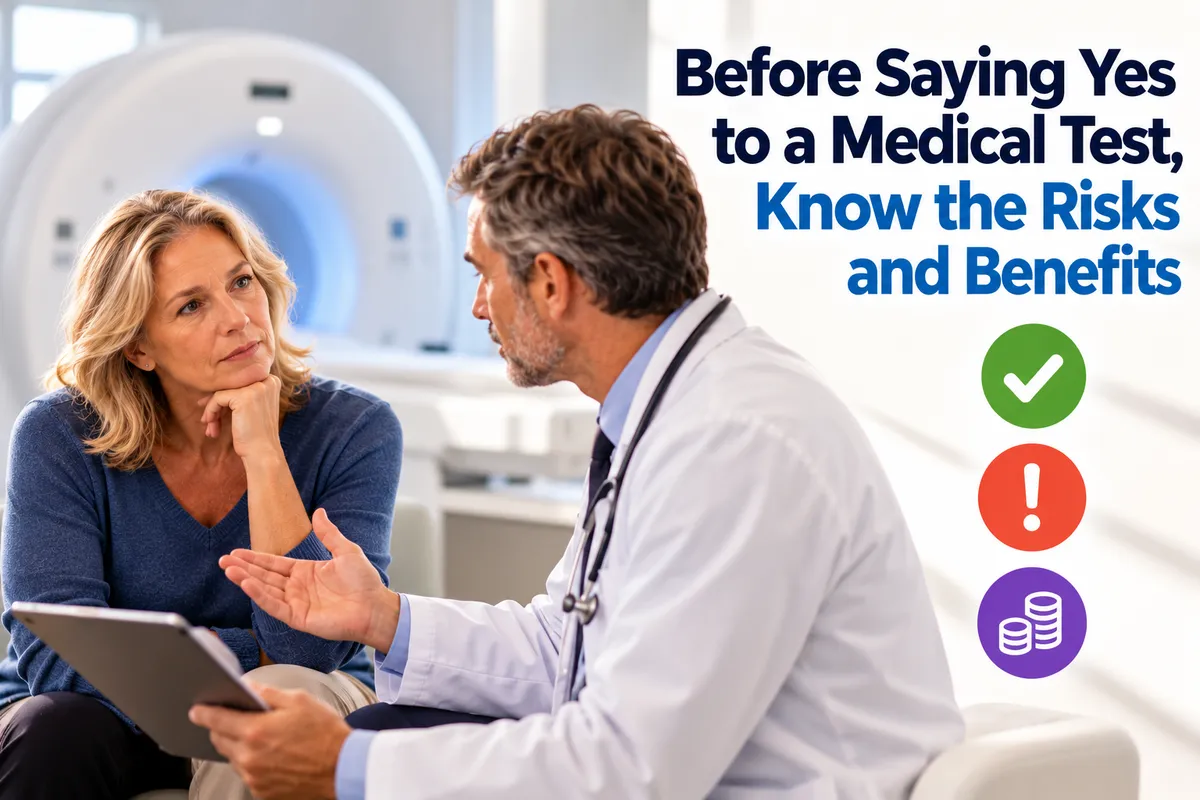
Imagine feeling perfectly healthy, walking into a medical clinic, and paying $2,500 for a full-body MRI scan.
A few days later, the results arrive.
Good news! No obvious cancer.
Bad news! The scan found three mysterious spots, a small cyst, and something the radiologist describes as indeterminate.
Indeterminate?
That's medical language for "We're not quite sure what this is."
Now you're worried.
Your doctor orders another scan. Then another. Perhaps a biopsy.
You spend the next six months worrying about a disease you may never have had.
Welcome to one of modern medicine's strangest problems:
Sometimes, looking harder for disease can make healthy people worse off.
But there's an equally dangerous mistake: failing to order a test when a patient's symptoms or risks clearly call for one.
The real question isn't whether medical testing is good or bad.
It's whether the right test is being ordered for the right person, at the right time, for the right reason.
1. More information isn't always better information.
We're living in the golden age of medical testing.
Blood tests can measure hundreds of substances.
CT scanners can examine the body in remarkable detail.
MRI machines can produce extraordinary images without exposing patients to ionizing radiation.
Genetic tests can identify inherited risks for certain diseases.
And companies now advertise full-body scans to people who feel perfectly healthy.
The sales pitch sounds wonderful.
Find disease early. Treat it early. Live longer.
What's not to like?
Quite a bit, potentially.
Major medical organizations, including the American College of Radiology, do not recommend routine whole-body MRI screening for average-risk people without symptoms.
Why?
Because finding more abnormalities is not the same as preventing more deaths.
Some findings are harmless. Others would never cause illness during a person's lifetime.
And some lead to additional testing that creates more risk than benefit.
This doesn't mean MRI scans are bad. They're extraordinarily valuable when medically appropriate.
Nor does it mean that everyone should avoid whole-body MRI. Certain people with inherited cancer syndromes, such as Li-Fraumeni syndrome, may benefit from specialized whole-body MRI surveillance.
The distinction is important.
A scan that makes sense for someone with a serious inherited cancer risk may make little sense for a healthy person with no symptoms or unusual risk factors.
2. Every test has risks, even when the test itself is painless.
Let's start with something most people don't realize.
A medical test can cause harm even when it never touches your body.
How?
By producing a misleading result.
A false positive tells you something may be wrong when nothing important is wrong.
A false negative tells you everything looks fine when disease is actually present.
Neither is particularly helpful.
Then there's radiation.
CT scans use ionizing radiation. At sufficiently high cumulative doses, radiation increases cancer risk. The risk from a medically necessary individual CT scan is usually small, and its benefit can greatly outweigh that risk.
MRI and ultrasound do not use ionizing radiation, although they have their own limitations and safety considerations.
And invasive procedures such as biopsies and colonoscopies can cause bleeding, infection, or other complications.
The goal isn't to avoid these procedures.
It's to make sure their expected benefits outweigh their risks.
A test should answer a medical question, not simply satisfy our curiosity.
3. Beware the medical domino effect.
Doctors have a name for what happens when one test leads to another, then another.
It's called a diagnostic cascade.
Imagine a patient who has a minor abnormality discovered during a routine scan.
The doctor orders another scan to investigate it.
That scan produces an uncertain result.
A specialist recommends a biopsy.
The biopsy causes bleeding.
The patient is hospitalized.
And eventually everyone discovers that the original finding was harmless.
This isn't just theoretical.
A case published in JAMA Internal Medicine described a 52-year-old woman whose evaluation for chest pain led to a cardiac testing cascade, serious complications, emergency surgery, and ultimately a heart transplant.
It was an extreme case, not a typical outcome.
But it illustrates something important.
The first test can open a door you never intended to walk through.
That doesn't mean doctors should ignore chest pain. Some forms of chest pain require immediate emergency evaluation.
It means testing decisions should reflect the patient's symptoms, examination, risk factors, and the likely benefit of each test.
The answer isn't always more testing.
Sometimes it's better clinical reasoning.
4. A test can be accurate and still mislead you.
Here's a little medical math that might surprise you.
Imagine a disease affecting just 1 out of every 1,000 healthy people.
Now imagine a test that's 99% sensitive and 95% specific.
Sounds excellent, right?
Let's test 10,000 people.
| 10 | Actually have the disease |
|---|---|
| 499–500 | False-positive results |
| ~2% | Chance that a positive result represents actual disease |
Illustrative calculation using the assumed sensitivity, specificity, and disease prevalence. Not data from a particular medical test.
That's right. Despite the impressive accuracy numbers, roughly 98% of positive results would be false alarms.
Why?
Because the disease is so uncommon.
Doctors call this the base-rate problem.
The less likely you are to have a disease before testing, the greater the chance that a positive screening result will be misleading.
This is why your age, symptoms, family history, medical history, and risk factors matter so much.
The same test can be extremely valuable for one patient and nearly useless for another.
5. Finding cancer early doesn't always mean saving a life.
This sounds almost impossible.
Surely finding cancer earlier is always better?
Not necessarily.
Here are three scientific concepts worth understanding.
Overdiagnosis: A test finds a real disease that would never have caused symptoms or shortened your life.
Some prostate, thyroid, and other cancers grow so slowly that they may never become dangerous.
But once someone hears the word cancer, doing nothing can feel impossible.
The result may be surgery, radiation, medication, or other treatment that offers no benefit but carries real risks.
Lead-time bias: A test finds a disease earlier, making survival after diagnosis appear longer even if the person dies at exactly the same age.
Imagine someone develops a cancer that would cause death at age 75.
Without screening, it's diagnosed at 72. The person survives three years after diagnosis.
With screening, it's diagnosed at 67. The person survives eight years after diagnosis.
Sounds like a remarkable improvement.
Except the person still dies at 75.
The test changed the date of diagnosis, not the date of death.
Length-time bias: Screening is more likely to find slower-growing diseases because they remain detectable for longer before causing symptoms.
That can make screen-detected cancers appear less dangerous than cancers found after symptoms develop.
None of this means cancer screening is bad.
It means that the best evidence for screening comes from showing that it reduces serious illness or death, not simply that it finds more disease.
6. Some medical tests absolutely save lives.
We shouldn't allow the dangers of unnecessary testing to obscure the dangers of failing to test.
Several screening approaches have strong evidence supporting their use in appropriate populations.
| Screening | Who may benefit |
|---|---|
| Blood pressure | Most adults |
| Colorectal cancer | Many adults beginning at age 45 |
| Breast cancer | Women in recommended age and risk groups |
| Cervical cancer | Eligible people with a cervix |
| Lung cancer | Certain adults with substantial smoking histories |
| Hepatitis C and HIV | Adults meeting screening recommendations |
These aren't interchangeable with full-body scans.
Each has its own evidence, age range, testing interval, and limitations.
For example, low-dose CT lung screening can reduce lung cancer mortality among appropriately selected high-risk people. That doesn't mean every nonsmoker should get annual lung scans.
Similarly, colonoscopy can find and remove precancerous polyps, potentially preventing cancer before it develops.
The point isn't to avoid testing.
It's to avoid unnecessary testing while making sure you receive the tests that matter.
7. The seven questions to ask before agreeing to a test
You don't need a medical degree to become a better-informed patient.
You just need to ask better questions.
- What disease or problem are we looking for? Ask your doctor to explain what the test is intended to find.
- How likely am I to have it? Your personal risk matters more than a scary advertisement.
- How accurate is this test for someone like me? Ask about false positives, false negatives, and what an abnormal result really means.
- What happens if the result is positive? Will you need another scan, biopsy, medication, or surgery?
- What happens if the result is negative? Could the disease still be present?
- Will the result change my treatment or improve my outcome? This is often the most important question.
- What are the risks, costs, and alternatives, including waiting or not testing? Sometimes observation is reasonable. Sometimes delaying a test is dangerous.
One more question deserves special attention:
"What happens if we don't do this test today?"
If the answer is that delaying it could put your life or health at risk, that changes everything.
For example, suspected stroke, heart attack, pulmonary embolism, or other medical emergencies require prompt evaluation.
Shared decision-making is important, but it shouldn't delay emergency care.
8. Don't mistake insurance coverage for scientific proof.
Here's another misconception.
If your insurance pays for a test, it must be medically necessary.
Not necessarily.
Insurance coverage reflects a mixture of evidence, medical policy, contracts, regulations, and benefit design.
Some covered tests provide substantial benefits.
Others may be of limited value in particular situations.
Conversely, a test that isn't covered may still be medically appropriate for an individual patient.
The U.S. Preventive Services Task Force evaluates preventive services and assigns recommendation grades based on scientific evidence.
Many services with A or B recommendations qualify for coverage without patient cost-sharing under applicable federal rules, although exceptions and plan-specific requirements exist.
But insurance coverage itself is not proof that a test will help you.
And paying thousands of dollars out of pocket certainly doesn't make a test more valuable.
Expensive medicine isn't necessarily better medicine.
Sometimes it's just more expensive.
9. How AI may help you make smarter testing decisions
This is where technology has an important role to play.
The best medical test is not necessarily the most sophisticated one.
It's the one that helps answer the right clinical question.
And identifying that question begins with understanding the patient.
That's one reason we developed Medome.ai.
Medome.ai is designed to help people organize their symptoms, medical history, family history, medications, risk factors, and prior test results.
It can help patients prepare more complete information for their doctors and identify questions worth discussing before undergoing testing.
For example, before agreeing to an expensive scan, you might want to understand whether your symptoms, medical history, or inherited risks point toward a more focused test.
Or whether a previous result has already answered the question.
Or whether a recommended screening test is more appropriate.
AI may help patients explore these issues and prepare for a more productive medical conversation.
But there's an important scientific distinction.
The potential of AI to improve testing decisions is not proof that a particular AI product reduces unnecessary testing, diagnostic errors, or medical harm.
Those benefits need to be demonstrated through properly designed clinical studies.
AI can also make mistakes, miss important findings, or recommend inappropriate tests. Its suggestions must be evaluated in clinical context.
The goal should be to give doctors better information and patients better questions, not to replace medical judgment with an algorithm.
Learn more at Medome.ai.
10. The real goal is better health, not more testing.
Medicine has made extraordinary advances.
We can see inside the human body in astonishing detail.
We can detect tiny amounts of DNA in the bloodstream.
We can identify inherited disease risks long before symptoms appear.
But our ability to find abnormalities has sometimes advanced faster than our ability to determine which abnormalities actually matter.
That's the challenge.
We need to find dangerous diseases early enough to change outcomes.
We need to avoid treating harmless findings as medical emergencies.
And we need to make decisions based on sound evidence rather than fear, advertising, or the belief that more information must always be better.
The bottom line
Before agreeing to a medical test, understand why you're getting it, what it can reveal, what it might miss, and what happens next.
Don't refuse an important test because you're worried about its risks.
And don't agree to an unnecessary test simply because someone promises peace of mind.
A normal result can sometimes provide false reassurance. An abnormal result can sometimes create unnecessary fear.
Good medicine isn't about ordering the most tests.
It's about asking the right questions, choosing the right tests, and making the right decisions with the answers.
Because when it comes to your health, the goal isn't to collect the most medical data.
It's to live the longest, healthiest life possible.
Scientific references and further reading
The following sources support the major scientific principles discussed above.
- American College of Radiology: Statement on Screening Total Body MRI — Explains why routine whole-body screening is not recommended for average-risk people.
- American Cancer Society: Full-Body MRIs and Their Risks — Discusses incidental findings, unnecessary procedures, false reassurance, and appropriate high-risk uses.
- USPSTF: Shared Decision-Making About Screening — Describes how patients and clinicians should weigh benefits, harms, alternatives, and personal preferences.
- USPSTF: Methods for Evaluating Screening Benefits and Harms — Covers overdiagnosis, overtreatment, false positives, and screening-related harm.
- American Cancer Society: Understanding Radiation Risk from Imaging — Explains how radiation risks differ across tests and why benefits must be weighed against risks.
These references support the general medical evidence. The Medome.ai section describes intended product capabilities and potential uses, not independently established clinical outcome benefits.