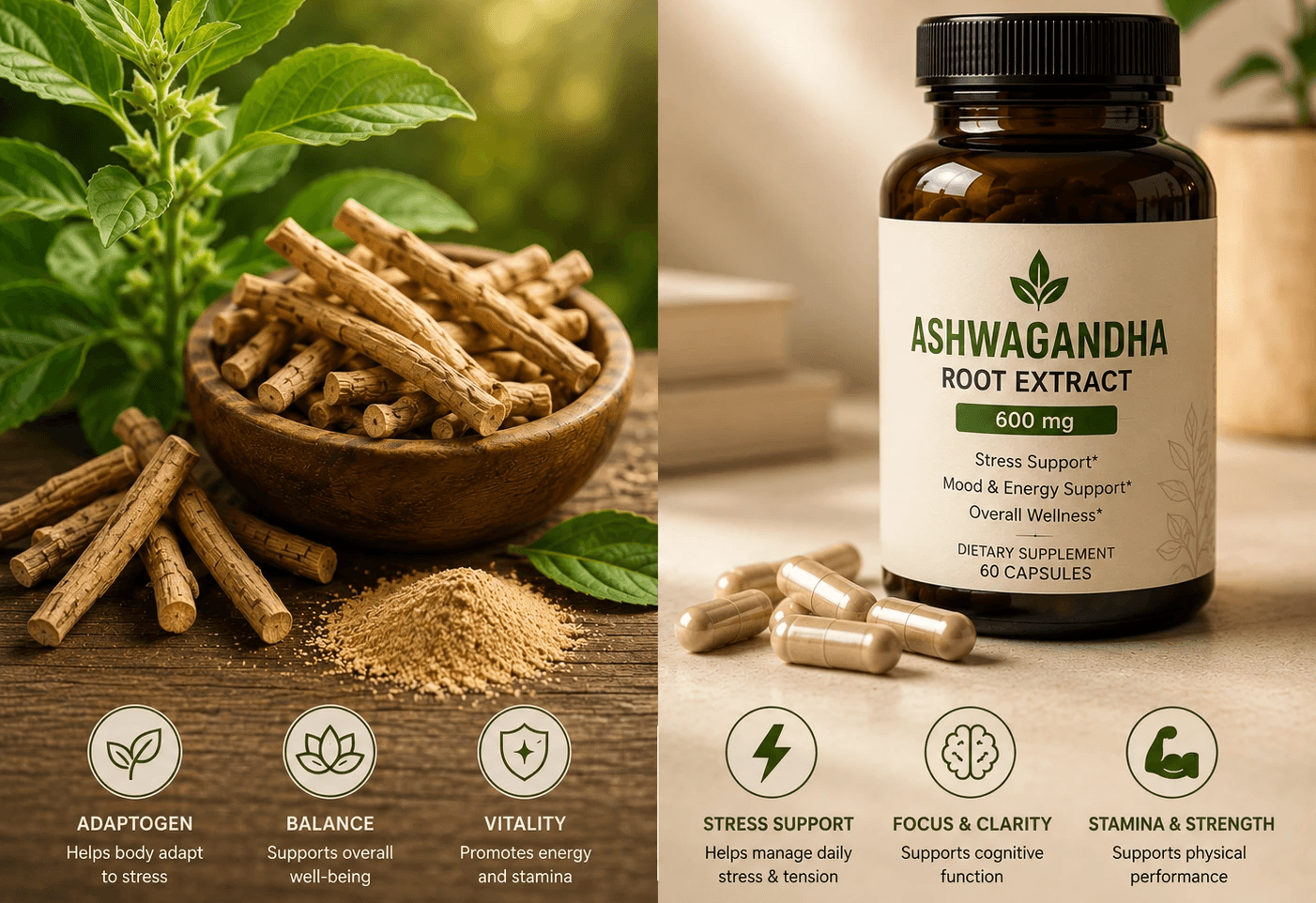
You've seen it on the shelf. You've heard the bros at the gym swear by it. Your buddy who reads Huberman in the sauna says it changed his life. Meanwhile, your mom thinks you're taking drugs.
Welcome to ashwagandha — the herb with the funny name, the long resume, and a side of science worth knowing about before you swallow anything.
So What Even Is It?
Ashwagandha (say it: "ash-wah-GAHN-dah") is a plant from India that's been used in traditional medicine for over 3,000 years. The Sanskrit name roughly means "smell of horse" — partly because of the root's earthy scent, and partly because it was said to give people the strength of one. Bold marketing for 1000 B.C.
The scientific name is Withania somnifera. That second word means "sleep-inducing," which is your first clue about what it does. Fun fact: it belongs to the nightshade family, so it's basically a cousin to tomatoes and peppers. The root is the part that ends up in capsules.
The Good Stuff (Where the Science Actually Lines Up)
This is not snake oil. Ashwagandha is one of the better-studied herbs out there. Here's what the research actually backs up.
It calms stress and anxiety. This is the headliner. Multiple solid studies show ashwagandha lowers cortisol (your body's main stress hormone) and meaningfully reduces anxiety. One big study with over 1,000 people found 600 mg a day for 8 weeks was safe and well-tolerated. Another found 240 mg of a concentrated extract cut anxiety scores noticeably in 60 days. It works by quieting down what scientists call the "stress highway" in your brain.
It helps you sleep. A review of five studies found ashwagandha actually improves sleep quality, especially in people with real insomnia (not people who already sleep fine and want to be even more well-rested). Best results showed up at 600 mg a day, taken for at least 8 weeks.
It bumps testosterone in men. A meta-analysis of 23 trials — that's the gold standard, a study of studies — found testosterone went up by about 57 ng/dL in men. Not life-changing, but real. (This effect did NOT show up in women, so it appears to be a guy thing.) Some studies also suggest better sperm quality.
It may lift mild depression. A 90-day trial using 500 mg a day showed real improvement in depression and anxiety scores, along with a bump in serotonin (the feel-good brain chemical).
It can help with blood pressure. A recent trial in people with high blood pressure showed 600 mg a day lowered cortisol by about 29% and cut triglycerides by 13%. No serious side effects.
So: less stressed, sleeping better, slight T boost, better numbers. Not bad for a root.
The Not-So-Good Stuff (Read This Part)
Now the part the supplement company TikToks tend to skip.
⚠️ Liver injury — rare, but real. This is the big one. Case reports from around the world — Japan, Iceland, India, the U.S., Europe — have documented people getting liver damage from ashwagandha. One person needed a liver transplant. Most cases happened after weeks or months of use and got better once they stopped. Watch for: yellow skin or eyes, dark pee, itching, nausea, or stomach pain. If any of that shows up, stop and see a doctor. The reassuring part: in controlled trials, liver tests stayed normal. So this seems uncommon, possibly tied to individual sensitivity, contaminated products, or high doses. Still — not zero.
It messes with your thyroid. Ashwagandha raises thyroid hormones, specifically T4. If your thyroid is underactive, that might actually help. If your thyroid is normal or overactive, that's a problem. Cases of thyrotoxicosis (way too much thyroid hormone) have been reported.
Stomach stuff. Mild nausea, loose stools, dry mouth. Shows up in about 5% of people in trials — and weirdly, sometimes more in the placebo group.
Drowsiness. Remember, somnifera = sleep-inducing. Some guys feel groggy, especially on higher doses. Feature or bug depending on when you take it.
Who Should NOT Take It
🚫 Skip ashwagandha entirely if you are:
Pregnant. Not enough safety data. Hard pass.
Dealing with hyperthyroidism or Graves' disease. It can crank thyroid hormones higher and make things worse.
Living with liver or kidney problems. The liver risk, while rare, isn't worth it.
Managing an autoimmune condition like lupus, MS, or rheumatoid arthritis. Ashwagandha revs up the immune system. If yours is already attacking you, you don't need a pep rally.
Scheduled for surgery. Stop at least 2 weeks before. It can mess with anesthesia and blood sugar.
Drug Interactions (Show This Section to Your Doctor)
Ashwagandha can play badly with several common medications.
It can make these stronger (more effect, more side effects):
Sedatives and sleep meds (Xanax, Ambien, Klonopin, etc.) — Stacking sedation on sedation can knock you out harder than you want.
Thyroid medication (levothyroxine) — Ashwagandha raises T4 on its own. Add a thyroid pill and you might end up with too much. Levels need to be watched.
Blood pressure medications — Ashwagandha may lower BP a bit. Combined with your meds, this could leave you dizzy.
Blood sugar medications (metformin, insulin, sulfonylureas) — Ashwagandha mildly lowers blood sugar. Stack it on top of diabetes meds and you could crash into low blood sugar.
It can make these weaker or weirder by messing with your liver's drug-processing system:
Your liver uses enzymes to break down medications. Ashwagandha can speed up one of them (called CYP3A4) and slow down another (CYP2B6). Translation: some drugs may get cleared faster (less effective) or slower (more side effects). This matters most for statins, some heart and seizure drugs, transplant drugs like cyclosporine and tacrolimus, the HIV drug efavirenz, and bupropion (used for depression and quitting smoking).
The encouraging news: one study testing ashwagandha against seven major liver enzymes found no significant problems at normal doses. So the risk may be more theoretical than real for most people — but if you're older, on several prescriptions, or take anything serious, talk to your doctor first.
It may weaken these:
Immunosuppressants — Drugs designed to calm your immune system don't love a supplement designed to fire it up.
What About Food and Drinks?
No real food danger zones. A few notes that are actually useful:
Take it with food if it upsets your stomach.
Warm milk is the traditional Indian way. Three thousand years of grandmas can't all be wrong.
Black pepper (specifically piperine, a compound in it) helps your body absorb the active stuff. Some supplements already mix it in.
Alcohol — No formal studies, but both alcohol and ashwagandha are sedating and both get processed by your liver. Combining them is asking your liver to do double overtime. Not a great call.
How Much, and For How Long?
There's no official "FDA dose" because ashwagandha is a supplement, not an approved drug. But here's what actually worked in studies:
For stress and anxiety: 240 to 600 mg a day of root extract, for 8 to 12 weeks.
For sleep: 600 mg or more a day, for at least 8 weeks.
For general well-being: 300 to 500 mg a day.
Most studies used standardized root extracts — meaning the label tells you exactly how much of the active stuff (called withanolides) you're getting. Look for products that list withanolide content, usually 2.5 to 5%.
Long-term safety past a few months hasn't been well studied. A lot of people cycle it: 8 weeks on, 2 to 4 weeks off. That's not formally tested, but it's reasonable.
One more thing: because supplements aren't tightly regulated, quality varies wildly between brands. Look for third-party testing — USP, NSF, or ConsumerLab. It's a stamp that says someone independent actually checked what's in the bottle.
The Bottom Line
Ashwagandha is real medicine dressed up as a supplement. For most healthy men, short-term use at sensible doses can lower stress, improve sleep, and give testosterone a small lift. Not magic. Not nothing.
But it's not for everyone. If you've got thyroid issues, liver trouble, an autoimmune condition, or you're on prescription meds — talk to your doctor before you start. "Natural" doesn't mean "harmless." Poison ivy is natural. So is lava.
Use it smart. Cycle it. Buy quality. Pay attention to how you feel.
Your grandmother's grandmother's grandmother was probably right about this one. Just don't make her mistakes either.
This article is for general education and isn't medical advice. Before adding any supplement, especially if you're on medications or have a health condition, check with your doctor.
HSA/FSA Eligible
Doctors Are Human.
That's Why There's Medome.
Start your free trial today. No credit card required.
Start Your Free Trial
Join thousands protecting their health with AI that never forgets
Critical details get missed when your health information is scattered. Medome connects the dots across your complete record.
Start Your Free Trial
Quick Links
Medome Men
Home
Pricing
About
Health News
HealthSigns
FAQ
Contact Us
Terms of Service
Privacy Policy
Get In Touch
Email: service@medome.ai
Phone: (617) 319-6434
This is Dr. Steven Charlap’s cell. Please text him first, explaining who you are and how he can help you. Use WhatsApp outside the US.
Hours: Mon-Fri 9:00AM - 9:00PM ET