Picture this: You're sprinting up the stairs because you forgot your homework. Or maybe you're chasing your dog around the yard because he stole your sock. Again.
Annoying? Sure. But here's something wild — those few seconds of huffing and puffing might be doing more for your health than a fancy gym membership ever could.
That's not a joke. (Well, okay, it's kind of a joke. But the science behind it is very real.)
The Surprising Discovery
Scientists at Monash University in Australia made a finding that's going to make your gym-loving cousin a little upset. They discovered that less than four minutes a day of short, intense movement could lower your chances of getting Type 2 Diabetes by more than a third.
Four minutes. That's shorter than most TikTok rabbit holes.
The researchers studied more than 22,000 adults in the United Kingdom for almost eight years. Here's the kicker — none of these people exercised regularly. Zero gym memberships. Zero marathon training. They were just normal folks living normal lives. But the ones who moved a little harder during everyday activities — like climbing stairs quickly or carrying heavy grocery bags — were way less likely to develop diabetes.
Wait, What's Type 2 Diabetes Again?
Quick science detour! Don't worry, there's no quiz at the end.
Your body uses something called insulin to move sugar from your blood into your cells, where it becomes energy. Think of insulin as a super-helpful delivery driver. With Type 2 Diabetes, the delivery driver either gets ignored or doesn't show up to work. So sugar piles up in your blood like undelivered packages on a porch.
Over time, all that sugar can damage your heart, kidneys, and eyes. Not great.
The really worrying part? Experts think more than 1.3 billion people could have Type 2 Diabetes by 2050. That is a LOT of porches with packages.
Meet the "Micropatterns"
The scientists came up with a fancy name for these tiny exercise bursts: physical activity micropatterns. There are two flavors:
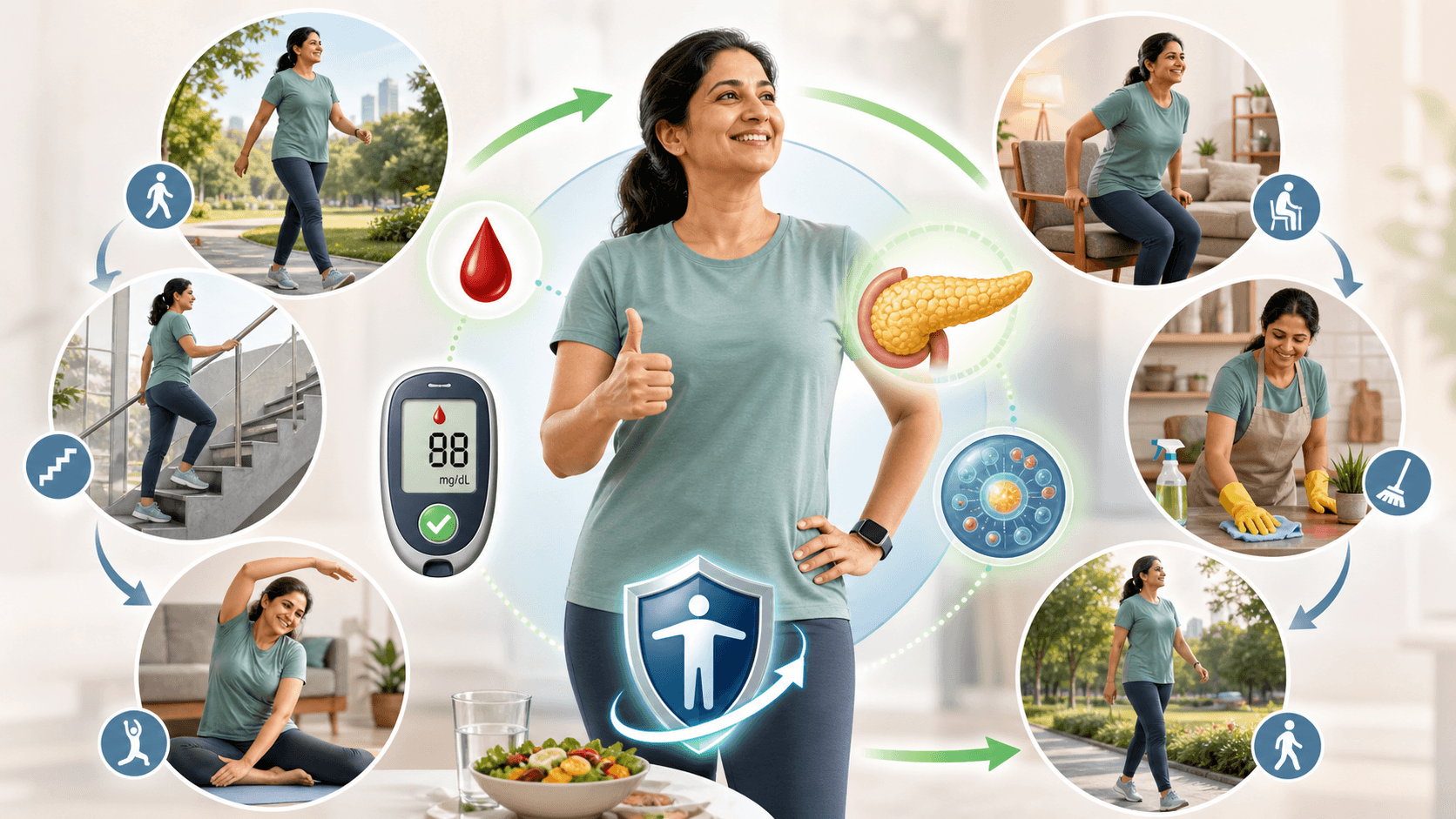
VILPA (say it like "vill-pah") stands for Vigorous Intermittent Lifestyle Physical Activity. These are short, intense bursts up to one minute long. Examples:
Sprinting up stairs
Chasing your dog who has, again, stolen your sock
Hauling all the grocery bags inside in one trip (you know you do it)
MV-ILPA stands for Moderate-to-Vigorous Intermittent Lifestyle Physical Activity. These last up to three minutes and aren't quite as intense. Examples:
Power-walking to catch the bus
Vacuuming like you actually care
Walking while lugging a heavy backpack
Here's where the numbers get cool:
About 10 quick VILPA bursts a day = a 36% lower risk of diabetes
About 39 longer MV-ILPA bursts a day = a 41% lower risk
That's huge for such tiny effort.
The Cool New Tool: How Do Scientists Spy on Your Movements?
Now for the really interesting part. How did researchers actually figure all this out?
Back in the day, scientists asked people to fill out questionnaires like, "How often did you exercise last week?" The problem? Humans are terrible witnesses to their own lives. We say things like, "Oh yeah, I totally went for a 30-minute jog." Did we though? Did we really?
Today, scientists use a tool called an accelerometer. It's a small device, kind of like a fitness tracker, that you wear on your wrist. It measures every wiggle, step, and arm swing throughout your day. Nothing escapes it. (Yes, even your awkward solo dancing in the kitchen.)
In the Monash study, people wore research-grade accelerometers for seven days. The devices recorded exactly how much intense and moderate movement happened — and when.
This is a HUGE upgrade from questionnaires. But it's not perfect. Here's where things get tricky.
The Challenges of Measuring Movement
1. One week isn't a lot of time. Wearing a tracker for seven days gives a snapshot, but maybe that week was unusually lazy or unusually busy. It's like judging a whole TV show by watching one episode.
2. The wrist doesn't see everything. A wrist tracker is great for picking up arm movements, but what about cycling? Or carrying a baby? Or pushing a shopping cart? Sometimes your arms stay still while your body works hard. It's like trying to figure out how good a soccer player is by only watching their elbows.
3. Your smartwatch might be fibbing. Consumer fitness trackers (the kind you can buy at the store) can be all over the place when it comes to accuracy. Your watch might say you burned 500 calories during a walk, but it could be way off. The American Heart Association says step counts are the most reliable thing consumer trackers measure. So if you want a starting point, count your steps!
4. Cause vs. coincidence. This is a big one. The Monash study watched what people did — it didn't tell anyone what to do. So while scientists see a strong link between micropatterns and lower diabetes risk, they can't be 100% sure the movements caused the lower risk. Maybe people who naturally move more also eat better or sleep better. It's like noticing that everyone with umbrellas is near rain — but the umbrellas didn't cause the rain.
Still, the evidence keeps stacking up. One study found that just an extra 20-minute brisk walk per day was linked to 19% lower odds of Type 2 Diabetes. Another found that vigorous activity helped lower risk no matter what time of day you did it.
How Hard Should You Push? Try the Talk Test
Forget heart rate monitors. Scientists use a simple trick called the talk test:
Light: You can chat AND sing your favorite song. (Stroll mode.)
Moderate: You can still talk, but singing is out. Breathing's a bit faster. (Brisk walk territory.)
Vigorous: You can only get a few words out. You're huffing. (You probably look ridiculous, but in a healthy way.)
Most adults can't keep up vigorous activity for more than a minute or two — and that's the whole point! Tiny bursts work.
Easy Ways to Sneak Micropatterns Into Your Day
You don't need special equipment or an app. Try these:
Take the stairs and go fast instead of taking the elevator
Carry groceries to the car in one trip like a strongman, no cart needed
Walk briskly when you're running errands
Play hard with kids or pets — make them tired, not you
Tackle chores with energy (yes, vacuuming counts!)
Walk uphill any chance you get
Carry a backpack with some weight in it on walks
The Catch (There's Always a Catch)
Here's the deal: you can't do this once and call it good. The lead author of the study, Dr. Kar Hau Chong, made it crystal clear that this has to become a regular daily habit, not a quick fix.
Sprinting up the stairs one time and then collapsing on the couch for three months? Sorry, that's not going to do it. The magic is in the consistency.
In fact, a famous American study called the Diabetes Prevention Program found that small amounts of regular physical activity, combined with a little weight loss, could lower diabetes risk by 44%. And the benefits lasted for years. The secret ingredient? Doing it every single day.
The Bottom Line
You don't have to become an athlete or buy fancy workout gear. Science is now showing that everyday hustle — running for the bus, racing up stairs, carrying your own groceries — adds up to real protection against one of the world's biggest diseases.
So the next time someone laughs at you for sprinting after your runaway dog, just smile. You're basically doing science.
And it only takes about four minutes a day…
HSA/FSA Eligible
Doctors Are Human.
That's Why There's Medome.
Start your free trial today. No credit card required.
Start Your Free Trial
Join thousands protecting their health with AI that never forgets
Critical details get missed when your health information is scattered. Medome connects the dots across your complete record.
Start Your Free Trial
Quick Links
Medome Men
Home
Pricing
About
Health News
HealthSigns
FAQ
Contact Us
Terms of Service
Privacy Policy
Get In Touch
Email: service@medome.ai
Phone: (617) 319-6434
This is Dr. Steven Charlap’s cell. Please text him first, explaining who you are and how he can help you. Use WhatsApp outside the US.
Hours: Mon-Fri 9:00AM - 9:00PM ET