A Funny But Honest Guide to Knowing What Your Weight Means for Your Health
Picture this: a beefy bodybuilder named Brutus and your couch-snuggling Uncle Bob both step on the scale. They weigh exactly the same. They're the same height. According to BMI — that famous number doctors love — they have the exact same body.
Brutus is over here doing one-arm pull-ups. Uncle Bob is over there fighting a bag of chips for his life.
Same BMI. Wildly different humans.
Welcome to the weird world of weight and health, where the most popular measuring stick is, frankly, a bit of a fibber. Don't worry though — there's a brand-new tool that actually gets it right, and you can use it from your couch (sorry, Uncle Bob).
What Even Is BMI?
BMI stands for Body Mass Index. To get yours, you grab your weight, divide it by your height squared, and boom — you have a number. The World Health Organization uses BMI to sort people into categories like "overweight" (25 to 29.9) and different classes of obesity (30 and up).
Doctors love BMI because it's quick, free, and only requires basic math. Honestly, it's the fast food of health measurements. Cheap, easy, and nobody has time for anything fancier.
But here's the catch.
Why BMI is the World's Worst Detective
BMI cannot tell the difference between:
A bodybuilder packed with muscle 💪
A regular person carrying the same weight in belly fat 🍩
It also doesn't know:
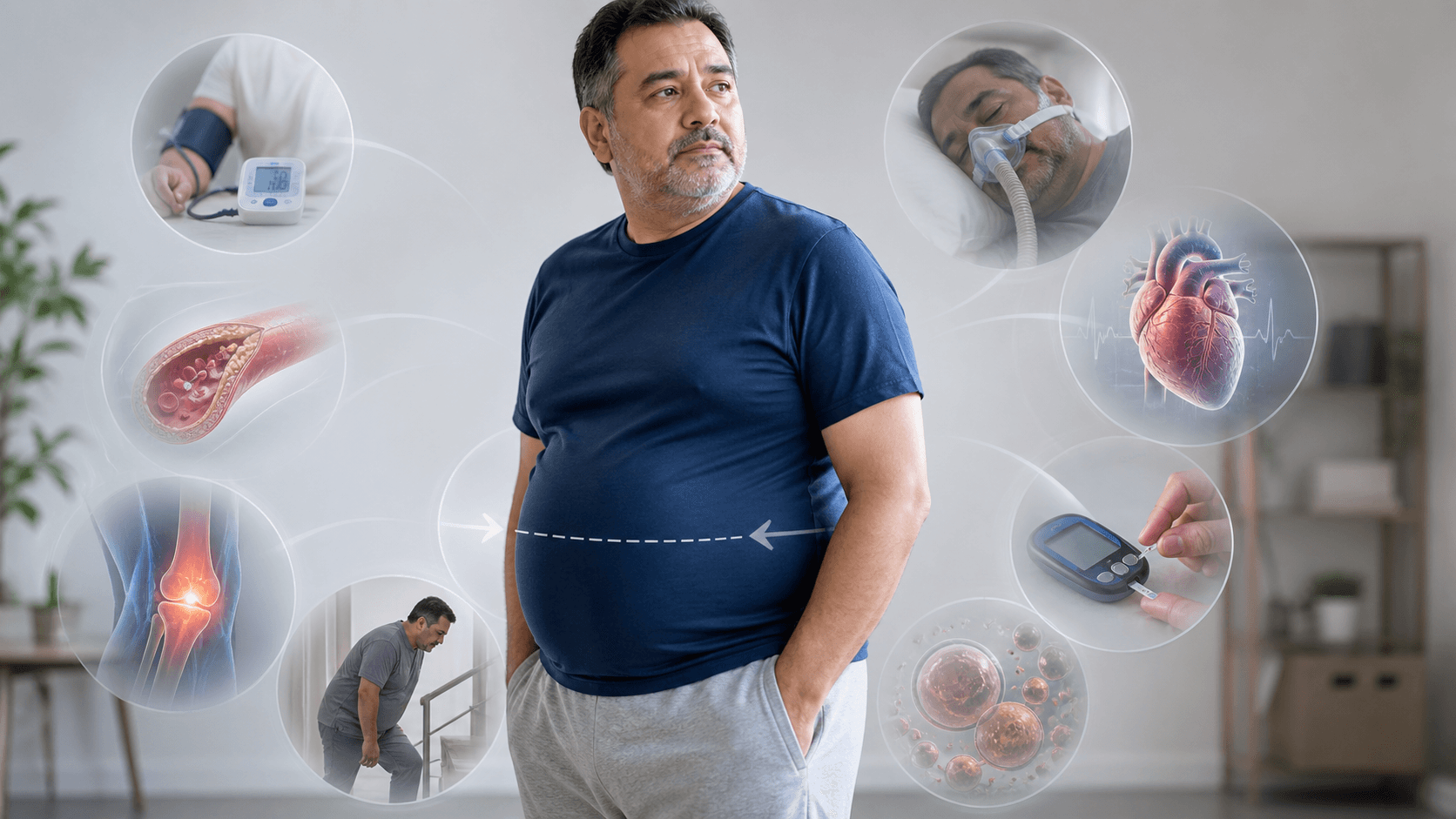
Where your fat is stored (your belly is way more dangerous than your thighs)
Whether your blood sugar is sneaking up on you
Whether your kidneys are silently grumbling
Whether your liver is throwing a party it shouldn't be
Think of BMI like a weather forecast that only tells you the temperature and ignores the giant hurricane heading straight for your house. Sure, it's information. But maybe not the information you actually need?
This isn't just nitpicking. Studies show BMI doesn't directly measure body fat, and it can either overestimate or underestimate health risks depending on your body type, age, and ethnicity. For people of Asian descent, serious health problems show up at lower BMIs than the standard charts say, which means the rules can totally miss people who are already in trouble.
So BMI is a fine starting point. But trusting it alone is like judging a book by its cover — and sometimes the cover is wrong, smudged, and possibly upside down.
Meet OBSCORE: The New Health Crystal Ball 🔮
In April 2026, scientists published a brand-new tool called OBSCORE in Nature Medicine. (No, it's not the name of a movie villain. It's actually really cool.)
Here's why OBSCORE is a big deal:
The researchers studied nearly 200,000 adults with a BMI of 27 or higher. They used fancy machine learning to look at over 2,300 different health measurements and figure out which ones actually matter. After all that detective work, the computer narrowed it down to just 20 features — the all-stars of predicting your risk for serious health problems over the next 10 years.
And we're not just talking about heart attacks. OBSCORE predicts your risk for 18 different complications, including:
❤️ Heart stuff: heart attack, stroke, angina, and more
🍩 Metabolic stuff: type 2 diabetes, high cholesterol, high blood pressure, kidney disease, gout, and fatty liver disease
🦴 Mechanical stuff: sleep apnea, joint problems, gallstones, hernias, and acid reflux
Basically, if your weight could mess it up, OBSCORE checks for it.
The 20 Magic Ingredients
OBSCORE only needs 20 things to do its thing. Most are stuff you either already know or can get from a recent doctor's visit. Here's a friendly breakdown:
Stuff you know without thinking 🧠
Your age
Your sex
Whether you smoke
Whether you have a family history of heart disease
Stuff you can measure at home 📏
Your BMI (yes, it's still useful — just not alone)
Your waist-to-height ratio (more on this in a sec)
Stuff your doctor knows 🩺
Your medical history (high blood pressure, joint pain, chest pain)
The medications you take (for blood pressure, cholesterol, blood sugar, or aspirin)
Stuff from a blood test 🩸
Total cholesterol and HDL ("good") cholesterol
HbA1c (your long-term blood sugar)
ALT (a liver health number)
Creatinine and cystatin C (kidney health numbers)
Urate (linked to gout)
That's it! Twenty things, and you've got a full picture of your health risks. Way better than one lonely BMI number trying to do the work of twenty.
Quick Side Note: The Magic of Waist-to-Height Ratio
Belly fat is the most dangerous kind of fat for your heart and your blood sugar. BMI doesn't notice belly fat. But waist-to-height ratio totally does!
To find yours: measure your waist (right between your lowest rib and the top of your hip bone) and divide by your height. Use the same units for both — like centimeters divided by centimeters. The closer you are to 0.5 or below, the better.
It's the kind of number BMI wishes it could be.
Does OBSCORE Actually Work?
Short answer: Heck yes.
Long answer: Scientists test these tools using something called a C-index. A score of 0.5 means the tool is basically guessing. A score of 1.0 means it's perfect. OBSCORE scored:
0.854 for predicting type 2 diabetes
0.863 for predicting kidney disease
0.864 for predicting gout
That's really, really good.
But here's the most jaw-dropping part. The researchers split people into five risk groups based on OBSCORE. Then they checked who actually got sick over time. The highest-risk group versus the lowest-risk group had:
89 times more kidney disease
47 times more cardiovascular deaths
42 times more type 2 diabetes
36 times more gout
Compare that to BMI alone, which only managed about 1 to 3 times more cases. So OBSCORE is roughly 15 to 85 times better than BMI at sorting out who's actually in danger.
It also beat the pants off other popular calculators like the ASCVD risk score — especially for non-heart problems like diabetes and sleep apnea.
The Plot Twist
Here's the part that might really shock you: almost half of the people OBSCORE flagged as highest-risk had a BMI between 27 and 30 — which is just "overweight," not "obese." And 30% of those at the highest risk for type 2 diabetes had a BMI under 30.
Translation: a lot of people with "only" a slightly high BMI are actually walking around with serious risk that BMI completely missed.
Yikes.
How to Use OBSCORE at Home (Yes, Really, From Your Couch)
The best part? OBSCORE is free. There's a public website at omicscience.org/apps/obscore/ where anyone can plug in their numbers. No sign-up. No saved data. No weird emails afterward.
Here's your game plan:
Step 1: Gather your stuff. Pull up your patient portal or grab your latest blood test results. Get out a tape measure for your waist. Check your medicine cabinet so you know exactly what you're taking.
Step 2: Punch in the numbers. The website has drop-down menus and notes to help you. It takes maybe 10 minutes.
Step 3: Get your results. OBSCORE spits out your personal 10-year risk for all 18 complications.
Step 4: Don't panic. Print or save the results, then bring them to your doctor.
That last step is super important — more on that in a moment.
The Catch (Because of Course There's a Catch)
OBSCORE is amazing, but it's not magic. Here are the real-world headaches:
Garbage in, garbage out. If you enter old, outdated lab values or you measured your waist wrong (or sucked in really hard for that sweet, sweet ego boost), your results won't be accurate. One study found that different online calculators gave 10-year risk estimates ranging from 3% to 43% for the same person. Wild.
The numbers might not be perfectly precise. OBSCORE is excellent at ranking people from low risk to high risk. But the exact percentage it gives you might be a little off in some cases. The researchers admit they need more testing in bigger and more diverse groups.
Tech can be tough. Not everyone has easy internet access, comfort with computers, or websites in their language. Older adults, people with disabilities, and folks with lower digital skills can have a really hard time using these tools. Over 90% of popular health websites have accessibility problems like low contrast or missing translations. Big yikes.
Numbers can be confusing. What does "15% ten-year risk" even mean? For a lot of people, that's not exactly meaningful in their daily life. Risk numbers need explaining.
So while OBSCORE is way better than BMI, it works best when you use it as a conversation starter with your doctor — not a replacement for one.
When to Call the Doctor
If OBSCORE shows you're at high risk, don't just close the browser tab and pretend it didn't happen. Make an appointment. Talk to your doctor about:
🥗 Lifestyle changes (food, sleep, movement, stress)
💊 Medications like the new GLP-1 drugs (you may have heard of semaglutide or tirzepatide — these are the ones)
🔬 Extra tests if something looks off
Even if you're not high-risk, it's a great conversation to have. Knowledge is power, and now you have much better knowledge than a single BMI number could ever give you.
The Bottom Line
For decades, BMI has been bossing around doctors' offices like it's the only number that matters. But BMI is basically the friend who shows up to a chess tournament and starts shouting "checkmate!" while moving the pieces randomly. It means well. It's not great at the job.
OBSCORE is the upgrade we've been waiting for. It uses 20 real, useful pieces of information to figure out your actual risk for 18 serious health problems. It works for many different ethnic backgrounds. It even tracks how your risk goes down when you take treatments like tirzepatide.
Is it perfect? Nope. Does it need to be used carefully and ideally with a doctor? Yep.
But for the first time, regular people have a real way to look beyond BMI and understand what their weight might actually mean for their future health. That's a pretty big deal.
So go ahead — measure your waist. Pull up your lab results. Visit OBSCORE. And maybe, just maybe, leave Uncle Bob alone about that bag of chips.
He's got bigger numbers to think about now.
This article is based on research published in Nature Medicine (Demircan et al., 2026), JAMA (Elmaleh-Sachs et al., 2023), and other peer-reviewed sources. It's meant to inform, not replace medical advice. Always talk to a healthcare provider before making decisions about your health.
HSA/FSA Eligible
Doctors Are Human.
That's Why There's Medome.
Start your free trial today. No credit card required.
Start Your Free Trial
Join thousands protecting their health with AI that never forgets
Critical details get missed when your health information is scattered. Medome connects the dots across your complete record.
Start Your Free Trial
Quick Links
Medome Men
Home
Pricing
About
Health News
HealthSigns
FAQ
Contact Us
Terms of Service
Privacy Policy
Get In Touch
Email: service@medome.ai
Phone: (617) 319-6434
This is Dr. Steven Charlap’s cell. Please text him first, explaining who you are and how he can help you. Use WhatsApp outside the US.
Hours: Mon-Fri 9:00AM - 9:00PM ET