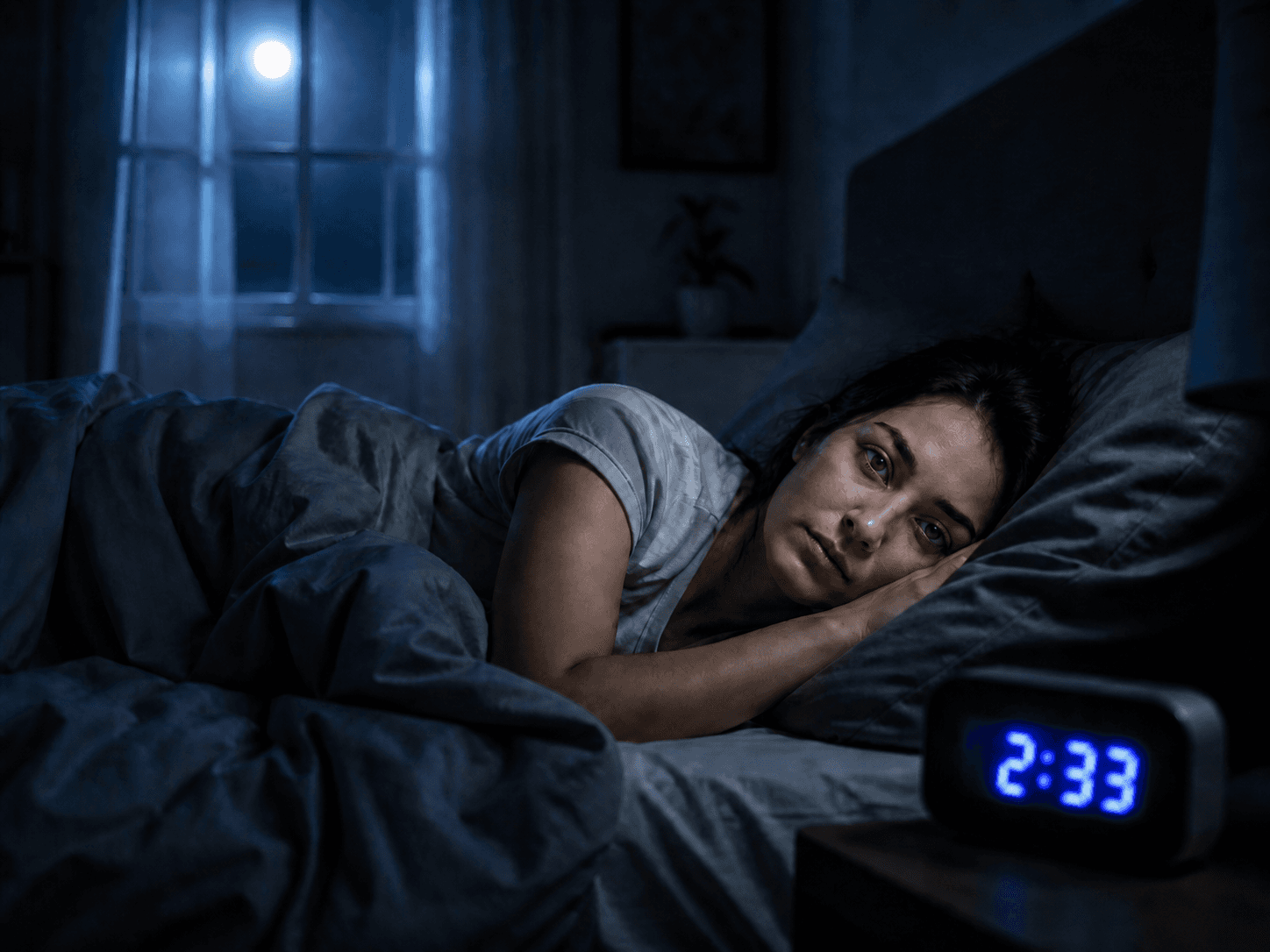
Picture this. It's 2:14 a.m. You have school in five hours. You're lying in bed, exhausted, eyes closed, doing everything right. And then your brain goes:
"Hey. HEY. Remember that thing you said in fourth grade? When you called the teacher 'Mom' in front of everyone?"
Yes, brain. I remember. Thanks for bringing it up at 2 a.m.
"Also, what if a shark got into a swimming pool? Like, somehow?"
Welcome to insomnia, the world's most annoying sleep problem. It's not just "having trouble sleeping one night." It's a whole thing. And it turns out, doctors have spent decades figuring out how to fix it. Spoiler: the answer is not "just try harder to fall asleep." (If that worked, nobody would have insomnia.)
Let's break it down.
Wait, What Even Is Insomnia?
Insomnia isn't just "I had a rough night." Doctors actually have rules for it. To officially have insomnia disorder, you have to:
Have trouble falling asleep, staying asleep, or waking up too early and not being able to get back to sleep.
Have this happen at least three nights a week.
Have it going on for at least three months.
Have it mess up your day — like making you tired, cranky, or unable to focus in class.
Have it happen even when you have plenty of time to sleep and a perfectly fine bed.
That last part is important. If you're only getting four hours of sleep because you stayed up watching YouTube until 3 a.m., that's not insomnia. That's just… you choosing chaos. Insomnia is when you want to sleep, you try to sleep, and your body is like "absolutely not."
Who Gets It?
Pretty much everybody, eventually. About 1 in 10 adults has full-blown insomnia, and another 15–20% deal with it sometimes. But here's the thing nobody tells you: kids and teens get it too.
Kids: Up to 30% have insomnia symptoms. For little kids, this often looks like fighting bedtime or needing a parent in the room to fall asleep.
Teens: Around 20–30% have it. Teen brains are extra hard mode because puberty actually shifts your body clock later — so you're biologically wired to stay up late, and then school cruelly starts at 7 a.m. Cool. Cool cool cool.
Older adults: About half deal with sleep problems. They tend to wake up in the middle of the night more than have trouble falling asleep.
And this is important: kids do NOT just "grow out of" insomnia. Studies that followed children for years found that only about a third stop having sleep problems by the time they're teens. So if you've been a bad sleeper your whole life — that's a real thing, and it's worth treating.
Why Insomnia Is Actually a Big Deal
Lots of people brush off bad sleep like it's no big thing. "I'll just have more coffee. I'll be fine." Except no — chronic insomnia is linked to:
Depression and anxiety (turns out, your brain needs sleep to do feelings correctly)
Heart problems later in life
Diabetes
Trouble at school or work
Being so tired you put cereal in the fridge and milk in the cabinet
Sleep is not optional. It's when your brain takes out the trash, files all your memories, and basically reboots the whole system. Skipping sleep is like never restarting your phone — eventually it just gets weird.
The MVP Treatment: CBT-I (Sleep Boot Camp for Your Brain)
Here's the wild part. The single best treatment for chronic insomnia isn't a pill. It's a thing called CBT-I, which stands for Cognitive Behavioral Therapy for Insomnia. (Yeah, that's a mouthful. We're going with "sleep boot camp" from here on.)
Big deal sleep doctors — like, the ones who literally write the rule books — say CBT-I should be the FIRST thing you try for insomnia. Before pills. Before anything.
It's usually 4 to 8 sessions with a therapist who specializes in sleep, and it's not the kind of therapy where you sit on a couch and talk about your feelings. It's more like having a coach teach you skills.
Here's what's in the playbook:
1. Sleep Restriction (The Sneaky Trick That Actually Works)
This sounds like a punishment, but stay with me. Sleep restriction means you go to bed later than you want to and only stay in bed for the amount of time you actually sleep. So if you've been lying in bed for 9 hours but only sleeping 6, your sleep coach makes you stay in bed for only 6.
Why? Because this makes your brain desperate for sleep. Like, "I will literally trade anything for sleep" desperate. After a few nights, you start falling asleep super fast. Then they slowly let you have more bed time as you earn it back.
It's basically making your body sleep-hungry. And it works ridiculously well.
2. Stimulus Control (Teaching Your Bed to Be a Bed Again)
Here's the problem most insomnia people have: their bed has become a place where they… don't sleep. They scroll. They worry. They watch shows. They do homework. They lie awake panicking about not sleeping.
So now their brain associates "bed" with "stress" and "phone" instead of "sleep." Whoops.
Stimulus control retrains the brain. The rules:
Bed is for sleep. That's it.
If you can't fall asleep in like 20 minutes, get up. Go to a chair. Do something boring.
Come back to bed only when you're actually sleepy.
No phone in bed. (I know. I'm sorry.)
It feels weird at first, but it teaches your brain that bed = sleep, every single time.
3. Cognitive Restructuring (Telling Your Brain to Chill)
This is the part where you fight back against the unhelpful thoughts your brain throws at you at night. Stuff like:
"If I don't get 8 hours, my whole day is RUINED."
"I'm going to fail my test because I can't sleep."
"I'll never sleep again. This is my life now."
These thoughts make you stress. Stress makes you stay awake. Staying awake makes the thoughts louder. It's a doom loop.
Cognitive restructuring teaches you to spot these thoughts and replace them with more accurate ones. Like, "One bad night isn't going to ruin my life. I've been tired before. I survived." Reasonable, calm, normal-volume thoughts.
4. Sleep Hygiene (The Basics — But Not Enough Alone)
Sleep hygiene is just good sleep habits:
Same bedtime and wake-up time every day (yes, even weekends — sorry)
No caffeine after the afternoon
Cool, dark, quiet room
Wind down before bed instead of going from "phone screen" to "pillow" with zero buffer
Here's the catch: doctors specifically say that sleep hygiene by itself is NOT enough to fix chronic insomnia. It's like brushing your teeth — important, but not a full dental plan. It's part of the package, not the whole thing.
Does CBT-I Actually Work?
Yes. Wildly well.
A massive study looking at 241 trials with over 31,000 people found that CBT-I has a "number needed to treat" of about 3 — which is doctor-speak for "you only need to treat 3 people for 1 of them to be totally cured." That's amazing. Most medications can't touch that.
About half of patients are basically cured after 6–8 weeks. And get this: a 10-year follow-up study found that two-thirds of patients still didn't have insomnia a full DECADE later. CBT-I doesn't just patch the problem. It actually fixes it.
It also works for people who have other stuff going on too — depression, PTSD, chronic pain, even cancer. The therapy bends to fit you.
"But There Aren't Enough Sleep Therapists!" (True. Here's the Fix.)
Here's the bad news: finding a real CBT-I therapist is genuinely hard. There aren't enough of them, especially in small towns, and insurance is weird about it. Lots of people who would benefit from CBT-I just… can't find anyone to give it to them.
The good news: there are now apps and websites that deliver CBT-I, and they actually work almost as well as in-person therapy. Two of them — Somryst and SleepioRx — are even FDA-cleared, which means doctors can officially prescribe them. Telehealth (CBT-I over video chat) also works just as well as showing up in person.
So if you can't find a therapist, you might still be able to get the treatment. Tech for the win.
Sleep Pills: The Backup Squad
Okay, but what about sleep medications? They exist. They work. But they're more like training wheels than a real bike — helpful for a bit, but you don't want to ride them forever.
Here's the rundown of the major teams:
Z-drugs (like zolpidem, brand name Ambien). These work fast and help you fall asleep and stay asleep. The problem? They can cause weird stuff. Like, sleep-walking, sleep-eating, even sleep-driving (terrifying). They can also be habit-forming, mess with your thinking, and make older adults more likely to fall. Doctors specifically tell older folks to avoid these.
DORAs (suvorexant, lemborexant, daridorexant). Way newer. They block a chemical in your brain called orexin that keeps you awake. They're less addictive than Z-drugs and a lot safer. Side effects include feeling sleepy the next day and having weird dreams. (You have been warned. Some people dream about their math teacher chasing them through Costco. It happens.)
Low-dose doxepin. This is an old medication used at very low doses just for sleep maintenance. It's gentle and even safe for older adults.
Ramelteon. Works like melatonin (the sleep hormone your body already makes). Mild but very safe. Good for people who can't fall asleep.
Diphenhydramine (Benadryl, ZzzQuil, etc.). This is the over-the-counter stuff. Doctors say: try not to use this regularly, especially if you're older. Your body builds up tolerance fast, and it can leave you feeling foggy and out of it the next day.
Trazodone and quetiapine. Sometimes prescribed off-label for sleep, but the evidence isn't great and they have their own side effects. Not first-choice.
The big takeaway: medications can be useful, especially if you need help fast. But they don't fix the underlying problem the way CBT-I does. The minute you stop taking the pill, the insomnia usually comes right back. CBT-I keeps working long after you stop.
The Game Plan: Putting It All Together
The official sleep doctor playbook (updated in 2026!) goes like this:
CBT-I alone is the best choice. Start there.
CBT-I plus medication is better than medication alone. If you need pills, also do the therapy.
Medication alone is the last resort. It works, but it's not the long-term answer.
Long-term remission rates back this up:
CBT-I alone: 41% still cured long-term
CBT-I + medication: 40% still cured long-term
Medication alone: 28% still cured long-term
The smartest move many people make: start with both pills and CBT-I to feel better fast, then slowly stop the pills while keeping the CBT-I skills. You get the quick relief AND the long-term fix.
Insomnia Myths That Need to Stop
Let's bust a few:
Myth: "Insomnia is just stress. Get over it." Nope. It's a real medical condition with actual diagnostic rules and real health consequences. Telling someone with insomnia to "just relax" is like telling someone with a broken leg to "just walk it off."
Myth: "Sleep hygiene fixes insomnia." Helpful! But not enough on its own. Doctors literally say so.
Myth: "Pills are the answer." They help short-term. They're not a fix. Side effects are real. Don't rely on them as your forever plan.
Myth: "Kids don't get insomnia." They very much do. And no sleep medications are FDA-approved for kid insomnia. Kids need behavioral approaches — basically, kid versions of CBT-I.
Myth: "I just have to live with it." ABSOLUTELY NOT. This one matters most. Insomnia is treatable at every age, even with other health conditions. Nobody — kids, teens, adults, grandparents — has to just suffer through it.
Your Actually-Useful Sleep Cheat Sheet
If you want to start improving your sleep tonight, here's the starter pack:
Set a real bedtime and wake-up time. Yes, even on weekends. Your body clock is not impressed by "sleeping in until noon Saturday."
Make your bed boring. No phone. No homework. No drama. Bed = sleep.
Wind down before bed. Give yourself 30 minutes of low-key activity before lights out. Read, draw, listen to music. Not scrolling.
Avoid caffeine after lunch. That afternoon iced coffee? It's still in your system at midnight. Caffeine is sneaky.
If you can't sleep, get up. Don't lie there for an hour fighting it. Go sit somewhere else. Do something low-key. Come back when you're actually sleepy.
Stop checking the clock. Counting how many hours of sleep you have left is a guaranteed way to get zero hours of sleep.
Talk to a doctor if it's chronic. Not "after one bad night." But if it's been weeks of bad sleep messing up your days? That's a real thing to bring up. Don't tough it out.
The Bottom Line
Insomnia is not your fault, it's not just "stress," and it's not something you have to silently suffer through. It's a real, fixable problem. The best treatment isn't a pill — it's a set of skills that retrain your brain to sleep again. Pills can help in the short term, but they're not the full plan.
Good sleep isn't a luxury. It's not something only "lucky people" get. With the right approach, almost anyone can sleep well again.
So tonight, when your brain decides 11:47 p.m. is the perfect time to remember every weird thing you've ever done — you can tell it: "Not tonight, brain. We've got a plan."
And then go to bed. Like, actually go to bed.
Sweet dreams. 😴
HSA/FSA Eligible
Doctors Are Human.
That's Why There's Medome.
Start your free trial today. No credit card required.
Start Your Free Trial
Join thousands protecting their health with AI that never forgets
Critical details get missed when your health information is scattered. Medome connects the dots across your complete record.
Start Your Free Trial
Quick Links
Medome Men
Home
Pricing
About
Health News
HealthSigns
FAQ
Contact Us
Terms of Service
Privacy Policy
Get In Touch
Email: service@medome.ai
Phone: (617) 319-6434
This is Dr. Steven Charlap’s cell. Please text him first, explaining who you are and how he can help you. Use WhatsApp outside the US.
Hours: Mon-Fri 9:00AM - 9:00PM ET