Fitness
Your Fitness Tracker Wants to Be Your Coach. Sometimes It Acts Like a Nag.
Jul 11, 2026 · 4 min read
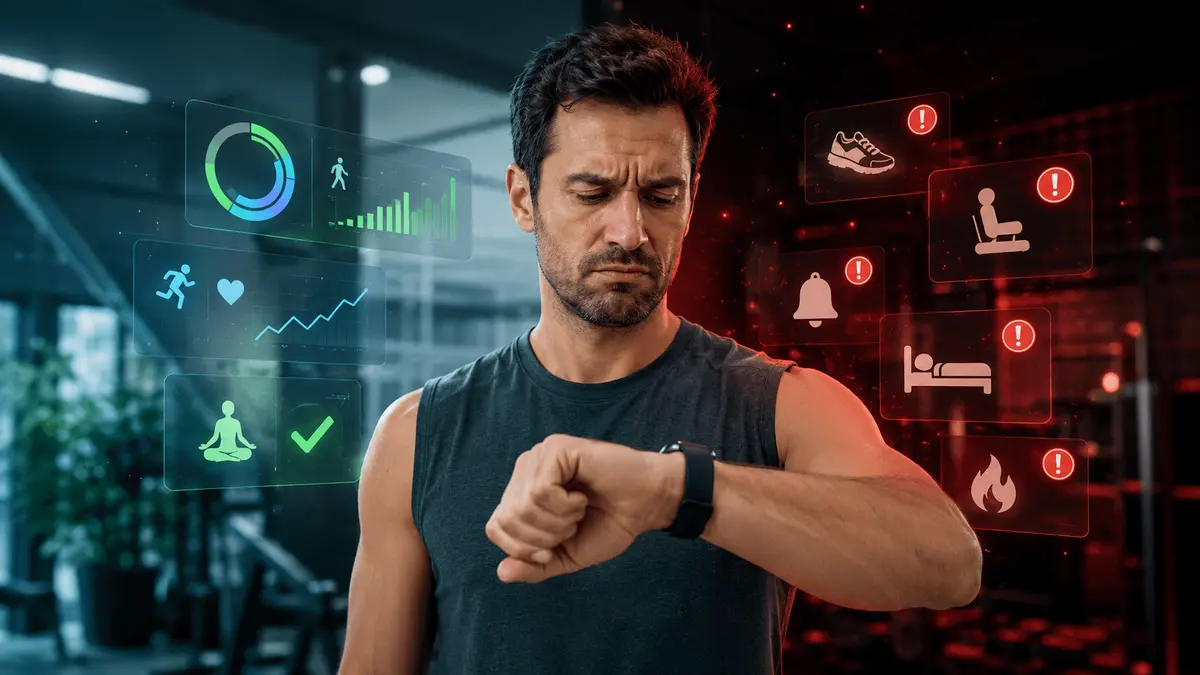
Picture your wrist buzzing at 9 p.m. "Just 1,200 steps to go!" You were about to go to bed. Now you're pacing the hallway like a raccoon hunting for snacks, because a tiny computer decided your day wasn't good enough.
Fitness trackers really do help most people move more. When scientists pooled results from more than 120 careful studies, they found trackers nudge people into roughly 1,200 to 1,850 extra steps a day, plus small improvements in body fat and heart health. Those are real wins.
But the same features that make trackers fun (points, streaks, leaderboards, buzzing reminders) can also make people anxious, guilty, or weird about exercise. Here are five traps, and how to dodge them.
Trap 1: The Magical 10,000 Steps That a Marketing Team Invented
You've heard 10,000 steps is the goal. Fun fact that will ruin someone's trivia night: that number has zero scientific basis. It came from a 1960s Japanese ad for a pedometer called "manpo-kei," which literally means "10,000-step meter." Catchy round number, not a medical finding.
The real science is gentler. The risk of early death keeps dropping as steps go up, but it flattens out around 6,000 to 8,000 steps a day for adults 60 and older, and 8,000 to 10,000 for younger adults. Even adding just 2,000 steps to whatever you do now measurably helps, including lowering blood pressure. So chasing 10,000 can be like setting the bar too high and then feeling bad for tripping.
Trap 2: Games That Stop Being Fun
Streaks, badges, and leaderboards are borrowed from video games for a reason. But researchers who studied nearly 59,000 social media posts about popular fitness apps found piles of frustration and guilt, especially when a goal felt impossible or a hard-won streak snapped after one rest day. Rest is supposed to be healthy. A streak counter can make it feel like failure.
Comparing yourself to others cuts both ways too. For some people, leaderboards motivate. For people who keep measuring themselves against superstars, the scoreboard just stings.
Trap 3: When Tracking Tips Into Disordered Eating
This is the serious one. Two recent reviews of dozens of studies found that using diet and fitness apps is linked to more disordered eating, more body dissatisfaction, and more compulsive exercise, especially in young women and people who track constantly. The riskiest type seems to be calorie-counting apps, which pull attention toward numbers and appearance instead of health.
Honesty check: this is a link, not proof that apps cause eating disorders, and people already struggling may be the ones drawn to tracking.
⚠️ If you have a history of an eating disorder, this kind of tracking deserves real caution.
Calorie counters, step goals, and streak mechanics are built to make you think about numbers constantly — which is the exact cognitive habit that eating disorder treatment works to loosen. If tracking is pulling you toward restriction, compulsive exercise, guilt after eating, or checking the app more than you check in with yourself, that's worth naming out loud to a doctor or therapist rather than pushing through. For support or a referral, the National Alliance for Eating Disorders helpline is 1-866-662-1235.
Trap 4: One Size Fits Nobody
Trackers are great at counting easy things (steps) and shaky at everything else. In one big review, only about 11% of devices had been properly tested for even one measurement, and estimates of exercise intensity were off by 29% to 80%.
It gets more uncomfortable. The optical sensors that read your heart rate shine light into your skin, and that light behaves differently by skin tone. Readings are less accurate on darker skin, and one lab model found signal loss of up to 61% with darker skin and higher body weight. That matters a lot when the same technology estimates blood oxygen, which many people leaned on during COVID. Add in the fact that tracker owners skew younger, wealthier, whiter, and more educated, and you get gadgets basically tuned for a narrow slice of humans.
Trap 5: Trusting the Number More Than Your Own Body
Here's a wild experiment. Researchers secretly showed people step counts that were 40% lower than reality. Their actual activity never changed. But the people who saw the fake low numbers felt worse, ate worse, had lower self-esteem, and even showed higher blood pressure and heart rate.
The number on the screen didn't just describe their day. It reshaped their body. That's the real danger of handing your judgment to a gadget. Your own signals (tiredness, soreness, "that felt great") are data too, often better data.
How to Use a Tracker Without Letting It Use You
Set your own goal instead of the default. For most adults, adding about 1,000 steps to your current normal is a solid, health-boosting target. Watch trends over weeks, not pass-or-fail days. Turn off streaks and leaderboards if they make you anxious. Trust step counts more than calorie or sleep estimates, which are far less reliable.
And remember: the tracker works for you, not the other way around. It's a helpful clipboard. It should never be your boss.
This article is general education, not medical advice, and it touches on eating and body image. A tracker is a tool for noticing patterns, not a scoreboard for your worth — if the numbers are fueling anxiety, guilt, or unhealthy habits, that's a good reason to put the device in a drawer for a while and talk to a doctor or therapist. If you're struggling with disordered eating, the National Alliance for Eating Disorders helpline is 1-866-662-1235. And if you want the honest version of what movement actually does for you, our piece on walking versus the pill is a better guide than any step goal.