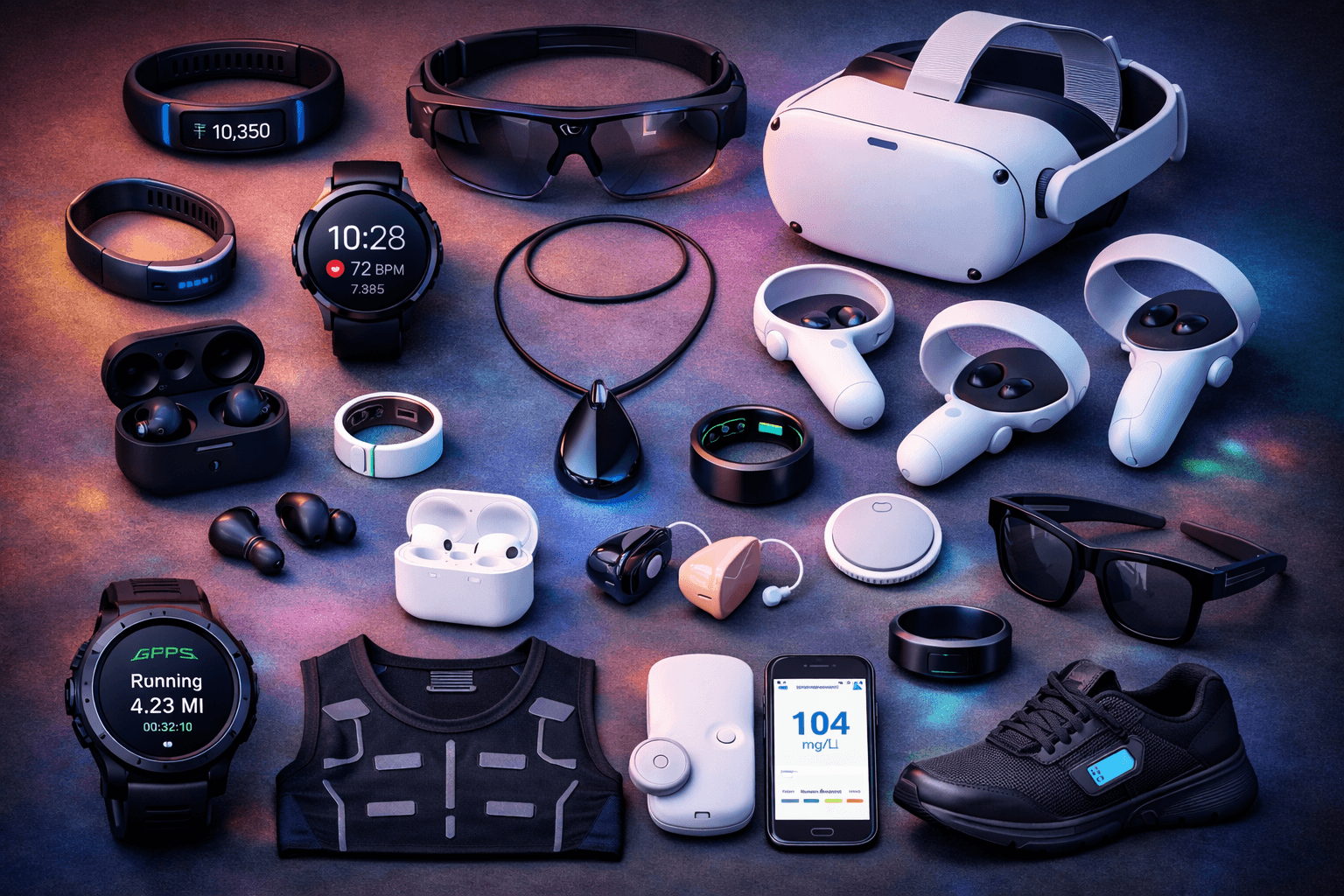
Your smartwatch is not a doctor. Your fitness tracker is not a medical lab. But used the right way, these little gadgets can actually change your life. Here is everything you need to know.
— A Complete Patient and Consumer Guide —
Somewhere on your wrist right now, or maybe on your finger, or stuck to your arm, there is a tiny computer keeping a very detailed diary about your body. It knows when you walked to the refrigerator at midnight. It has opinions about your sleep. It is ready to buzz dramatically at you the moment your heart does anything it considers suspicious.
These gadgets are everywhere. Hundreds of millions of people worldwide wear some version of them, from basic step-counting fitness bands to sophisticated smartwatches that can record a medical-quality heart tracing. Blood sugar monitors now sit invisibly on people's arms, sending glucose readings to their phones every few minutes. Blood pressure cuffs connect to apps and build months of data. Tiny rings sleep on fingers all night, studying the wearer's heart rate and movement.
It is, by any measure, remarkable technology. And like most remarkable technology, it is also widely misunderstood, over-trusted, under-trusted, and occasionally the source of completely unnecessary panic at two in the morning. This guide exists to help you avoid all of that.
"Your device is a very enthusiastic first draft. Your doctor's equipment is the final edit. Both have their place."
Section 1: What These Devices Actually Are
A wearable health device is any gadget you wear on your body that collects information about what is happening inside your body. The most common ones are smartwatches like the Apple Watch or Samsung Galaxy Watch, fitness trackers like Fitbit and Garmin, smart rings like the Oura Ring, continuous glucose monitors like the Dexcom and Libre, and home blood pressure cuffs from brands like Withings and Omron.
Each works differently, measures different things, and comes with its own set of strengths and weaknesses. What they all share is the same fundamental promise: that by paying closer attention to your body over long stretches of time, you can understand your health better and catch problems sooner.
How Wrist Sensors Work
Most smartwatches and fitness trackers use a technology called photoplethysmography (say that five times fast). Tiny green LED lights shine into your skin, and sensors detect how light bounces back. When your heart beats, blood surges through your wrist and absorbs the light differently.
It is clever, non-invasive, and surprisingly effective. It is also affected by movement, cold temperatures, tattoos, poor circulation, skin tone, and a low battery. Knowing this explains a lot about why readings are sometimes strange.
Section 2: What They Are Good At (and What They Are Not)
People tend to make one of two mistakes. Either they trust wearables completely, treating every reading as absolute medical truth, or they dismiss them entirely as toys for tech enthusiasts. Neither approach is right.
They Are Good At:
Counting steps and tracking daily movement throughout the day
Showing how your heart rate changes during exercise and rest
Monitoring your resting heart rate and flagging unusual trends over time
Estimating calories burned during activity
Spotting broad sleep patterns such as how long you slept and how often you woke
Sending alerts about possible irregular heartbeats
Tracking blood sugar every few minutes if you use a continuous glucose monitor
Motivating you with goals, streaks, and progress badges
Storing weeks of health data your doctor can review
They Are Not Good At:
Replacing your actual doctor or a clinical medical exam
Diagnosing any disease or medical condition with certainty
Producing perfectly accurate readings at all times
Measuring heart rate reliably during intense exercise
Accurately measuring blood pressure from the wrist without a cuff
Working well on cold skin, tattooed skin, or with poor circulation
Telling you definitively whether something is or is not seriously wrong
The Most Important Sentence in This Guide
Consumer wearable devices are tools for spotting trends and patterns over time. They are not medical diagnostic tools, and they were never designed to be. Every recommendation in this guide flows from that single fact.
Section 3: The Accuracy Problem
Your wearable device is going to give you wrong readings sometimes. This is not a defect. It is not the universe conspiring against you. It is just how the technology works. Understanding when and why readings go wrong will save you an enormous amount of unnecessary worry.
Common Causes of Inaccurate Readings
Loose fit: the sensor cannot maintain steady contact with your skin
Movement during the reading: running, waving arms, doing dishes, or gesturing
Cold hands: blood vessels constrict and reduce the signal at the skin surface
Low battery: consistently degrades sensor performance even before the device dies
Tattoos: dark ink can block the green light sensors use to detect blood flow
Dirty sensor: dried sweat and skin oils coat the lens and block accurate readings
Darker skin tones: older devices were less accurate; newer models have improved
Medical conditions: poor circulation, certain arrhythmias, and some medications
Nail polish (for pulse oximeters): dark polish on the measured finger causes errors
"One strange reading when you feel fine is almost certainly the device being dramatic. A pattern of strange readings over many days is worth a phone call."
Section 4: How to Wear Your Device Correctly
A surprising number of accuracy problems come down to something simple: wearing the device wrong. Here is how to get it right for the most common device types.
Wrist Devices (Smartwatches and Fitness Trackers)
Position it one finger-width above your wrist bone. Not on the bone itself and not halfway up your forearm.
Wear it snug but not painful. You should be able to slide one finger under the band comfortably, but no more than that.
Keep the sensor in firm contact with your skin at all times. No clothing between device and wrist, no air gaps.
Tighten it a little more during exercise to prevent bouncing. Slightly looser at night for comfort is fine.
Clean the sensor and band underside regularly with a damp cloth. Dried sweat blocks readings.
Give your wrist a break of about an hour each day to let your skin breathe.
If you develop a rash or skin irritation, remove the device immediately and let your skin heal completely before trying again.
Continuous Glucose Monitors (CGM Sensors)
Follow the manufacturer instructions exactly for sensor placement, usually the back of the upper arm or abdomen.
Clean the area with an alcohol wipe and let it dry fully before pressing the sensor down.
Replace the sensor on schedule, typically every 10 to 14 days depending on the brand.
Know that CGM readings run 10 to 15 minutes behind your actual blood sugar. This is physics, not a malfunction.
Always do a traditional finger-stick blood glucose test if you feel very low or very high and the reading does not match.
Check your model's water resistance rating before submerging it in water.
Home Blood Pressure Monitors
Sit quietly for five full minutes before taking any reading. Set a timer. This step is not optional.
Empty your bladder first. A full bladder raises blood pressure readings.
Sit with your back supported, feet flat on the floor, and your arm resting on a table at heart level.
The cuff goes on your bare arm, not over clothing. The bottom edge should sit about one inch above your elbow crease.
Do not talk or move during the reading. Stay still and quiet throughout.
Avoid caffeine and vigorous exercise for at least 30 minutes before taking a reading.
Take two or three readings, waiting one to two minutes between each. Use the average of the readings.
Take readings at the same time each day. Morning before taking medications is usually most informative.
Skin Rash Alert
If your skin looks red, bumpy, or irritated under your device, take it off. Clean the area gently, let it heal completely, and then try again. Some bands cause reactions from materials or trapped sweat. You may need a different band material.
Section 5: Understanding Your Numbers
Numbers without context are just noise. Here is the context you need for the measurements your device is most likely to show you.
Heart Rate
60 to 100 | 40 to 60 | 100 or above |
|---|---|---|
Normal resting heart rate for most adults (beats per minute) | Normal for athletes and very fit people | Above normal at rest; worth mentioning to your doctor |
Heart rate rises during exercise, stress, fever, caffeine, and dehydration. It falls during sleep and deep relaxation. A resting rate that is consistently higher or lower than your personal baseline over several days is worth noting. One fast reading after you rushed to answer the door is not. Focus on weekly trends, not individual numbers.
Steps
7,000 | 10,000 | +2,000 |
|---|---|---|
Daily steps linked to clear health benefits in most adults | Popular goal that originated from a 1960s Japanese marketing campaign, not from science | Additional steps beyond your current average that produce meaningful benefit |
Any increase from your current daily average produces health benefits. Wrist-based trackers can add false steps from hand movements like cooking, laundry, or waving. Use your step count as a general guide, not an exact measurement.
Sleep
7 to 9 hours | 8 to 10 hours |
|---|---|
Recommended nightly sleep for most adults | Recommended nightly sleep for teenagers |
Consumer sleep tracking estimates when you were asleep versus awake using movement and heart rate. It is less reliable for specific sleep stages. Focus on total sleep time trends over weeks rather than nightly stage percentages from the app.
Blood Oxygen (SpO2)
95 to 100% | 90 to 94% | Below 90% |
|---|---|---|
Normal for healthy adults | Low; contact your doctor | Seek emergency care immediately |
Consumer smartwatch SpO2 readings are significantly less accurate than dedicated medical pulse oximeters. Cold fingers, nail polish, and poor circulation can produce falsely low readings. If you feel genuinely short of breath, use a dedicated clip-on pulse oximeter or go to a medical facility, not your smartwatch alone.
Blood Pressure
Below 120/80 | 130/80 | 140/90 | 180/120 or above |
|---|---|---|---|
Normal | Stage 1 high blood pressure | Stage 2 high blood pressure | Hypertensive crisis. Seek immediate care. |
Blood pressure rises and falls naturally throughout the day. One elevated reading is not a diagnosis of high blood pressure. Your doctor will define your personal target range. Never adjust blood pressure medications based on home readings without talking to your doctor first.
Section 6: Device Comparison Guide
Not all wearable devices are created equal, and not every device is right for every person. This section gives you the tools to match the right device to your specific needs. It draws on the evidence table from the accompanying research file, which includes published study links and FDA clearance documentation for every device listed.
The capability matrix chart below shows at a glance which devices track which health metrics. Following the chart, you will find a Best Picks table summarizing the evidence-backed winner in each category, and a full evidence table covering all 22 devices reviewed.
Device Capability Matrix
Use this chart to see which devices cover which health metrics. A full checkmark means the device fully supports that capability. A half-filled circle means partial or limited support. A minus sign means the capability is not available.
(Refer to the original document for the full capability matrix chart.)
Best Picks by Evidence Category
The table below shows the single best device in each use-case category based on published clinical evidence and FDA clearance status.
Category / Capability | Best Device | Key Evidence Summary |
|---|---|---|
AFib screening (high-risk older adults) | Apple Watch | EQUAL trial used Apple Watch; Apple Heart Study confirmed AFib with 84% positive predictive value. |
Spot ECG to share with clinician (more leads) | KardiaMobile 6L | NICE evidence summary; single-lead ECG accuracy review reports AFib sensitivity above 87%. |
Diabetes CGM (strongest clinical evidence) | Real-time CGM (Dexcom family) | MOBILE RCT showed improved HbA1c; CGM meta-analysis shows improved time in range by 70 minutes per day. |
OTC glucose pattern tracking (no prescription) | Dexcom Stelo | CGM class evidence plus ADA technology standards of care guidance. |
Home blood pressure (best accuracy) | Withings BPM Connect (upper arm) | AHA recommends automatic upper-arm cuff; device listed and validated at ValidateBP.org. |
Cuffless BP wearable (OTC cleared) | Aktiia G0 / Hilo Band | FDA 510(k) clearance K250415; first OTC-cleared cuffless continuous BP wearable. |
Workout heart-rate accuracy | Polar H10 (chest strap) | Wrist HR accuracy worsens during intense exercise; chest straps used as reference standard in published studies. |
Sleep trend tracking (patterns, not diagnosis) | Oura Ring | World Sleep Society guidance; strongest independent validation among consumer sleep trackers. |
Home oxygen checks (OTC, FDA-cleared) | Masimo MightySat Medical | First OTC FDA-cleared fingertip pulse oximeter; follow FDA guidance on limitations. |
Full Device Evidence Summary
The table below summarizes all 22 devices reviewed. The accompanying Excel file contains the complete evidence details including specific study citations, correlation data, and target population notes.
Device | What It Measures | Best Used For | Evidence and Clearance Status |
|---|---|---|---|
Apple Watch (Series 4 or newer) | Heart rate, ECG, AFib alerts, steps, sleep, SpO2 | AFib screening in adults aged 65 and older with risk factors; capturing heart rhythm during palpitations | FDA Cleared (ECG and AFib notification) |
Fitbit Sense and Charge (similar models) | Heart rate, ECG on some models, AFib alerts, steps, sleep, SpO2 | AFib screening alerts; daily step motivation; sleep pattern tracking | FDA Cleared (ECG models) |
Samsung Galaxy Watch (ECG models) | Heart rate, ECG, AFib alerts, steps, sleep, SpO2 | AFib screening for adults 22 and older; Android ecosystem users who want ECG | FDA Cleared (ECG and irregular rhythm notification) |
Withings ScanWatch | Heart rate, ECG, steps, sleep, SpO2 | Long-battery ECG watch; simple reports to share with a clinician | FDA Cleared (ECG app) |
Garmin (Venu, Fenix, Forerunner, Vivosmart) | Heart rate, steps, GPS, sleep, SpO2 on some models, training load | Fitness and athletic training; GPS tracking; exercise heart-rate zones | Wellness device (not FDA cleared for medical use) |
WHOOP Strap | Heart rate, HRV, sleep, breathing rate, skin temperature | Recovery coaching and training load optimization; athletes who prefer no screen | Wellness device; FDA issued warning letter in 2025 about certain health claims |
Oura Ring | Heart rate, HRV, sleep, temperature trends, steps | Sleep trend tracking; people who dislike wrist devices; menstrual cycle temperature trends | Wellness device; best independently validated consumer sleep ring |
Samsung Galaxy Ring | Heart rate, sleep, activity, temperature trends | General wellness for Samsung ecosystem users; lightweight alternative to smartwatch | Wellness device; limited independent validation published so far |
KardiaMobile (single-lead ECG) | 30-second single-lead ECG rhythm strip; automated rhythm label | Capturing ECG during palpitations; AFib screening spot check to share with clinician | FDA Cleared; AFib sensitivity above 87% in published reviews |
KardiaMobile 6L (six-lead ECG) | 30-second six-lead ECG rhythm strip; automated rhythm label | More detailed ECG strip for clinician review; intermittent symptom capture | FDA Cleared; NICE evidence summary supports clinical use |
Dexcom Stelo (OTC CGM) | Glucose reading every few minutes; trend arrows; time in range | Learning how food and exercise affect glucose without a prescription; type 2 diabetes pattern tracking | FDA Cleared (over the counter); no prescription required |
Abbott Lingo (OTC biosensor) | Glucose trend readings; app pattern feedback | Glucose awareness and pattern tracking without a prescription | FDA Cleared (over the counter) |
FreeStyle Libre (CGM family) | Glucose trends; time in range; scan or continuous by model | Diabetes management; reducing hypoglycemia risk; spotting highs and lows | FDA Cleared (prescription); strong RCT evidence base |
Withings BPM Connect (upper-arm cuff) | Blood pressure and pulse (upper arm); home BP log | Home BP monitoring for hypertension; medication adjustments; validated in pregnancy | Clinically Validated (ValidateBP.org); ISO standard met |
Omron Platinum BP5450 (upper-arm cuff) | Blood pressure and pulse (upper arm); home BP log | Home BP monitoring for hypertension; people who want a validated upper-arm device | Clinically Validated (ValidateBP.org) |
Omron HeartGuide (wrist BP watch) | BP (wrist); heart rate; basic activity and sleep | On-the-go BP spot checks when away from home | FDA Cleared; wrist position is harder to get right than upper arm |
Aktiia G0 and Hilo Band (cuffless) | Cuffless BP estimates from wrist; day and night BP trends; requires periodic calibration cuff | Frequent BP tracking including nighttime patterns for adults monitoring hypertension | FDA Cleared (K250415); first OTC-cleared cuffless continuous BP wearable |
Masimo MightySat Medical (pulse oximeter) | SpO2 oxygen estimate; pulse rate (fingertip clip) | Home oxygen checks during respiratory illness or with lung disease; use with clinician guidance | FDA Cleared (first OTC-cleared fingertip pulse oximeter) |
Nonin TruO2 OTC (pulse oximeter) | SpO2 oxygen estimate; pulse rate (fingertip clip) | Home oxygen monitoring similar to Masimo; pick based on comfort and availability | FDA Cleared (OTC) |
Polar H10 (chest strap) | ECG-grade heart rate during exercise; RR intervals for HRV apps | Accurate workout heart-rate zones; athletic training; cardiac rehabilitation | Research Reference Standard; used as criterion measure in heart-rate accuracy studies |
Withings Sleep Mat (under-mattress) | Bedtime and wake time; sleep disruption trends; heart rate; snoring estimates | Sleep pattern tracking without wearing any device at night | Wellness device; estimates total sleep time reasonably; not diagnostic |
VitalPatch and VivaLnk (adhesive patches) | Continuous ECG; heart rate; breathing rate; temperature; activity (varies by model) | Post-hospital remote patient monitoring programs under clinician supervision only | Clinical and prescription use only; TIM-HF2 trial showed benefit in structured heart failure programs |
Important Note About Device Evidence
Evidence quality varies widely across devices. Blood pressure cuffs, CGMs, and ECG devices have the strongest clinical trial evidence. Recovery trackers and general wellness bands have the least. Always ask your doctor which device, if any, makes sense for your specific health situation.
Section 7: When Your Device Sends an Alert
Your device just buzzed urgently. Before anything else, take a breath. A large proportion of wearable health alerts are false alarms. Manufacturers set alert thresholds conservatively because they would rather warn you too often than miss something important.
Step by Step: What to Do When an Alert Arrives
Stay calm. Panicking raises your heart rate, which can make the alert worse, which makes you panic more.
Check whether the device is properly positioned and in firm contact with your skin.
Sit still for a minute, then take another reading. Were you moving or exercising when the alert came?
Think about what you were doing. Exercise, movement, and vigorous arm activity all trigger false alerts.
Check in with your body. Do you feel dizzy? Any chest discomfort? Trouble breathing? Your symptoms matter more than the number on the screen.
If you feel completely fine and the alert does not repeat, it was almost certainly nothing. Write down what happened anyway.
Section 8: When to Call Your Doctor and When to Wait
You Do Not Need to Call For:
A single strange reading when you feel completely fine
Small day-to-day variations in your numbers (that is just normal biology doing its job)
An alert during or immediately after exercise or vigorous movement
A sleep score that seems low but you feel rested
A blood pressure reading slightly elevated right after you rushed to take it
Call Your Doctor During Business Hours If:
You get the same alert repeatedly over several days in a row
Your readings are consistently much different from your usual numbers
You feel mildly unwell alongside unusual readings
Your blood sugar is frequently going very high or very low despite your usual management
You are simply unsure whether what your device is showing is normal for you
Go to the Emergency Room or Call 911 Immediately If You Have:
Chest pain or pressure of any kind, even if mild.
Significant trouble breathing or feeling you cannot catch your breath.
Feeling like you might faint, or actually fainting.
Blood sugar dangerously low and you cannot bring it up by eating or drinking.
Blood pressure above 180/120 combined with symptoms like headache or vision changes.
Oxygen readings below 90% with shortness of breath.
Any severe symptom that is not going away.
When in doubt, always go. It is always better to be told everything is fine than to wait.
Section 9: Quick Reference at a Glance
Situation | What to Do | Level |
|---|---|---|
One strange reading, feeling fine | Recheck in a few minutes | Wait |
Same alert multiple days in a row | Write it down; call your doctor | Call Doc |
Alert during or right after exercise | Rest and recheck. Likely a false alarm. | Wait |
Alert plus dizziness or chest discomfort | Call your doctor or go to urgent care | Urgent |
Chest pain, fainting, severe breathing trouble | Call 911 immediately | Call 911 |
Blood sugar very low, cannot bring it up | Call 911 | Call 911 |
Blood pressure 180/120 or above with symptoms | Go to the ER immediately | Call 911 |
Blood pressure 180/120 or above, no symptoms | Recheck; if still high, call doctor right away | Urgent |
SpO2 below 90% with shortness of breath | Go to the ER | Call 911 |
Device disagrees with medical equipment | Trust medical equipment; mention to your doctor | Note |
Skin rash under the device | Remove device; let skin fully heal first | Wait |
Device causes anxiety or obsessive checking | Take a break; talk to your doctor | Self-Care |
You have a pacemaker; want a new wearable | Ask your cardiologist before using anything new | Ask Doc |
Section 10: Six Things People Get Wrong About Wearables
Myth | Reality |
|---|---|
My smartwatch is as accurate as the equipment at my doctor's office. | It is not, and it was never designed to be. Medical equipment meets far stricter standards. Use your device for trends; trust medical equipment for medical decisions. |
10,000 steps a day is the proven goal for good health. | The 10,000-step goal began as a 1960s Japanese marketing campaign, not science. Research shows 7,000 to 8,000 steps captures most of the health benefit. Any increase from your baseline helps. |
If my device detects an irregular heartbeat, I definitely have one. | Many of these alerts are false alarms triggered by movement, a loose fit, or natural variation. A real arrhythmia needs confirmation by an ECG at your doctor's office. |
Wearables can detect heart attacks. | No current consumer wearable can reliably detect a heart attack. If you think you are having one, call 911 immediately. Do not pause to check your watch. |
I can adjust my medications based on my device readings. | Never do this without talking to your doctor first. Changing medication doses based on a consumer device could be genuinely dangerous. |
My sleep stage data is accurate. | Sleep stage data from wrist devices is estimated from movement and heart rate. Real sleep staging requires brain wave monitoring in a clinical setting. Use sleep data for general patterns only. |
Section 11: A Word About Pacemakers and Defibrillators
If you have a pacemaker or an implantable cardioverter-defibrillator (ICD), you need to speak with your cardiologist before using any new wearable device. This is not excessive caution. It is a real safety concern.
Some wearable devices use a technology called bioimpedance to estimate body composition, breathing rate, or stress levels. Bioimpedance sends tiny electrical signals through your body. In some people with implanted heart devices, these signals can potentially interfere with how the implant works.
The Safe Approach
Talk to your cardiologist BEFORE using any new wearable if you have a pacemaker or ICD.
Ask specifically whether the device model you want to use includes bioimpedance technology.
Basic optical (light-based) heart rate sensors are generally lower risk, but still check with your doctor first.
Do not rely on device company customer service alone. Your heart doctor knows your situation best.
Section 12: When the Gadget Starts Stressing You Out
There is a phenomenon researchers call wearable-related health anxiety, and it is more common than you might expect. It happens when a device that was supposed to make someone feel more in control instead makes them feel constantly worried.
Signs the Device Is Causing More Harm Than Good
Checking your heart rate more than ten times a day when you feel completely fine
Being unable to start your day without reviewing last night's sleep score first
Having a slightly off reading ruin your mood for hours
Spiraling into internet searches about your readings that always end in alarm
Feeling anxious when the device is charging and you cannot check your numbers
What to Do
Take a device break for a few days. This is not giving up; it is taking care of your mental health.
Limit how often you open the app. Once a day is plenty for most people.
Turn off most notifications and only check data when you genuinely want to.
Talk to your doctor or a mental health professional. Health anxiety is very treatable.
Remember: the device is a tool. It should work for you, not the other way around.
Section 13: How to Use Your Data with Your Doctor
"Your device sees you 24 hours a day. Your doctor sees you for 15 minutes a year. Sharing your data bridges that enormous gap."
One of the most underused benefits of wearable devices is the data they can bring to medical appointments. Most doctors spend a combined 15 to 30 minutes with any patient over the course of an entire year. Your wearable sees you around the clock.
Export a report from your device's app before your appointment. Apple Health, Fitbit, Garmin Connect, Dexcom Clarity, and most others have this feature.
Bring at least two to four weeks of data, not just yesterday's readings.
Highlight anything that concerned you or seemed unusual, so your doctor does not have to dig through everything.
Tell your doctor what device you use and what brand. This helps them understand the data quality.
Come with specific questions. For example: My resting heart rate seems higher this month. Is that worth looking at?
Ask your doctor which measurements matter most for your specific health situation.
Ask whether your device can sync directly to your health portal, such as MyChart.
Section 14: Practical Tips for Long-Term Success
Set Goals That Start Where You Are
If you walk 2,000 steps a day now, aim for 2,500 first. Not 10,000.
Increase your goal by 10 to 15 percent once the current one feels comfortable.
Celebrate every win, including small ones. Your brain responds to recognition.
Take rest days without guilt. Recovery is part of health.
Check Your Data Wisely
Once or twice a day is enough. Checking every few minutes causes anxiety, not insight.
Focus on weekly and monthly trends, not day-to-day variation.
Avoid comparing your numbers to other people. Your normal is your normal.
Keep Your Device Performing Well
Keep software and firmware updated. Manufacturers regularly release accuracy improvements.
Keep the device charged. Low battery degrades sensor performance before the device dies.
Clean the sensor with a damp cloth regularly to remove sweat and skin oils.
Replace worn-out bands. Damaged bands fit poorly and reduce accuracy.
Wear it consistently. The device learns your patterns over time and becomes more accurate for you personally.
Section 15: Bringing It All Together with Medome
There is one problem that every wearable device on this list shares, and it is the same problem no single device can solve on its own: each one speaks only its own language. Your smartwatch knows your heart rate. Your glucose monitor knows your blood sugar. Your blood pressure cuff knows your numbers from Tuesday morning. But none of them know about each other, and none of them can put what they are measuring into the context of your whole life, your history, or the patterns that have been quietly building in your body over months and years. That gap is exactly what Medome was built to fill.
Medome brings every data stream from every wearable you use into a single AI model built specifically around health and wellbeing, and then it does something no individual device or app can do on its own. It adds context. A heart rate of 85 beats per minute means one thing during a rest day and something completely different the week after you started a new medication, or the morning after a poor night of sleep. Medome knows the difference, because it has been watching continuously and building your personal health picture the whole time.
Because Medome is longitudinal, meaning it keeps adding to your history rather than resetting every day, it can catch slow-moving changes that no single reading would ever flag on its own. It can notice that your resting heart rate tends to climb two days before a flare-up. It can spot that your sleep gets worse during weeks when your glucose is less stable. It can connect a stretch of low mood to shifts in your activity level, skin condition, and overnight heart rate variability, and surface a connection you would never find by switching between five separate apps.
"Individual wearables give you numbers. Medome gives you the story those numbers are actually telling, told in full, in context, and over the full arc of your health journey."
This is the difference between data and understanding. Your devices are excellent at collecting signals. Medome is what turns those signals into something you can actually learn from, act on, and share with your doctor in a way that is complete rather than fragmented. The more you use it, and the more of your health history it accumulates, the clearer and more useful that picture becomes.
What Makes Medome Different
Context: Medome knows your personal baseline, your history, and your lifestyle, so a reading that looks normal for someone else may flag as unusual for you specifically.
Continuous: Medome never stops watching. There are no gaps between check-ins, no moments when your health picture goes dark.
Longitudinal: Your data grows richer over time. Patterns that take months to form are exactly the ones Medome is designed to find.
Cross-signal correlations: Medome can connect dots across heart rate, glucose, sleep, mood, skin changes, activity, and symptoms that no single-device app can ever see together.
At the end of the day, your wearable health device is exactly what the name suggests: a device. A very sophisticated, occasionally dramatic, sometimes wrong, genuinely useful tool. It cannot tell you whether you are healthy. It cannot replace the judgment of someone who went to medical school. It cannot feel how you feel.
What it can do, if used thoughtfully, is help you pay closer attention to your body, spot patterns that would otherwise be invisible, build better habits, and have much richer conversations with your healthcare team. That is not a small thing. That is actually quite powerful.
Use it that way, and you will get something real out of it. Trust your body first, use your device second, and call your doctor whenever something does not feel right, regardless of what any screen says.
Medical Disclaimer
This guide is written for general health education purposes only. It is not a substitute for personalized advice from your doctor, nurse, or other qualified healthcare provider. Always consult your healthcare team before making changes to your health routine, medications, or treatment plan. If you are experiencing a medical emergency, call 911. Sources informing this guide include evidence-based recommendations from the New England Journal of Medicine and the JACC framework for interpreting abnormal wearable data, as well as published research on photoplethysmography accuracy, false alarm rates, and bioimpedance safety in patients with cardiac implantable electronic devices.
HSA/FSA Eligible
Doctors Are Human.
That's Why There's Medome.
Start your free trial today. No credit card required.
Start Your Free Trial
Join thousands protecting their health with AI that never forgets
Critical details get missed when your health information is scattered. Medome connects the dots across your complete record.
Start Your Free Trial
Quick Links
Medome Men
Home
Pricing
About
Health News
HealthSigns
FAQ
Contact Us
Terms of Service
Privacy Policy
Get In Touch
Email: service@medome.ai
Phone: (617) 319-6434
This is Dr. Steven Charlap’s cell. Please text him first, explaining who you are and how he can help you. Use WhatsApp outside the US.
Hours: Mon-Fri 9:00AM - 9:00PM ET