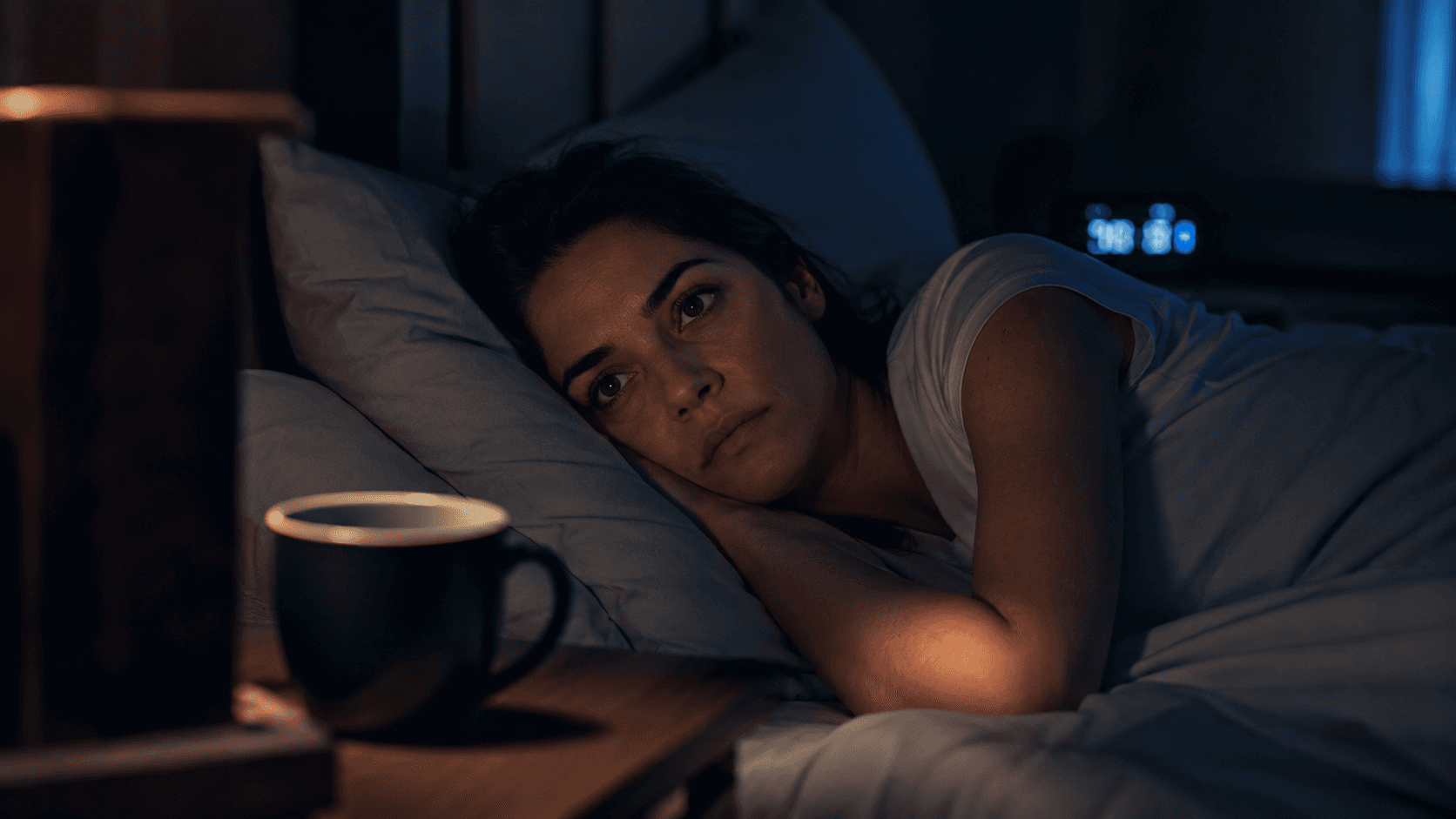
Here is a comforting lie many of us tell ourselves: "Coffee doesn't affect my sleep. I can have an espresso after dinner and still pass out at bedtime." New research from Wroclaw Medical University in Poland says hold on, because falling asleep and sleeping well are two very different things. Caffeine can quietly sabotage the quality of your sleep even when you log a full eight hours.
The secret is something called slow-wave activity, which scientists measure with an EEG, a tool that records the brain's electrical signals using sensors on the scalp. You can sleep all night and still get cheated out of the good stuff.
What sleep actually is
Sleep is not one flat state. It is a cycle of stages your brain travels through several times a night.
Stage 1 is light sleep, the drifting-off phase. You wake easily, and it lasts only a few minutes. Stage 2 is where your heart rate slows, your temperature drops, and your brain fires off little bursts of activity called sleep spindles. This stage fills about half your night. Stage 3 is deep sleep, also called slow-wave sleep, and it is the crown jewel. Your brain produces big, slow electrical waves called delta waves. During this phase your body repairs tissue, strengthens your immune system, and locks in memories. Growth hormone, vital for development in teens and repair in adults, is released mostly here. Then comes REM sleep, when your brain lights up almost as much as when you are awake. This is when most dreaming happens, and it supports emotional processing, creativity, and learning.
One full cycle takes about 90 minutes, and you run through four to six cycles a night. Deep sleep clusters in the first half of the night, while REM takes over the second half.
The adenosine story
To understand how caffeine sneaks in, meet adenosine. Throughout the day, as your cells burn energy, a molecule called adenosine builds up in your brain. The more it accumulates, the sleepier you feel. It is basically your brain's tiredness gauge filling up, and scientists now accept it as a genuine sleep-regulating substance.
Adenosine works by docking onto specific receptors on brain cells, mainly the A1 and A2A types. When it binds, it quiets down the chemicals that keep you awake and switches on the pathways that put you to sleep. The fuller the gauge, the stronger the push toward bed.
Now here is caffeine's trick. A caffeine molecule is shaped a lot like adenosine, so it slides right into those same receptors. But it does not switch them on. It just sits there, blocking the real adenosine from docking. Imagine jamming a broken key into a lock. It does not open the door, but it stops the right key from fitting. Your brain never gets the "time for bed" message, so you feel alert. The tiredness is still there. You just cannot feel it.
The proof: deep sleep takes the hit
A systematic review of studies and clinical trials confirmed the usual caffeine complaints. It makes you take longer to fall asleep, cuts your total sleep time and efficiency, and makes your sleep feel worse. But the most consistent and important finding is the drop in slow-wave activity, the EEG fingerprint of deep, restorative sleep.
In one carefully controlled experiment, even a low dose of caffeine, just 100 milligrams or roughly one cup of coffee taken at bedtime, significantly reduced slow-wave activity during the first deep-sleep period. People still fell asleep. On a standard sleep study, they still looked like they reached deep sleep. But the electrical signature of that sleep was shallower. Their brains were producing fewer of the big, slow delta waves that mark truly restorative rest. They got the quantity but lost the quality.
This happens through those same adenosine receptors. Your brain uses adenosine signaling to track how much deep sleep it owes itself after a long day awake, a kind of running tab called sleep debt. By blocking the receptors, caffeine fools the brain into thinking the tab is smaller than it really is, so it does not pay you back with as much deep sleep. You feel rested. You were not fully repaid.
Why coffee hits people so differently
Genetics explains a lot. A gene called CYP1A2 controls how fast your liver breaks down caffeine. Fast metabolizers clear it quickly and might handle an evening coffee just fine. Slow metabolizers process it sluggishly and are far more likely to lie awake staring at the ceiling.
But there is a second important gene: ADORA2A, which builds the adenosine A2A receptor, one of caffeine's main targets. Research found specific versions of this gene that determine how sensitive a person is to caffeine's effect on sleep. In one study, people carrying a particular version showed that caffeine failed to block their brain's deep-sleep rebound, meaning their adenosine system basically ignored the caffeine. Others responded exactly as expected. This is why one friend can drink espresso after dinner and sleep like a baby while another is wired after a single afternoon tea.
Timing matters too, thanks to caffeine's half-life, the time it takes your body to clear half of it. For most adults that is about 5 to 6 hours. So if you down a 200 milligram coffee at 3 p.m., you still have around 100 milligrams sloshing around at 8 or 9 p.m. For slow metabolizers, that lingering dose hangs on even longer.
Age plays a role as well. As you get older, you naturally make less deep sleep. Slow-wave activity declines steadily from your teen years onward. Pile caffeine on top of that natural decline and the problem compounds, which is why older adults may be more sensitive to caffeine's effects on sleep than younger people.
The trap to avoid
The researchers warn about a sneaky cycle. Poor sleep leaves you tired the next day, so you reach for more caffeine, which then damages your sleep again, and around and around it goes. Caffeine may even slow the rate at which your brain builds up the need for deep sleep in the first place, so it is not just masking sleepiness, it may be quietly changing how your sleep system works.
One researcher summed it up perfectly. Caffeine does not actually give you energy. It borrows it from your body's nighttime recovery, and like any loan, it eventually comes due. So enjoy your coffee, but maybe schedule the last cup for the morning, and let your brain collect what it is owed after dark.
This article is for general education and isn't medical advice. Caffeine sensitivity varies enormously between individuals — some metabolize it in two hours, others in eight or more, which is why the same evening espresso wrecks one person and not another. If you have persistent sleep problems that don't improve with cutting back on caffeine and following good sleep hygiene, a sleep evaluation is worth considering — insomnia, sleep apnea, and restless legs syndrome are all treatable. If you're on medications, several common drugs (some antidepressants, oral contraceptives, certain antibiotics) slow caffeine metabolism significantly; that's worth knowing.
HSA/FSA Eligible
Doctors Are Human.
That's Why There's Medome.
Start your free trial today. No credit card required.
Start Your Free Trial
Join thousands protecting their health with AI that never forgets
Critical details get missed when your health information is scattered. Medome connects the dots across your complete record.
Start Your Free Trial
Quick Links
Medome Men
Home
Pricing
About
Health News
HealthSigns
FAQ
Contact Us
Terms of Service
Privacy Policy
Get In Touch
Email: service@medome.ai
Phone: (617) 319-6434
This is Dr. Steven Charlap’s cell. Please text him first, explaining who you are and how he can help you. Use WhatsApp outside the US.
Hours: Mon-Fri 9:00AM - 9:00PM ET