Longevity
Your $400 Biological Age Test Just Lost to a Tape Measure
Aug 22, 2026 · 8 min read
Finnish researchers put fancy DNA aging tests up against a bathroom scale and some basic questions. The scale won.
There's a whole industry built on telling you your "real" age. Not the boring number on your driver's license, but your biological age, calculated from your DNA and delivered in a slick app with a chart that goes up or down depending on how virtuous you've been.
These tests cost hundreds of dollars. Companies encourage you to retake them every six months to watch your progress. It feels scientific, personal, and a little bit like cheating death.
A new study from Tampere University in Finland, published in Aging Cell, decided to check whether these tests actually tell you anything useful about your future health.
Short version: a tape measure, a scale, and two questions about your habits predicted future disease better than the DNA tests did.
First, what are these tests actually measuring?
Your DNA has chemical tags stuck to it called methylation marks. Think of them as sticky notes on the pages of a book. The book text doesn't change, but the sticky notes shift over your lifetime based on age and what you've been exposed to.
Scientists noticed those patterns are surprisingly predictable, so they built "epigenetic clocks" that read the sticky notes and estimate how old your body seems to be.
The first versions, from Horvath and Hannum, were trained to guess your actual calendar age. Later ones got more ambitious. PhenoAge and GrimAge were trained on clinical lab markers and death records rather than birthdays. DunedinPACE tries to measure your rate of aging, like a speedometer instead of an odometer.
And here's the thing that makes this story interesting rather than a simple debunking: these clocks genuinely work. In a Scottish study of up to 9,537 people followed for 13 years, GrimAge predicted who would develop COPD, type 2 diabetes, and heart disease. The signal is real.
So why did they lose?
The question nobody asks in the ad copy
Here's the trap, and it's subtle enough that it fools smart people constantly.
"This test is significantly linked to disease" and "this test tells you something you didn't already know" are two completely different claims. Companies love the first one because it's true and sounds impressive. The second one is what actually matters, and it's much harder to prove.
The technical term is incremental predictive value. Plain English: if I already know your age, sex, whether you smoke, how much you drink, and your body measurements, does adding a DNA test make my prediction any better?
It's like hiring a very expensive consultant who confirms everything your existing staff already told you. Accurate? Yes. Worth the invoice? Different question.
"An epigenetic clock may identify a statistically significant risk of future disease, but that does not necessarily mean it is a better predictor of disease risk," says lead author Daria Kostiniuk, a doctoral researcher. "What is important is to determine whether these tests provide additional information beyond what can already be learned from established risk factors. If tests are touted as transformative tools, the companies selling them should also be able to demonstrate that they provide this type of additional value."
Nobody had run that head to head comparison properly. So they did.
The setup
The team used the Cardiovascular Risk in Young Finns Study, which started tracking 3,596 Finnish kids back in 1980 and has been following them ever since. That's not a dataset you can whip up on a weekend.
For this analysis they took 1,108 participants aged 34 to 49, all healthy with no chronic disease diagnoses at the start, and followed them for 7 to 9 years to see who got sick.
Then they built two kinds of prediction models and let them fight.
Team Boring: age, sex, smoking, alcohol, BMI, and waist to hip ratio.
Team Expensive: the same kind of information plus an epigenetic clock.
Team Boring won. The clocks added no meaningful predictive value on top of the cheap stuff.
"People interested in their health and disease risk should carefully consider whether they might be better off with a set of scales, a measuring tape and an assessment of their lifestyle," says senior research fellow Saara Marttila, who led the study.
Why this isn't actually shocking
Once you see the reason, it becomes obvious.
Epigenetic clocks and body measurements are not measuring separate things. They overlap heavily. Higher BMI and waist to hip ratio are consistently linked to faster epigenetic aging across multiple studies. In a US study of 2,758 women, every measure of body fat was linked to accelerated epigenetic age. In a Taiwanese study of 2,474 people, the same pattern held. An Australian study found weight and declining diet quality tracked with epigenetic aging too.
So the clock is partly just reading your body composition back to you, translated into fancier units. You paid $400 for a number you could have gotten from a tape measure and a mirror.
There's a second reason. Traditional risk factors already explain most of the risk. The vast majority of people who have a first heart attack had at least one non-optimal traditional risk factor beforehand. When the existing tools are already catching most of the signal, a new test has very little room left to be useful in.
The measuring tape thing, explained properly
The study's whole punchline involves a tape measure, and the original coverage never explains how to use one. So here it is.
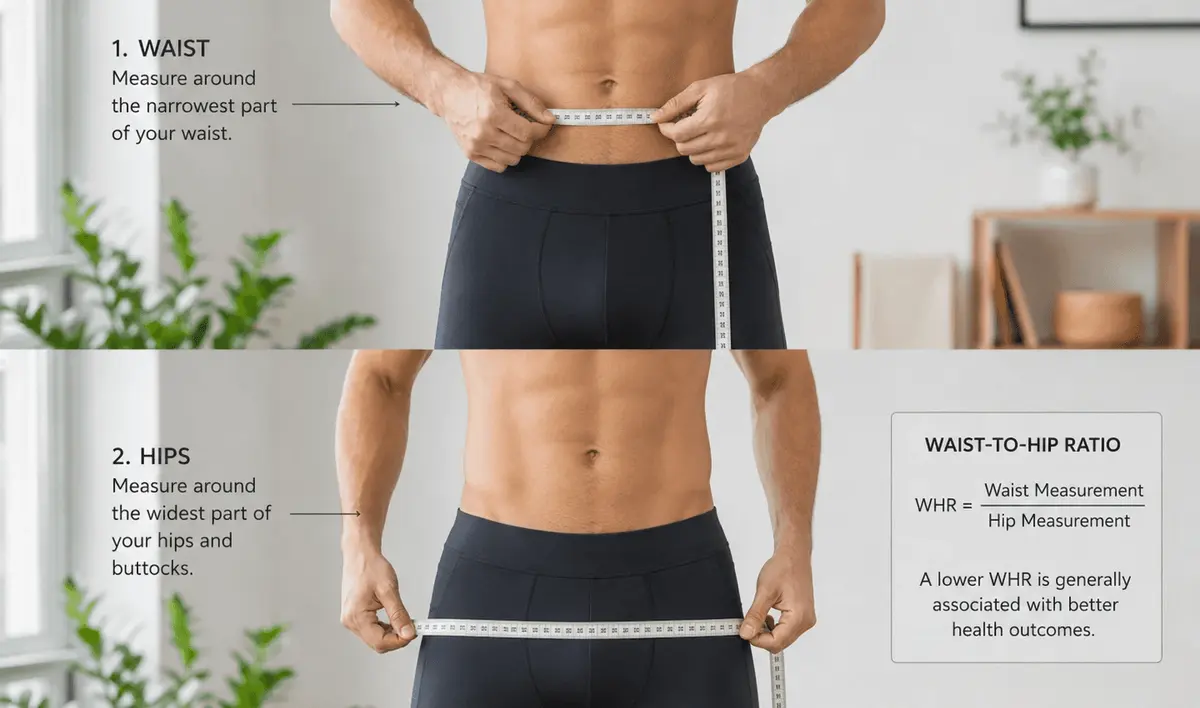
Waist to hip ratio, step by step:
- Stand up, relax, breathe out normally. No sucking in.
- Measure your waist at the narrowest point, usually just above the belly button.
- Measure your hips at the widest point around your rear.
- Divide waist by hips.
Someone with a 34 inch waist and 40 inch hips has a ratio of 0.85.
Broadly, the World Health Organization flags increased risk above about 0.90 for men and 0.85 for women. Waist circumference alone works too, with elevated risk generally starting around 40 inches for men and 35 inches for women.
Two important caveats. Thresholds vary by ancestry, and cutoffs are meaningfully lower for people of South Asian and East Asian descent. And these are population level risk markers, not verdicts on any individual person. A muscular athlete and a sedentary person can post identical BMIs while being in completely different health situations. BMI is a crude instrument. It's just a crude instrument that happens to be free.
The free tools nobody mentioned
If the point is that cheap beats expensive, here's the cheap stuff worth actually doing:
- Blood pressure. Free at most pharmacies. One of the strongest predictors in existence and completely invisible without measuring.
- A basic blood panel. Cholesterol and A1c, usually covered by insurance or cheap out of pocket. Notably, the study didn't even include these and the simple model still won.
- Validated risk calculators. The AHA's PREVENT calculator, the ASCVD Risk Estimator, and QRISK3 are free online, built on enormous datasets, and give you a real numerical risk estimate in about two minutes.
Total cost: roughly zero. Total number of saliva tubes you need to mail anywhere: also zero.
The retest problem
Here's a wrinkle that deserves more attention than it gets. These companies suggest testing every six months to track your progress.
But epigenetic clocks have real measurement noise. Run the same sample twice and you can get different answers. For some clocks, that technical wobble is large enough to rival the amount of genuine change you'd expect in half a year.
Which means the little bounce in your app might be your lifestyle overhaul working. Or it might be laboratory static wearing a costume. Without knowing a test's test-retest reliability, you can't tell the difference, and that number is rarely printed on the box.
The part that actually matters most
Something the debate keeps skipping: you can't do anything with an epigenetic age reading.
There is no treatment for a bad clock result. No doctor writes a prescription for it. The only response available to you is to change the traditional risk factors, which is to say, the exact things you could have measured directly for free.
Smoking, drinking, weight, and waist size are actionable. That's the entire difference. One set of numbers tells you where the steering wheel is. The other tells you the car feels old.
Being fair to the clocks
This study is a reality check, not a burial. Several honest limits:
The group was young for this. Everyone was 34 to 49 and healthy at the start. Clocks were often developed and validated in older adults, where disease is more common. They might perform better there.
The follow-up was short. Seven to nine years in healthy middle aged people means relatively few illnesses occurred, which makes small advantages hard to detect statistically. Clocks have shown clearer results over longer stretches and for predicting death specifically.
The group wasn't diverse. This was a homogeneous White Finnish population. Whether results transfer to other ancestries is an open and openly acknowledged gap.
Prediction isn't the same as biology. Losing a forecasting contest doesn't mean epigenetic aging is unimportant. Plenty of researchers argue the real value of the epigenome is in understanding how aging works at the mechanistic level, not in producing a better number for an app. That's a serious position and this study doesn't touch it.
Different setup, possibly different answer. Change the clocks tested, the comparison factors, or the specific disease studied, and results could shift.
Bottom line
For predicting chronic disease in middle aged adults, six pieces of information you can gather in about ten minutes beat DNA tests costing hundreds of dollars.
That could change. Clocks might prove their worth in older populations, over longer time frames, or for specific diseases. But the burden of proof sits with the people selling them, and right now that proof isn't there.
Until it is: scale, tape measure, blood pressure cuff, honest answer about the drinking. It's not as fun as an app with a graph. It's just better.
General information, not medical advice. Talk to a clinician about your own risk picture.
REFERENCES
Kostiniuk, D., Székely, F., Lyytikäinen, L. P., Ciantar, J., et al. (2026). Traditional disease risk factors outperform epigenetic clocks as predictors of non-communicable disease morbidity in a middle-aged cohort. Aging Cell, 25(7), e70626. https://doi.org/10.1111/acel.70626
Horvath, S. (2013). DNA methylation age of human tissues and cell types. Genome Biology, 14(10), R115. https://doi.org/10.1186/gb-2013-14-10-r115
Levine, M. E., Lu, A. T., Quach, A., et al. (2018). An epigenetic biomarker of aging for lifespan and healthspan. Aging (Albany NY), 10(4), 573-591. https://doi.org/10.18632/aging.101414
Lu, A. T., Quach, A., Wilson, J. G., Reiner, A. P., et al. (2019). DNA methylation GrimAge strongly predicts lifespan and healthspan. Aging (Albany NY), 11(2), 303-327. https://doi.org/10.18632/aging.101684
Belsky, D. W., Caspi, A., Corcoran, D. L., et al. (2022). DunedinPACE, a DNA methylation biomarker of the pace of aging. eLife, 11, e73420. https://doi.org/10.7554/eLife.73420
Wen, Y., Chen, Y., & Ma, Y., et al. (2025). Long-term BMI trajectories and epigenetic age acceleration: The role of genetic risk for obesity. BMC Medicine, 23(1), 589. https://doi.org/10.1186/s12916-025-04410-6
/cover-sm.webp)