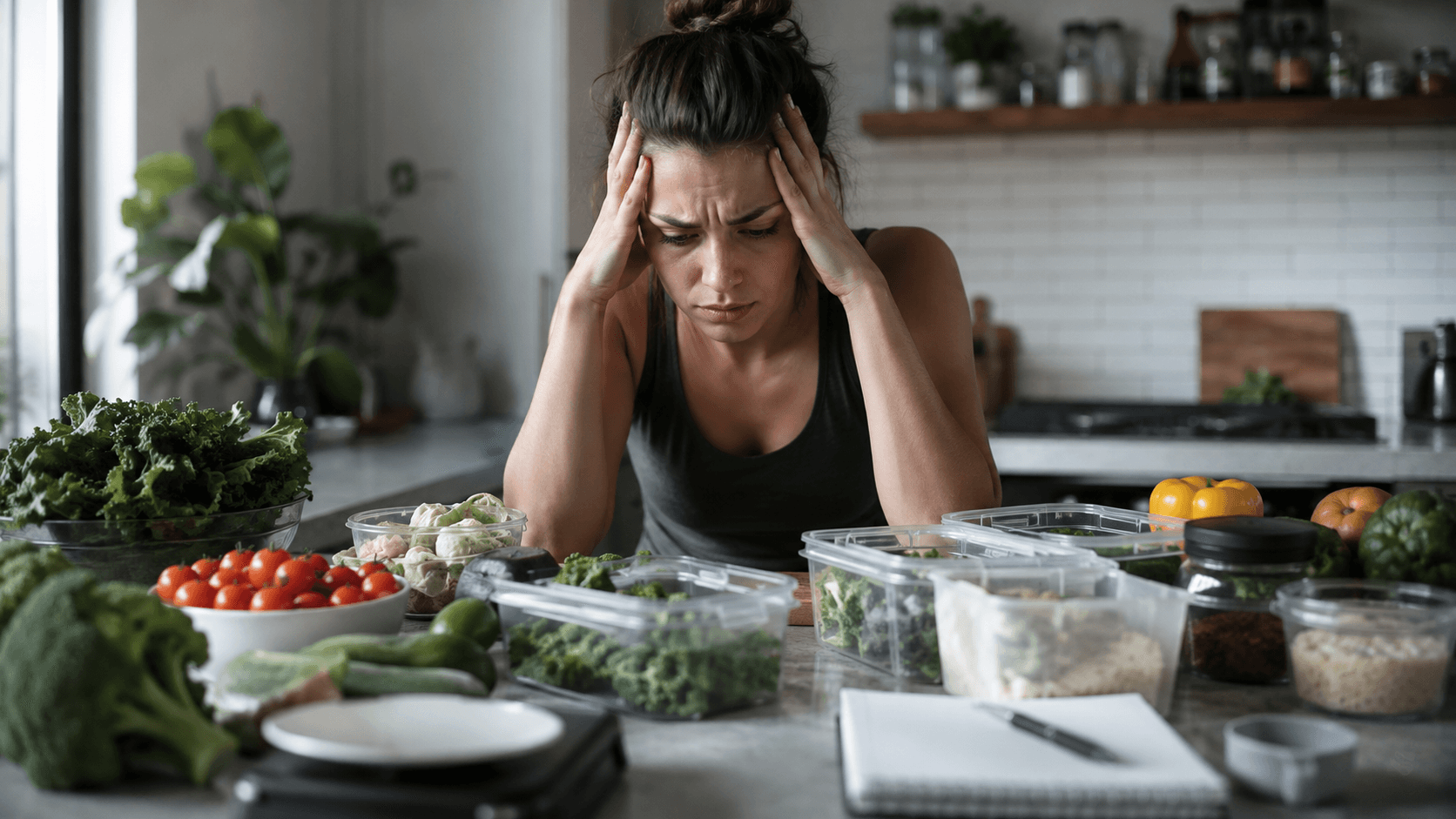
"Clean eating" sounds wholesome, doesn't it? Fresh veggies, no junk, glowing skin, a kitchen that looks like a magazine. For some people, it's a healthy, balanced way to live. But for others, the quest to eat "pure" food can quietly twist into something stressful, isolating, and even harmful.
Here's the surprising truth: the line between healthy eating and an eating problem isn't about what you eat. It's about your relationship with food.
What even is "clean eating"?
Funny enough, nobody agrees on a definition, and that's part of the problem. In general, clean eating means choosing foods seen as natural, whole, and "pure," while avoiding foods seen as fake, processed, or "toxic." But the rules are all over the place. One person bans gluten, another bans dairy, another insists on organic-only, another swears off sugar entirely.
The real difference between clean eating and normal nutrition advice is the moral spin. Foods stop being "more or less nutritious" and become "good" or "bad," "clean" or "dirty," "pure" or "poison." Suddenly, eating isn't just about health. It becomes a way to prove you're disciplined, virtuous, and a Good Person. That's a heavy load to put on a salad.
Social media poured fuel on the fire
Clean eating didn't blow up by accident. Instagram, TikTok, and Pinterest turned it into a glossy, share-worthy lifestyle, with perfect meals, supplement routines, and endless "what I eat in a day" videos. The result is a never-ending feed of beautiful food that quietly mixes up being thin, being fit, being healthy, and being morally good.
And the research shows real harm. One study of young women found that viewing clean eating and fitness content on Instagram was linked to body image issues and disordered eating, though posting it wasn't. In other words, passively scrolling may be more damaging than creating. Another study found that just five minutes of looking at clean eating content lowered people's mood.
Here's the key insight: it's not how much time you spend online, it's what you look at. Weight-loss and "perfect food" content was tied to worse body image and more binge eating, regardless of screen time. The content is the active ingredient, not the clock.
One study even found that nearly a quarter of university students showed signs of an obsession with healthy eating, and those who used image-heavy apps and followed nutrition influencers were more likely to have those tendencies.
When healthy eating becomes a disorder
There's a name for healthy eating gone too far: orthorexia nervosa. It's an unhealthy fixation on eating only foods you consider pure or healthy.
It's different from the eating disorders most people have heard of. With anorexia, the driving fear is usually about weight and body shape. With orthorexia, the obsession is about food quality and purity. A person with orthorexia doesn't necessarily want to be thin. They want to be "clean."
Orthorexia isn't yet an official medical diagnosis, and experts still debate exactly how to define it. Some research suggests it's its own distinct problem. Others argue it's really a modern, rebranded version of anorexia, where the language of "thinness" has been swapped for the language of "wellness." Either way, it's clearly causing real distress for real people.
Some groups seem more at risk. Interestingly, students studying nutrition and people in health careers tend to show higher rates, as do athletes (one study of athletes found about 30 percent showed orthorexic tendencies). Knowing a lot about food, it seems, doesn't protect you, and may sometimes feed the obsession.
The real warning signs
So when does careful eating cross into a problem? The red flags are rigidity, distress, and a life that gets smaller. Watch for:
An obsessive focus on food quality and purity
Strict, unbending food rules
Guilt or anxiety after "breaking" the rules
Social or work life shrinking because of food
That last one is telling. People with orthorexia often start turning down dinner invitations, avoiding restaurants, and feeling intense anxiety when they can't control how food is prepared. The world quietly narrows down to what's "allowed." Research has linked orthorexia to higher stress, anxiety, depression, and health worry. The pursuit of perfect health ends up harming actual health.
⚠️ If food rules are causing you guilt, isolation, or anxiety, that's worth real support — not a stricter diet.
Orthorexia isn't yet a formal DSM diagnosis, but it's a real pattern with real consequences: rigid food rules, guilt after "breaking" them, social isolation, and downstream physical effects from over-restriction. If you recognize yourself in the warning signs above — especially the shrinking social life or the inability to eat anything you didn't prepare — reach out before it tightens further.
National Alliance for Eating Disorders helpline — 1-866-662-1235 (Monday-Friday, staffed by licensed clinicians)
A therapist trained in eating disorders — find one through Psychology Today's directory or by asking your primary care doctor for a referral
Healthy eating doesn't require purity. The relationship with food matters as much as the food itself.
One group of researchers put it memorably: orthorexia isn't just an individual problem. It's a symptom of an "orthorexic society," one that constantly tells us our food choices reflect our worth.
The paradox: good nutrition really does matter
Here's the tricky balance. Eating well genuinely helps your body and your mind. A review of many trials found that improving diet quality can reduce depression symptoms. Diets rich in fruits and veggies and low in added sugar are linked to lower anxiety.
But the relationship isn't a straight line where "more obsession equals more health." It's more like a curve. Too little care about food can hurt you. But too much care, the rigid, anxious, guilt-soaked kind, hurts you in a different way. It trades nutrition for stress, flexibility for fear, and shared meals for isolation.
The bottom line
Clean eating sits at a messy crossroads of real nutrition science, social media hype, food morality, and personal vulnerability. Balanced, flexible healthy eating is a wonderful thing. But when food rules become rigid, when meals trigger guilt and anxiety, when eating becomes a moral test, and when chasing "purity" starts shrinking your life, that's when clean eating has quietly become a problem.
The healthiest plate isn't the "purest" one. It's the one you can enjoy without fear, share with people you love, and not lose sleep over. Food is fuel and pleasure and connection, not a final exam on your character.
This article is for general education and isn't medical advice. Eating disorders, including orthorexia, are serious mental health conditions — and they can affect anyone regardless of body size, gender, or food knowledge. If your relationship with food is causing distress, isolation, or rigid rules that are shrinking your life, please reach out: the National Alliance for Eating Disorders helpline (1-866-662-1235) is staffed by licensed clinicians, and a therapist trained in eating disorders can help. Healthy eating includes flexibility and enjoyment — that's not weakness, it's actually part of what makes it sustainable.
HSA/FSA Eligible
Doctors Are Human.
That's Why There's Medome.
Start your free trial today. No credit card required.
Start Your Free Trial
Join thousands protecting their health with AI that never forgets
Critical details get missed when your health information is scattered. Medome connects the dots across your complete record.
Start Your Free Trial
Quick Links
Medome Men
Home
Pricing
About
Health News
HealthSigns
FAQ
Contact Us
Terms of Service
Privacy Policy
Get In Touch
Email: service@medome.ai
Phone: (617) 319-6434
This is Dr. Steven Charlap’s cell. Please text him first, explaining who you are and how he can help you. Use WhatsApp outside the US.
Hours: Mon-Fri 9:00AM - 9:00PM ET