Here is a riddle: What if we told you that more than 370,000 Americans die every single year from causes that we already know how to prevent? Not from mysterious new diseases, not from conditions we haven’t figured out yet, but from things we have the tools, the knowledge, and the medicine to stop before they ever start. A 2017 study published in the American Journal of Preventive Medicine put the number at 372,054 preventable deaths annually, two thirds of them from heart disease and cancer. Let that sink in. That’s the entire population of New Orleans, gone every year, and we mostly just shrug.
Welcome to American healthcare, where we are extraordinarily good at treating you once you’re already falling apart, and surprisingly bad at keeping you from falling apart in the first place.
Picture a bathtub overflowing onto the bathroom floor. Now picture two approaches to fixing this problem. The first person grabs every towel in the house, mops frantically, calls a water damage company, and replaces the warped floorboards. The second person walks over and turns off the faucet.
American medicine is very, very good at the towels. It has built an entire economy around them.
Primary prevention, which just means stopping disease before it happens, accounts for somewhere between 2.7 and 3.5 percent of total healthcare spending in this country, according to research published in The Lancet. Think about that the next time you hear someone say we have the greatest healthcare system in the world. We spend nearly nothing trying to keep people healthy, and then we spend everything trying to rescue them once they aren’t.
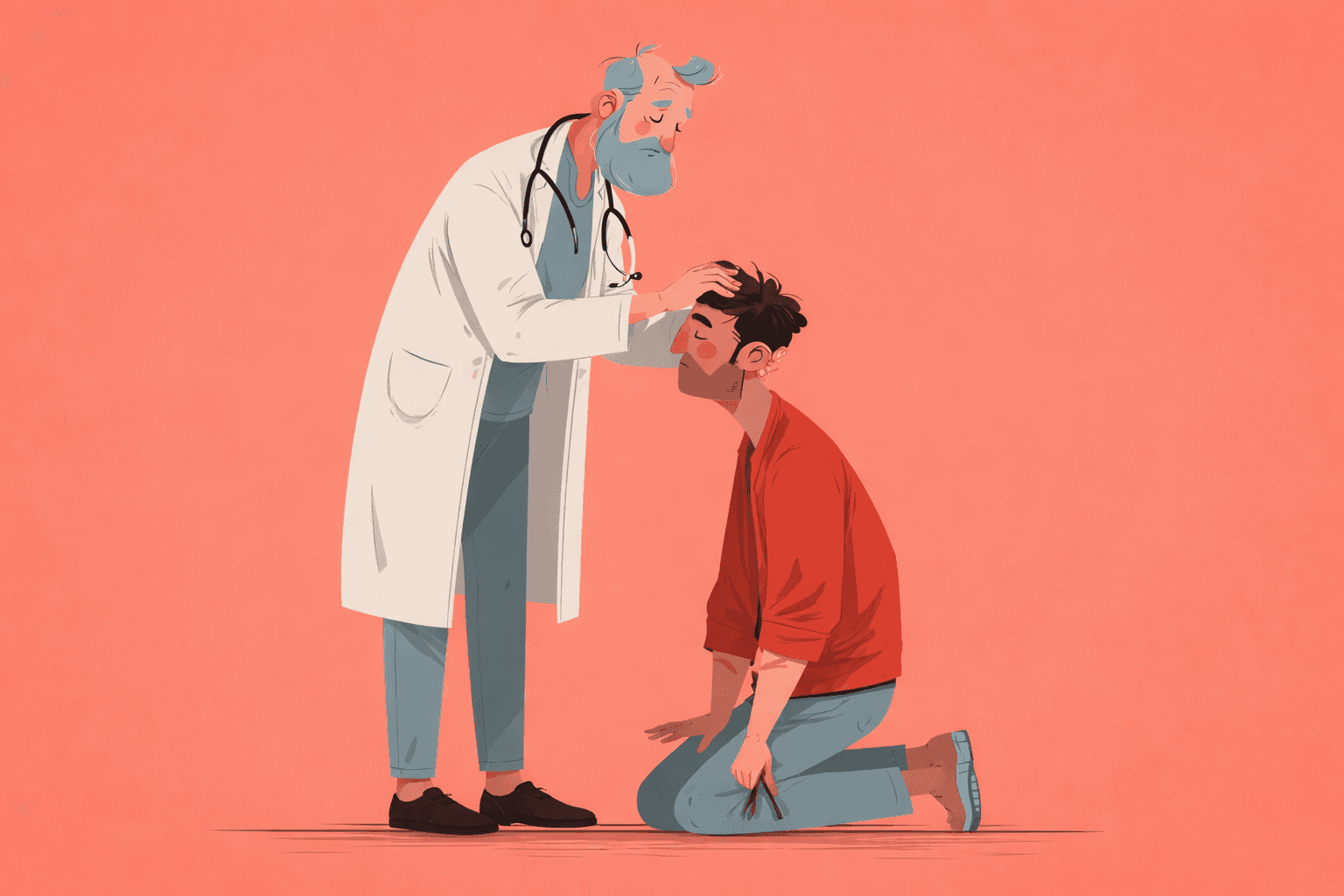
The doctor will see you now. But mostly only after something has gone wrong.
Here is something that will make you feel bad for your family doctor, who is probably a genuinely good person drowning in an impossible job. Researchers writing in JAMA Network Open calculated that if a primary care physician wanted to deliver every recommended preventive service to a standard patient panel, it would take seven hours per day, devoted to prevention alone, on top of everything else they already do. Seven hours. The average primary care visit lasts about fifteen minutes.
Your doctor is not ignoring prevention because they don’t care. They are ignoring it because they are seeing twenty five patients a day, dealing with insurance paperwork, managing three chronic conditions per patient, and trying not to cry in the supply closet. A 2022 piece in the Journal of the American Medical Association pointed out that for a physician managing 2,500 patients, meaningful preventive counseling is essentially a mathematical impossibility under the current system.
The system was not built for prevention. It was built for sick people. There is a reason we don’t call it a health system. We call it a healthcare system, and the care only really kicks in when your health is already leaving the building.
Now for the part that should make everyone furious, because we actually know what works. The research is not ambiguous. The results are not complicated. Prevention saves lives at a scale that is almost hard to believe, and we are largely choosing not to do it.
Take heart disease. A 2024 Scientific Statement from the American Heart Association, published in Circulation: Cardiovascular Quality and Outcomes, found that a full quarter of cardiovascular deaths in this country could be avoided if we simply addressed modifiable risk factors through lifestyle changes and medication. One in four. That’s not a rounding error. That is hundreds of thousands of people walking around, going to their grandchildren’s birthday parties, finishing books they started, living lives they would otherwise not have had.
Or consider diabetes, which affects tens of millions of Americans and cost the country $327 billion back in 2017 alone, according to Diabetes Care. Lifestyle modification programs for people with prediabetes, the stage before full diabetes develops, are among the most cost effective medical interventions ever studied. The cost per quality adjusted life year gained runs around $1,500. For context, we routinely approve cancer drugs that cost tens of thousands of dollars per quality adjusted life year without blinking.
Sodium. Let’s talk about sodium for a second, because it sounds boring and the numbers are anything but. Research cited in a 2011 American Heart Association policy statement in Circulation found that reducing average dietary sodium intake to 1,500 milligrams per day would save $26.2 billion in healthcare costs annually. Every year. From salt. And we haven’t done it.
A 40 percent tax increase on cigarettes, according to the same research, would generate $682 billion in total cost savings by 2025 through reduced smoking rates and their downstream health consequences. Smoke free air laws alone would save $10 billion per year in healthcare costs. These are not controversial scientific findings tucked away in obscure journals. They are sitting in the open, waiting for someone to act on them.
The argument against investing in prevention usually involves money. Prevention costs money upfront. The savings come later. Insurers and employers don’t want to pay for interventions today whose benefits might show up in someone else’s budget five years from now. It’s a genuinely messy problem.
But the scale of inaction’s cost is almost incomprehensible. A 2018 study in PLoS ONE calculated that noncommunicable diseases will impose a $94.9 trillion economic burden on the United States between 2015 and 2050. That works out to the equivalent of a 10.8 percent annual tax on the entire economy, every year, for thirty five years. That’s not a healthcare statistic. That’s a civilization level problem wearing a stethoscope.
Meanwhile, the return on investment for prevention programs is striking. Community based prevention programs return $5.60 for every dollar spent within five years. Worksite wellness programs generate $3.27 in medical cost savings within twelve to eighteen months, plus another $2.73 in reduced absenteeism per dollar invested. Building bike and pedestrian trails returns nearly three dollars in medical savings per dollar of construction cost.
A 2010 study in the American Journal of Public Health found that a modest five percent reduction in diabetes and hypertension prevalence would save $9 billion annually in the near term, rising to $24.7 billion per year as downstream complications declined. Five percent. That is not a moonshot. That is the kind of number you get from taking prevention seriously for a few years.
The math here is not close. It is not even in the same neighborhood as close. Prevention pays. We are choosing not to do it anyway, because the American healthcare economy is organized around treatment, treatment pays better in the short term, and changing that requires the kind of coordination that makes everyone uncomfortable.
The System That Wasn’t Built for You
To understand why prevention gets so little attention, you have to understand how the medical system grew up. Most developed countries, after a landmark 1920 British report called the Dawson Report, built their health systems around primary care as the foundation. The United States looked at that model and decided to organize everything around hospitals and specialists instead, which is a little like designing a city entirely around its emergency rooms.
Researchers writing in BMC Public Health back in 2003 described how primary care physicians see themselves as one stop shops whose practice is dominated by what they called secondary and tertiary care, meaning diagnosis, treatment, and damage control. The expectation from patients, from insurers, from the entire cultural framework of medicine, is that you come in sick and leave with a fix. Prevention is what happens in the waiting room poster nobody reads.
Medicare, the insurance program for seniors who need prevention most urgently, only recently began covering preventive services and annual wellness visits at no cost. Before that, many older Americans were paying out of pocket for the privilege of being told to exercise more.
And despite the Affordable Care Act’s expansion of coverage, a study in JAMA Internal Medicine found that the proportion of insured adults who couldn’t afford to see a physician actually increased from 7.1 percent to 11.5 percent between 1998 and 2017. We expanded coverage. Access got worse. The system finds a way.
What Turning the Faucet Off Actually Looks Like
The good news, and there is genuine good news here, is that we know what a better system looks like. Team based care, where nurses, pharmacists, dietitians, community health workers, and behavioral health professionals share the prevention workload with physicians, shows the strongest evidence for actually increasing preventive service delivery. A 2024 systematic review in BMC Medicine found that multicomponent team based interventions improved preventive care delivery with an odds ratio of 3.10. That’s not a small effect.
Community health workers, often people from the same neighborhoods and backgrounds as the patients they serve, have proven especially powerful at improving cardiovascular risk factors and reducing health disparities in underserved communities, according to a 2023 American Heart Association scientific statement in Circulation.
Artificial intelligence tools are beginning to show real promise too, including an AI powered diabetes prevention program published in JAMA in 2025 that proved noninferior to traditional human coaching, while reaching far more patients through sheer accessibility. Given that only three percent of Americans with prediabetes currently participate in any diabetes prevention program, scale matters enormously.
None of this requires inventing something new. It requires deciding that keeping people healthy is worth organizing a system around.
The United States spends more on healthcare than any other nation on earth, and gets middling results by nearly every international measure. We have brilliant physicians, miraculous surgical techniques, and pharmaceutical innovations that border on science fiction. We just forgot, somewhere along the way, to turn off the faucet.
More than 372,000 people will die this year from conditions we know how to prevent. The quarter of cardiovascular deaths that don’t have to happen will happen anyway. The $26 billion we could save by shaking the salt shaker a little less gently will not be saved. Not because the science is unclear. Not because we lack the tools. But because we built a system that makes far more money treating the flood than preventing it.
The doctor will see you now. Try not to get sick in the meantime.
HSA/FSA Eligible
Doctors Are Human.
That's Why There's Medome.
Start your free trial today. No credit card required.
Start Your Free Trial
Join thousands protecting their health with AI that never forgets

Critical details get missed when your health information is scattered. Medome connects the dots across your complete record.
Start Your Free Trial
Get In Touch
Email: service@medome.ai
Phone: (617) 319-6434
This is Dr. Steven Charlap's cell. Please text him first, explaining who you are and how he can help you. Use WhatsApp outside the US.
Hours: Mon-Fri 9:00AM - 9:00PM ET