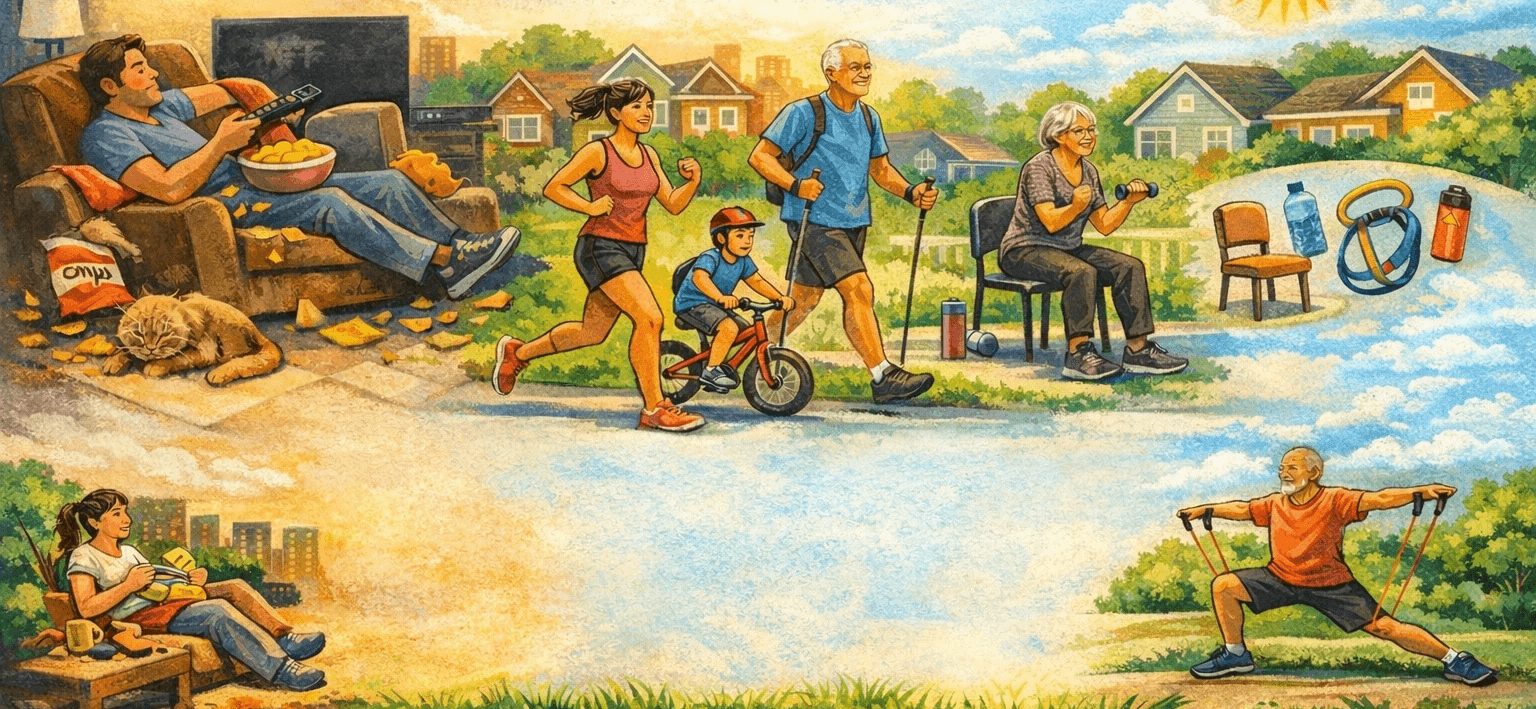
The Ultimate At-Home & Neighborhood Exercise Guide
For Every Age, Ability, and Excuse
PART 1: THE BASICS
Chapter 1: Why Bother Moving?
Because your couch is not a gym, no matter how much time you spend on it.
Let's be honest. Getting off the couch is hard. Netflix is right there. The chips are within arm's reach. Your body has perfected the art of staying perfectly still. And yet, here you are, reading an exercise guide. That already makes you a champion.
Here is the thing: your body was built to move. Think of it like a car. Leave a car parked in the driveway for six months and it starts falling apart. Same goes for you. The good news? Even a little movement goes a very long way.
🤩 Mind-Blowing Fact: People who exercise just 75 minutes per WEEK have significantly lower death rates than people who do nothing. That is roughly 11 minutes a day. You spend more time than that looking for the TV remote. |
What Exercise Actually Does For You
Exercise is like a magic pill that does not come in pill form. It cuts your risk of dying early by about 30 to 40 percent. It lowers blood pressure, improves blood sugar, strengthens bones, sharpens your brain, lifts your mood, helps you sleep, and makes you more fun at parties.
Exercise builds two kinds of fitness you need:
• Aerobic fitness (cardio): Makes your heart and lungs work well. Think walking, jogging, swimming, and dancing.
• Anaerobic fitness (strength training): Builds muscle and keeps bones strong. Think push-ups, squats, and resistance bands.
You need both. Not one or the other. Both. Like peanut butter and jelly. Like socks and shoes. Like you and exercise.
"You do not have to be great to start, but you have to start to be great." -- Les Brown |
Minimum Exercise Requirements by Age
Age Group | Aerobic (Cardio) | Strength Training | Balance/Flexibility |
Ages 3 to 5 | Active throughout the day | Through active play | Through active play |
Ages 6 to 17 | 60 minutes daily | 3 days/week | Daily through activity |
Ages 18 to 64 | 150 to 300 min/week moderate OR 75 to 150 min vigorous | 2+ days/week | Encouraged |
Ages 65+ | Same as 18 to 64 (adjust for ability) | 2+ days/week | 3 days/week -- REQUIRED |
💡 Good News: Exercise goals do NOT change based on gender. Men and women need the same amounts. Women are somewhat less likely to meet these goals, which means this guide is especially important. |
Chapter 2: Equipment You Actually Need
Great news: you do not need a fancy gym membership, a personal trainer named Chad, or equipment that looks like a medieval torture device. Most exercises in this guide cost nothing or very little.
Free Equipment (Already in Your Home)
• A Sturdy Chair -- one without wheels. Use it for seated exercises and standing support.
• A Wall -- perfect for wall push-ups, balance support, and stretching.
• Your Stairs -- step-ups, stair climbing, and calf raises.
• Your Floor -- stretches, push-ups, core work, and yoga.
• A Doorway -- doorframe stretches and hanging resistance work.
• Supportive Shoes -- any walking or athletic shoe with ankle support.
Low-Cost Equipment Worth Buying
• Resistance Bands ($10 to $20): A set of 3 (light, medium, heavy). Replace dumbbells for most exercises.
• Yoga/Exercise Mat ($15 to $25): Protects your knees and back on hard floors.
• Ankle/Wrist Weights ($10 to $25): Cuff weights 1 to 5 lbs. Great for seniors and strength work.
• Water Bottles (FREE): Two matching water bottles make great light dumbbells. Bonus: hydration.
• Phone Timer (FREE): Your phone already has one. Use it for interval training.
💡 Resistance Band Pro Tip: Studies show resistance bands produce the same strength gains as gym machines. They are portable, affordable, and they do not judge you when you take a week off. |
Chapter 3: How Hard Should You Work?
There is a sweet spot between 'napping' and 'requiring medical attention.'
The Talk Test: The Simplest Rule Ever
• Moderate intensity: You can talk but you cannot sing. If you can belt out a full chorus, speed up. If you cannot say a single word, slow down.
• Vigorous intensity: You can say a few words but need to catch your breath between sentences.
The Borg Scale: Giving Your Effort a Number
The Borg Scale rates exercise effort from 6 (sitting still) to 20 (maximum effort). Aim for 12 to 14 for most sessions.
Score | Level | What It Feels Like |
6 to 9 | Very Light | Basically resting |
10 to 11 | Light | Easy stroll |
12 to 14 | Moderate (TARGET) | Slightly breathless, can talk |
15 to 17 | Hard | Definitely working |
18 to 20 | Maximum | Cannot speak |
⚠️ IMPORTANT for Heart Patients and Diabetics: If you take beta-blocker medications (like metoprolol or atenolol), they slow your heart rate. Do NOT use target heart rate. Use the Borg Scale or the Talk Test instead. |
Heart Rate Targets
Your target heart rate for moderate exercise is 50 to 70 percent of your maximum heart rate.
220 minus your age = estimated maximum heart rate
Example: Age 50 means max of 170 BPM. Moderate zone: 85 to 119 BPM. Vigorous zone: 119 to 153 BPM.
💡 Breathing Rule: Never hold your breath during strength training. Exhale on the hard part (lifting/pushing). Inhale on the easy part (lowering). Holding breath spikes blood pressure. |
Chapter 4: Safety First, Stretcher Never
Warm up, cool down, and listen to your body. Your body is usually right.
Before Every Workout
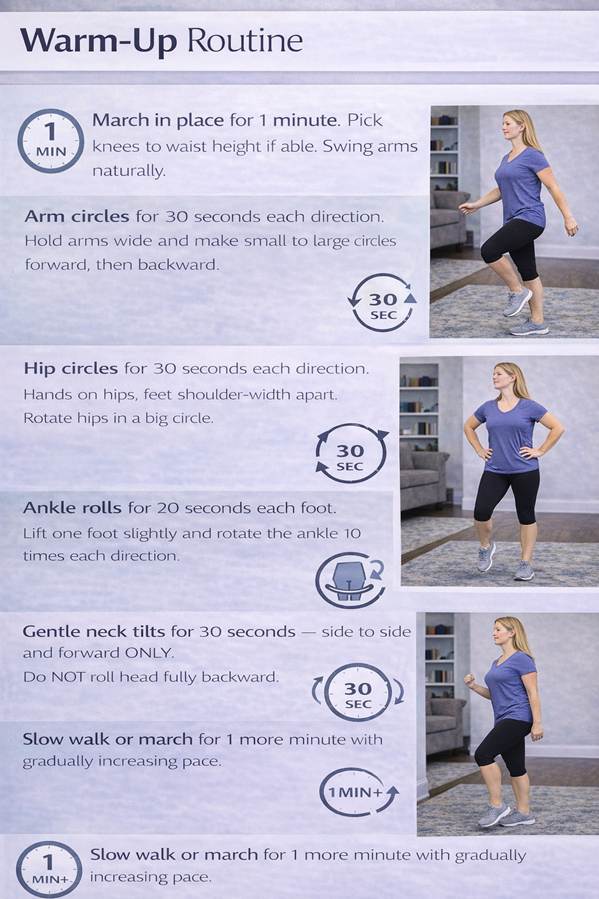
• Warm up for 5 minutes -- walk slowly, march in place, or do gentle arm circles.
• Drink water before you start.
• Clear your exercise space of rugs, cords, toys, and pets. Your dog loves you but is a fall hazard.
• Wear supportive, non-slip shoes. Socks on hardwood floors count as a high-risk sport.
• Tell someone where you are if exercising outdoors alone, especially seniors.
🚨 STOP EXERCISING AND CALL FOR HELP IF YOU FEEL: Chest pain, pressure, or tightness. Pain spreading to your arm, jaw, or neck. Severe shortness of breath. Dizziness or fainting. Irregular or racing heartbeat. |
After Every Workout
• Cool down for 5 minutes. Walk slowly, stretch gently. Stopping suddenly drops blood pressure fast.
• Stretch while muscles are still warm. Hold each stretch 10 to 30 seconds. Do not bounce.
• Drink more water.
• Note how you feel. Exhausted for hours means too much. Energized means perfect.
The 5-Minute Universal Warm-Up
Chapter 5: Medications and Exercise
⚠️ Always check with your doctor before starting a new exercise program if you have a chronic condition or take daily medications. This guide is educational, not a medical prescription. |
Medication Type | Common Examples | Effect on Exercise | What to Do |
Beta-Blockers | Metoprolol, Atenolol | Slows heart rate; will NOT reach normal target zones | Use Borg Scale (12 to 14) instead of heart rate |
ACE Inhibitors / ARBs | Lisinopril, Losartan | Can cause first-dose dizziness | Cool down slowly. Take time standing up after exercise. |
Diuretics | Furosemide, HCTZ | Increase dehydration and electrolyte loss | Hydrate extra well. Exercise in cooler conditions. |
Insulin and Diabetes Meds | Metformin, Insulin | Exercise lowers blood sugar; hypoglycemia risk | Check blood sugar before/after. Carry fast sugar snack. |
Blood Thinners | Warfarin, Eliquis | Increased bleeding risk from falls | Avoid high-fall-risk activities. Focus on balance training. |
Statins | Atorvastatin, Rosuvastatin | Rare: muscle pain during exercise | Report new unexplained muscle pain to doctor. |
Corticosteroids | Prednisone | Long-term use weakens bones and muscles | Weight-bearing and resistance exercise is especially important. |
Antidepressants | SSRIs, some antipsychotics | Fatigue or heat sensitivity | Exercise in cooler conditions. Start slowly. |
💡 Low Blood Sugar Warning Signs: Shaking, sweating, anxiety, sudden weakness, confusion, fast heartbeat. Stop, sit down, take 15g fast sugar (4 glucose tablets or 4 oz juice). Wait 15 minutes. |
PART 2: BY AGE GROUP
Chapter 6: Little Movers -- Ages 3 to 5
🌟 Goal: Keep them physically active throughout the entire day to support brain development, bone growth, and healthy habits for life. |
The good news about 3 to 5-year-olds: they have no idea what exercise is and they do not care. They just want to run, jump, climb, and be chaotic. That chaos IS their workout. Your job is to give them space, safe surfaces, and maybe participate before they outrun you entirely.
What Counts as Exercise for Preschoolers
Everything counts. Running in the yard. Chasing the dog. Dancing to their favorite song. Riding a tricycle. Playing tag. Throwing a ball. Climbing at the playground. All of it is exactly what the science recommends.
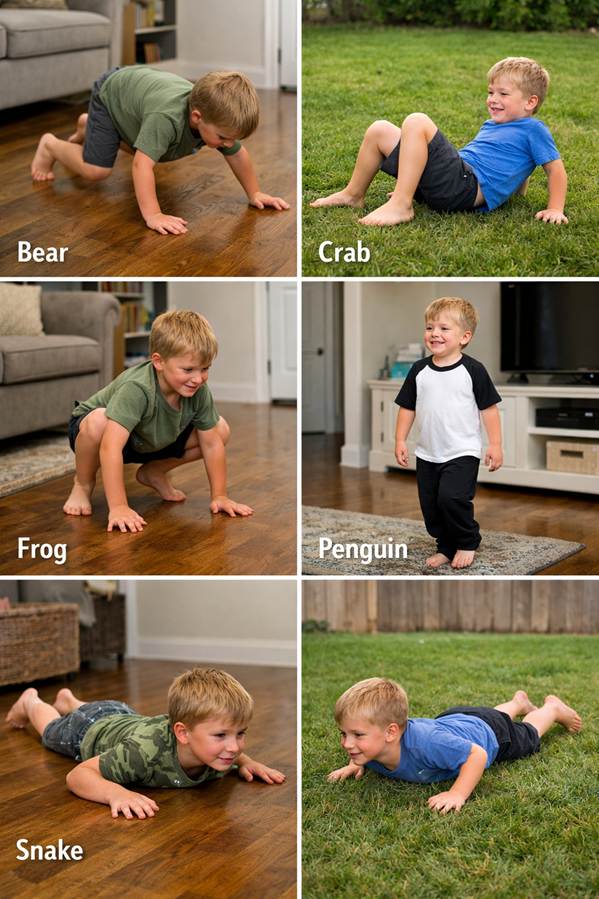
The Animal Walk Adventure
Sample Active Day: Ages 3 to 5
Sample Active Day | All Day |
Morning | Active Wake-Up (10 min): Stretch like a cat. March around the house. Jump 10 times. |
Mid-Morning | Outdoor Play (30 min): Sidewalk chalk games, tricycle, running in the yard, or playground time. |
After Lunch | Indoor Dance Party (15 min): Dance to 3 to 4 favorite songs. Wiggle, jump, spin, collapse laughing. |
Afternoon | Active Play (30 min): Ball games, tag, Simon Says with movements, or animal walks. |
Evening | Family Walk (15 to 20 min): Walk around the neighborhood. Count dogs, birds, or red cars. |
Children who are active from ages 3 to 5 build lifelong habits. You are not just playing with them -- you are changing the course of their health for the next 80 years. |
Chapter 7: Kids and Teens -- Ages 6 to 17
🎯 Goal: 60 minutes of moderate to vigorous activity daily. At least 3 days/week should include vigorous activity AND muscle-strengthening AND bone-strengthening activities. |
The secret about kids and exercise: they do not need a structured workout routine. They need fun physical activities that challenge their bodies. Move the body, then watch the screens. That is the deal.
Bone-Building Is a Once-in-a-Lifetime Opportunity
Bones build their maximum density during childhood and teenage years. After about age 30, you cannot build more bone -- only maintain or lose it. Running, jumping rope, basketball, gymnastics, and dance are especially good for bone building.
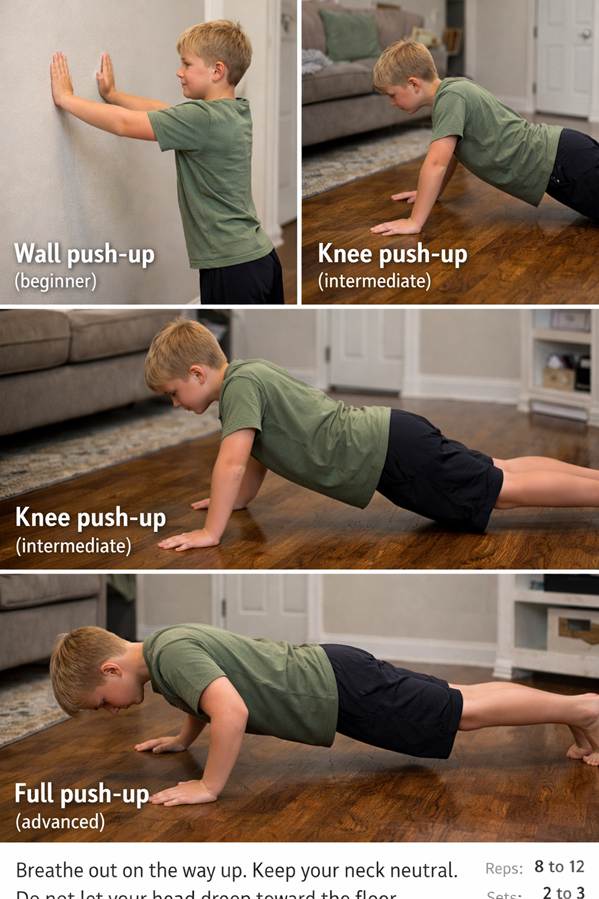
Push-Up Variations
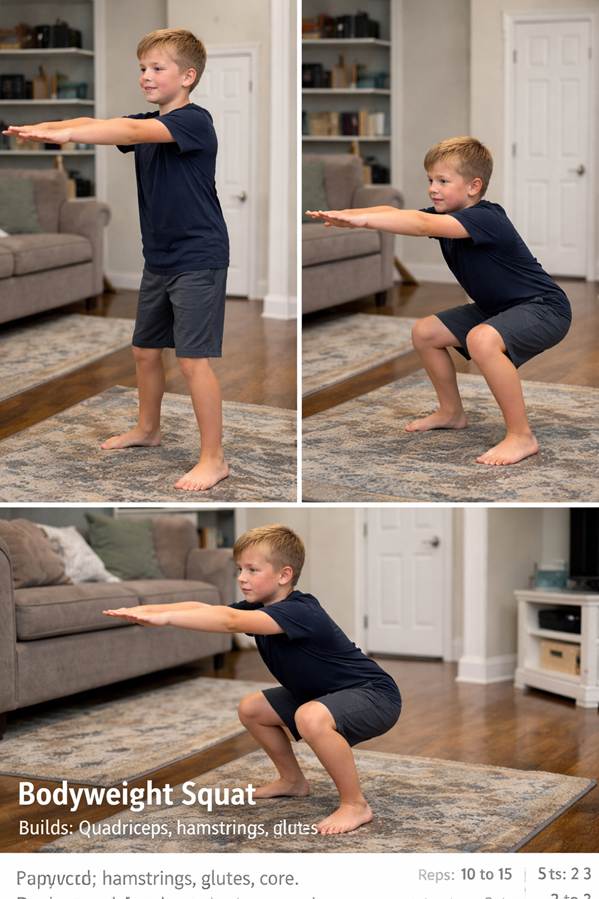
Bodyweight Squat
Sample Weekly Plan: Ages 6 to 17
Weekly Plan | 60 min/day |
Monday | Active Play: Bike ride (30 min) + push-ups, squats, jumping jacks (15 min) + stretching (15 min) |
Tuesday | Vigorous Cardio: Running, jump rope, or sports for 60 min. Running is both aerobic AND bone-strengthening. |
Wednesday | Strength Focus: Push-ups, squats, lunges, plank holds (30 min) + neighborhood walk (30 min) |
Thursday | Fun Activity: Dance, martial arts, swimming, or any sport for 60 min. |
Friday | Mixed: 30 min outdoor play + 15 min body weight exercises + 15 min yoga or stretching |
Weekend | Active Family Time: Hike, bike, swim, or sports. Memories get made AND bones get built. |
Chapter 8: Adults -- Ages 18 to 64
🎯 Goal: 150 to 300 min/week moderate cardio OR 75 to 150 min/week vigorous cardio, PLUS strength training 2+ days per week targeting all major muscle groups. |
The average adult spends 6 to 8 hours sitting each day. You can break exercise into 10-minute chunks throughout the day and get the same benefit as one longer session. Science confirmed it. You are welcome.
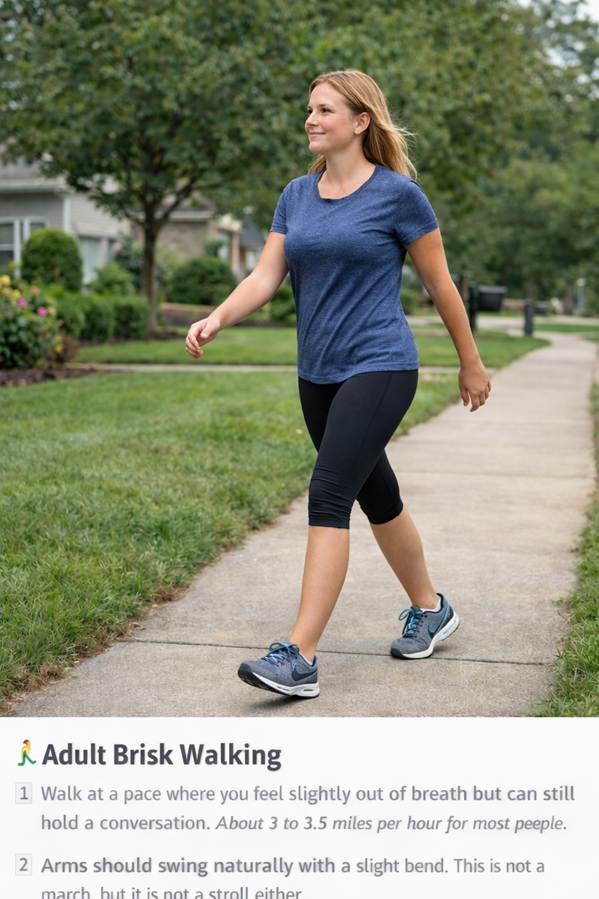
Brisk Walking -- Your Best Starting Exercise
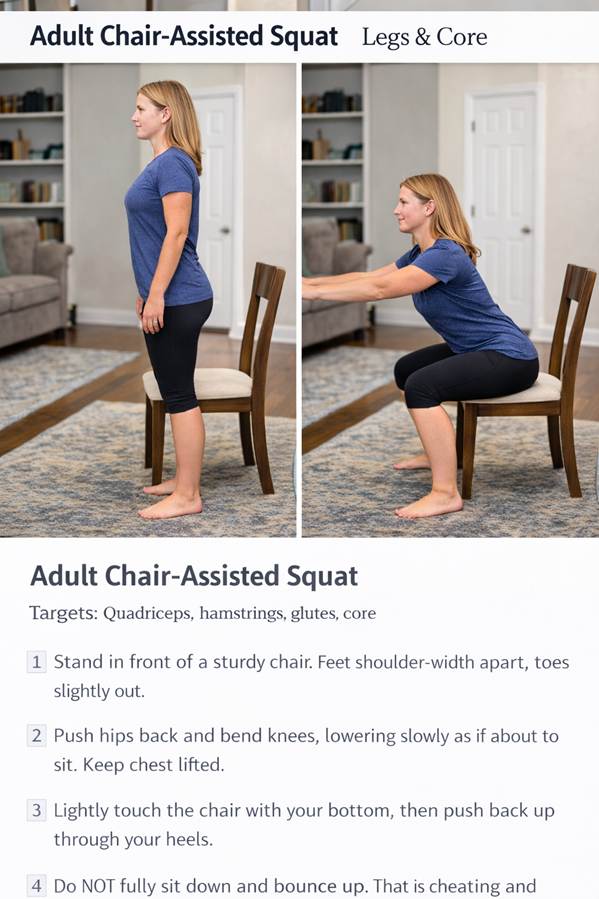
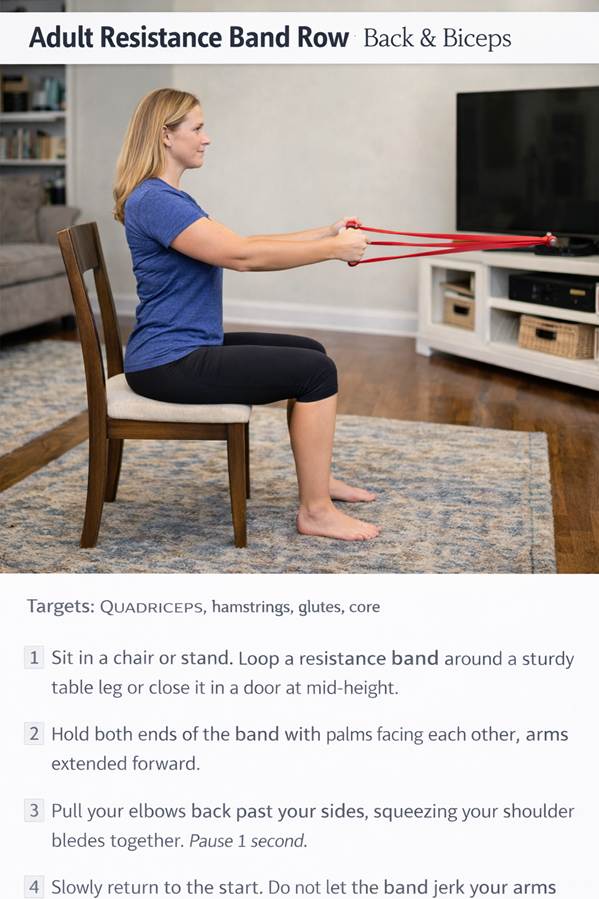
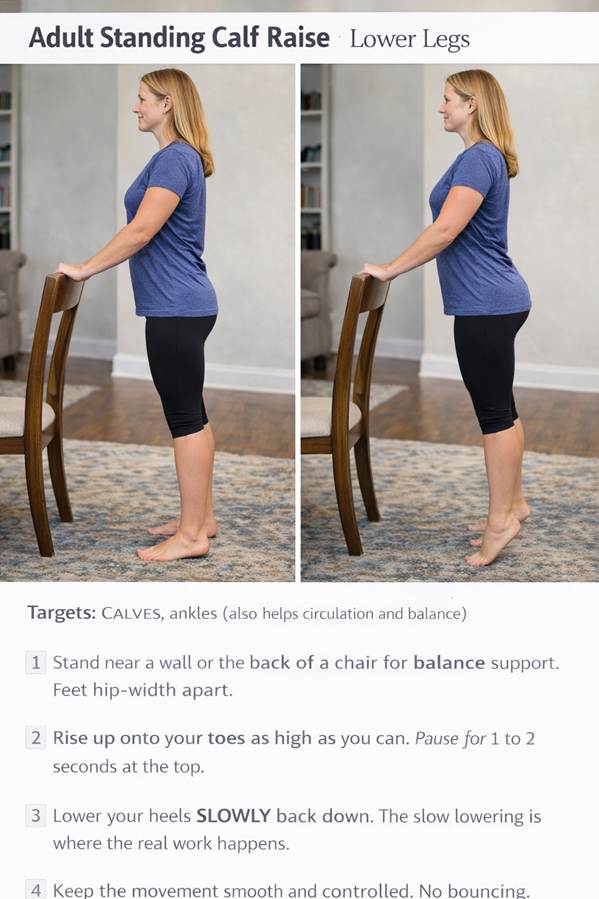
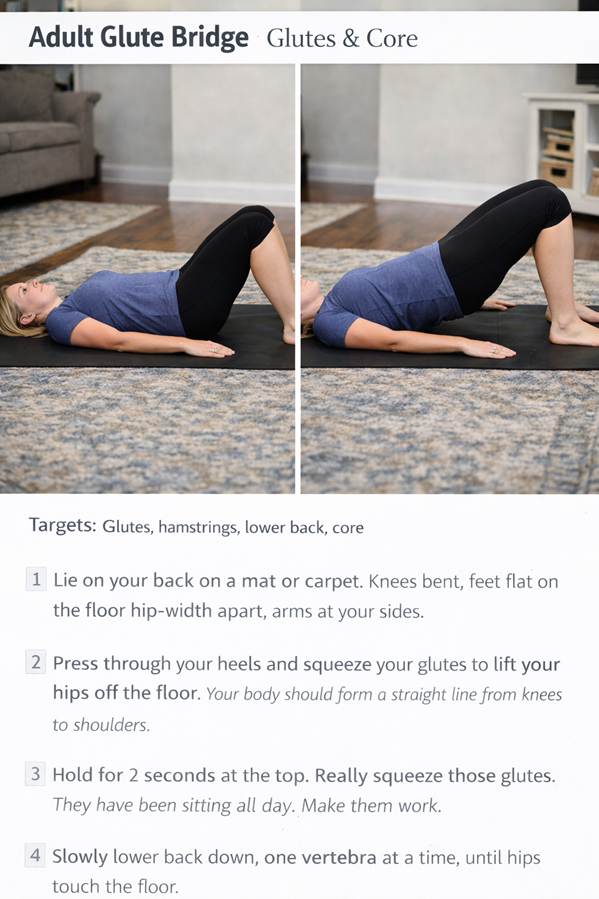
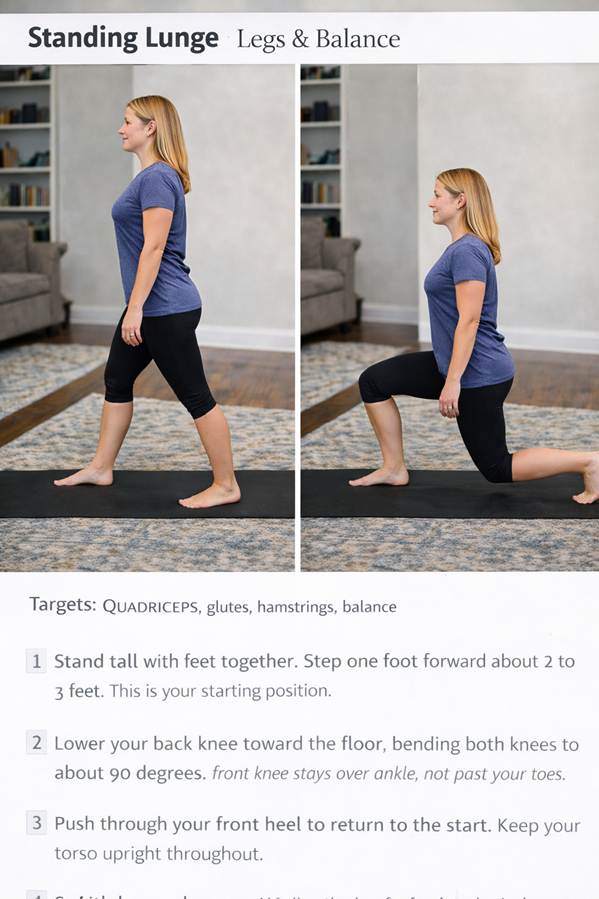
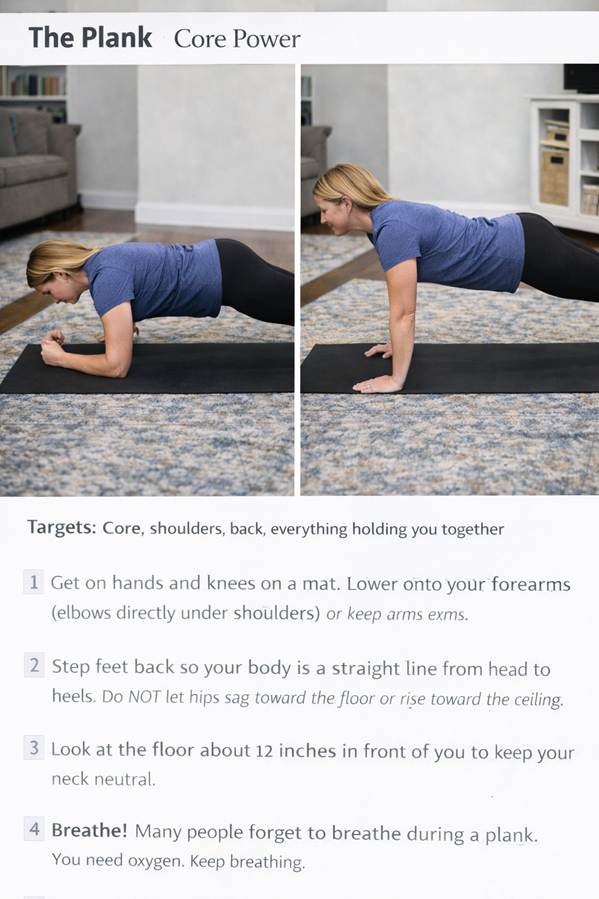
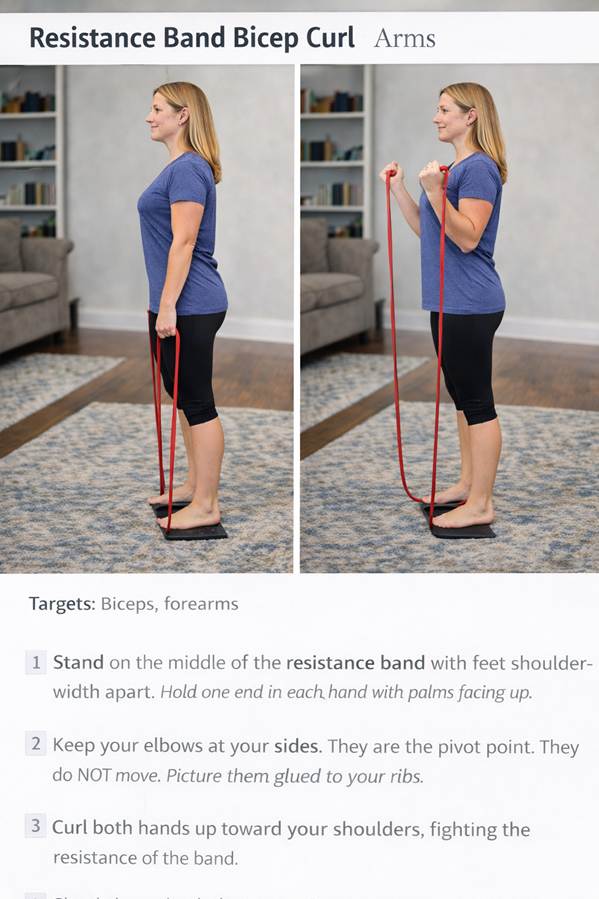
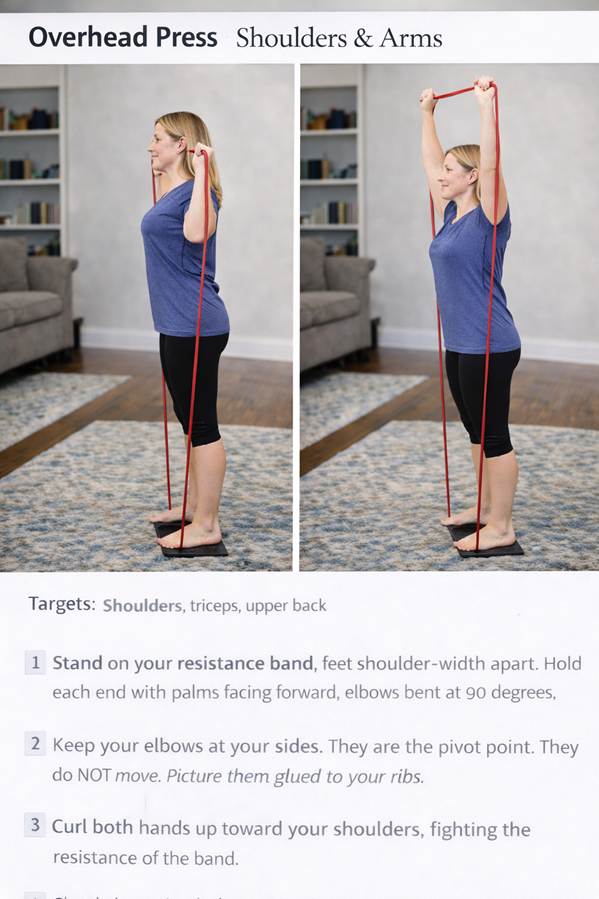
The Essential 8: Home Strength Exercises
Busy Adult Weekly Plan
Weekly Plan | 30 min average |
Monday | Strength (30 min): Warm up 5 min. Squats 3x12, Push-ups 3x10, Plank 3x30 sec, Glute Bridge 3x12. Cool down 5 min. |
Tuesday | Brisk Walk (30 min): Neighborhood walk. Moderate pace. Music only -- no calls that make you walk slower. |
Wednesday | Strength (30 min): Band Row 3x10, Bicep Curl 3x12, Overhead Press 3x10, Calf Raises 3x15, Lunges 2x10 each. |
Thursday | Cardio Mix (30 min): 10 min walk + 10 min bike or jog + 10 min cool-down walk. |
Friday | Full Body Strength (30 min): Repeat Monday routine. Your body will remember it. |
Saturday | Longer Activity (45 to 60 min): Hike, bike, swim, yard work, or dance. This counts. All of it counts. |
Sunday | Active Rest: Gentle stretching, yoga, or slow walk. Let muscles recover. They earned it. |
Chapter 9: Active Aging -- Adults 65 and Up
🎯 Goal: Same aerobic goals as younger adults PLUS balance and strength training at least 3 days per week. Balance training is not optional at this age -- it is medicine. |
Falls are the leading cause of injury in older adults. One in four adults over 65 falls every year. The right exercises reduce fall risk by 23 to 35 percent. You have more control over this than you think.
The Otago Program: Proven Fall Prevention
The Otago Program reduced falls by 35 percent in clinical trials. It uses a chair, cuff weights, and clear floor space -- and progressively builds difficulty as you get stronger.
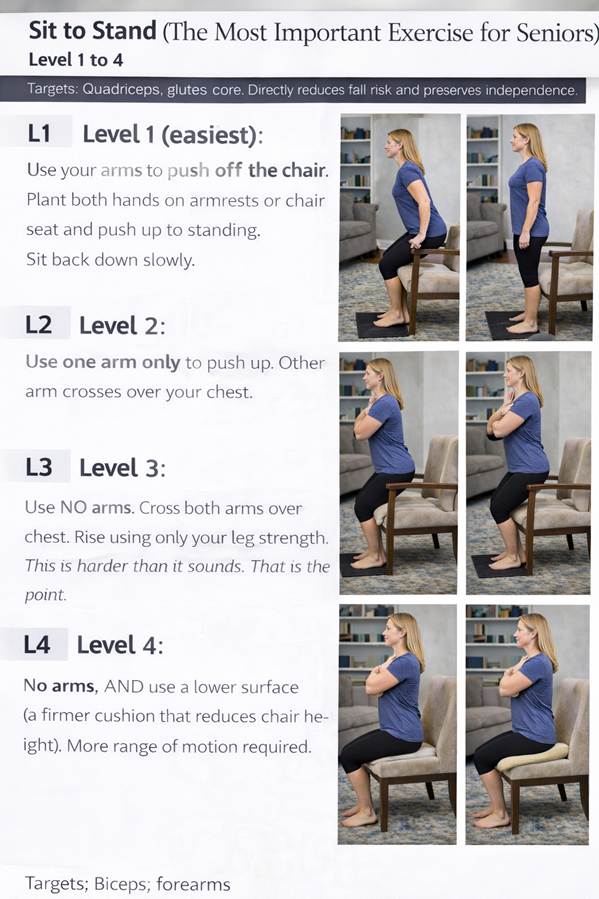
Sit to Stand -- The Most Important Exercise for Seniors
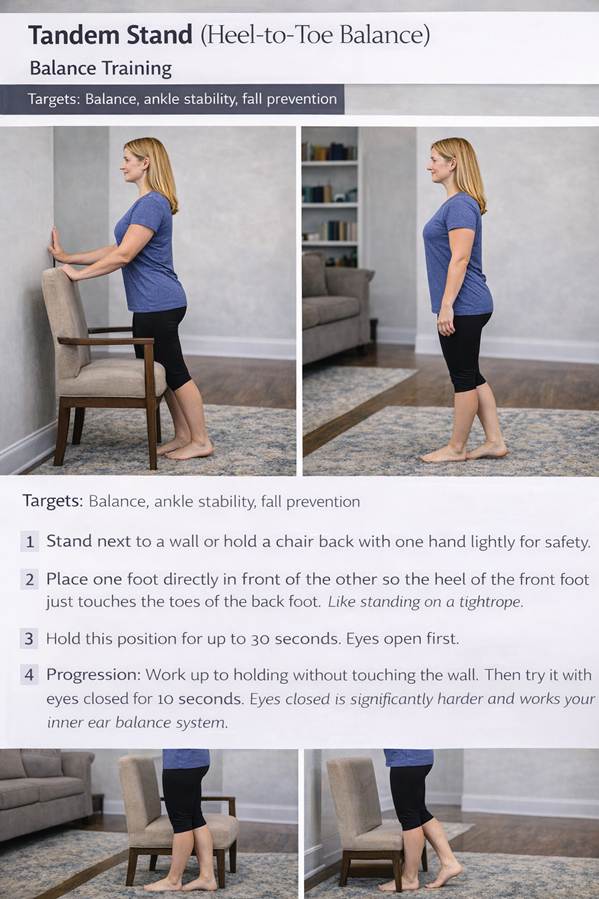
Tandem Stand -- Heel-to-Toe Balance
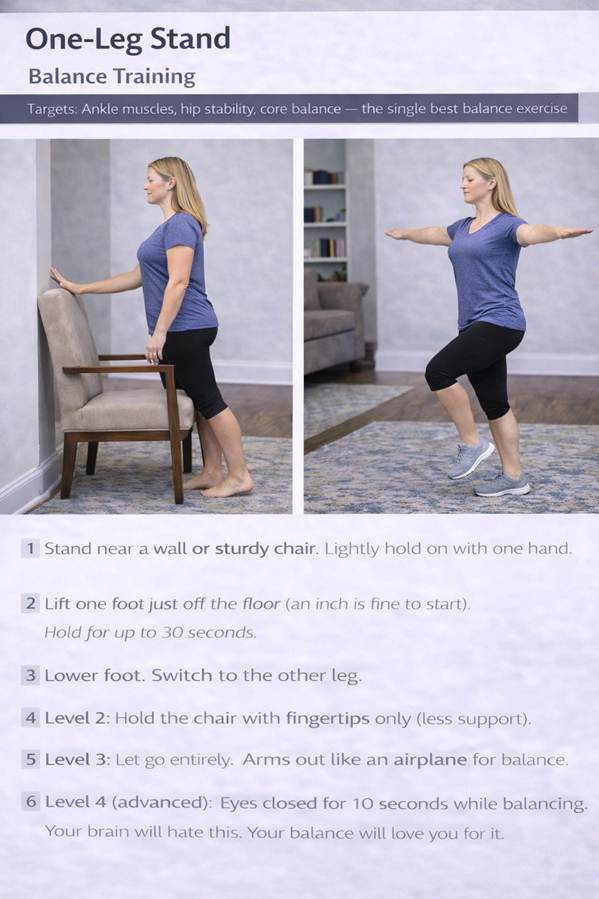
One-Leg Stand
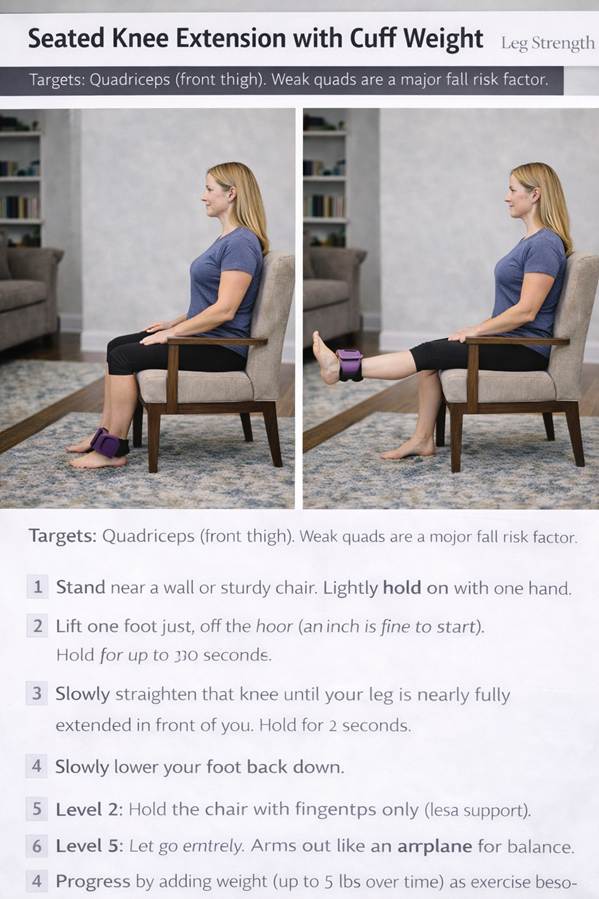
Seated Knee Extension
Senior Weekly Plan: Ages 65+
Weekly Plan | 25 to 40 min/day |
Monday | Strength + Balance (35 min): Warm up 5 min. Sit-to-Stand 3x10. Knee Extensions 2x10 each. Calf Raises 3x12. Tandem Stand 3 each side. |
Tuesday | Walking (30 min): Brisk neighborhood walk. Aim for slightly breathless pace. |
Wednesday | Balance + Strength (35 min): One-Leg Stand 3 per leg. Hip Abduction 2x12 each. Seated Row with band 2x12. Seated Marching 5 min. |
Thursday | Walking (30 min): Same or different route. Notice something new every time. |
Friday | Full Routine (40 min): Combine all week exercises. This is your longest session. |
Weekend | Active Rest (20 to 30 min): Gentle walk, gardening, or light stretching. You earned this life. |
People who exercise regularly in their 60s, 70s, and 80s have significantly better brain function, mood, independence, and quality of life. It is NEVER too late to start. |
Chapter 10: Seniors with Limited Mobility -- Chair-Based Exercise
A chair is not a limit. It is a piece of exercise equipment you already own.
Studies of nursing home residents who could not walk showed that 16 weeks of chair-based exercise improved strength, balance, hand grip, manual dexterity, and even thinking ability. You do not need to stand to make progress.
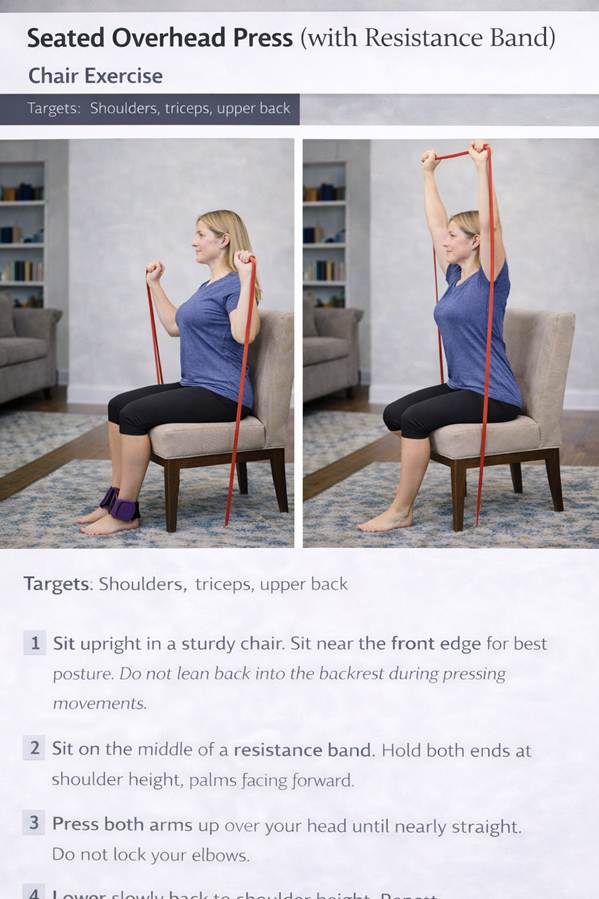
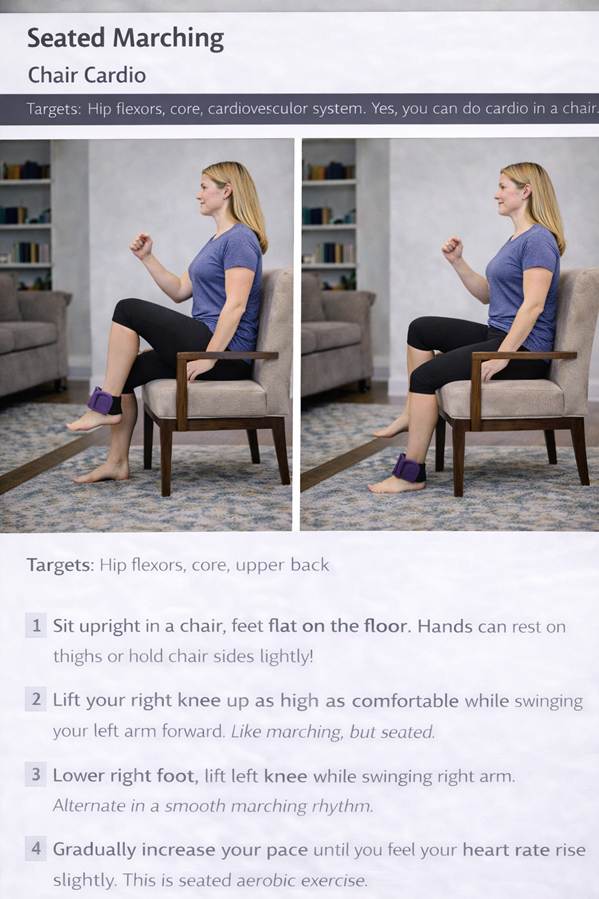
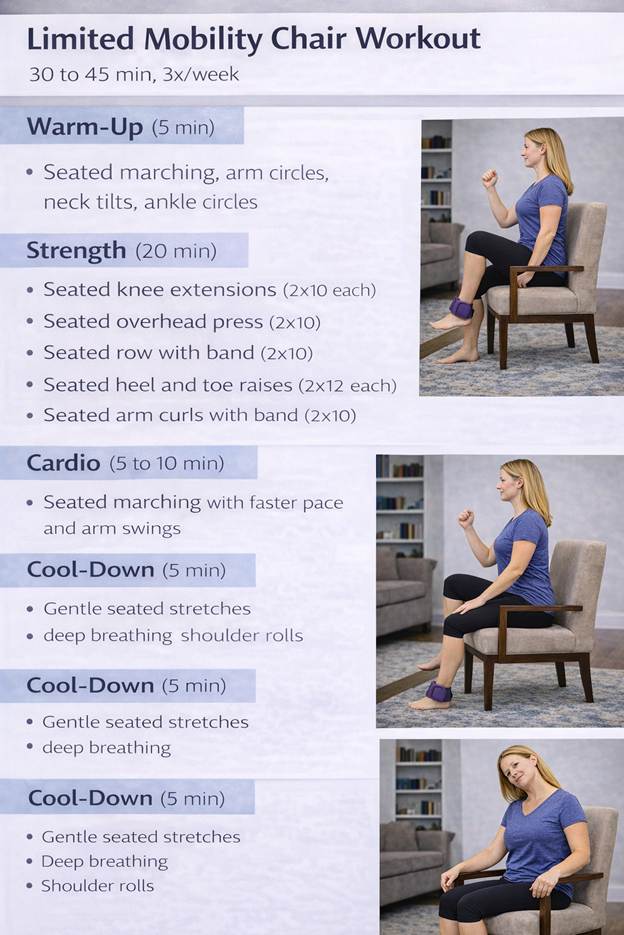
Limited Mobility Chair Workout
Chair Workout | 30 to 45 min, 3x/week |
Warm-Up (5 min) | Seated marching, arm circles, neck tilts, ankle circles |
Strength (20 min) | Seated knee extensions 2x10 each, Overhead press 2x10, Row with band 2x10, Heel and toe raises 2x12, Arm curls 2x10 |
Cardio (5 to 10 min) | Seated marching with faster pace and arm swings |
Cool-Down (5 min) | Gentle seated stretches, deep breathing, shoulder rolls |
💡 The LiFE Approach: Sneak exercises into daily activities. Calf raises while washing dishes. Balance on one foot while brushing teeth. Sit-to-stands during TV commercial breaks. Zero extra scheduled time required. |
PART 3: MEDICAL CONDITIONS
Chapter 11: Heart Disease and Heart Failure
⚠️ Always get medical clearance before starting an exercise program if you have been diagnosed with heart disease or heart failure. Exercise is highly beneficial and recommended, but your doctor needs to confirm clinical stability first. |
Home-based cardiac rehabilitation produces outcomes just as good as gym-based programs for mortality, exercise capacity, and quality of life. A major review of 24 clinical trials found no difference in death rates between home-based and center-based cardiac rehab.
The Heart Failure Home Exercise Protocol (HF-ACTION)
Phase | Location | Sessions/Week | Duration | Intensity |
Weeks 1 to 2 | Supervised or home | 3 | 15 to 30 min | 60% HRR or Borg 12 |
Weeks 3 to 6 | Supervised or home | 3 | 30 to 35 min | 70% or Borg 13 |
Weeks 7 to 12 | Transitioning to home | 5 | 35 to 40 min | 70% or Borg 13 |
Week 13+ | Home | 5 | 40 min | 60 to 70% or Borg 12 to 14 |
🚨 Stop immediately if you feel: Chest pain or pressure. Dizziness or lightheadedness. Unusual shortness of breath. Palpitations or irregular heartbeat. Call your doctor before resuming. |
Heart Condition Home Plan -- Maintenance Phase
Maintenance Plan | 40 min, 5x/week |
| |
Warm-Up (5 min) | Slow walking or seated marching. NEVER skip this. |
| |
Aerobic (30 min) | Brisk walking or stationary cycling. Borg 12 to 14. Talk test: slightly breathless. |
| |
Resistance (optional) | Elastic band exercises: 8 to 10 movements, 1 to 3 sets of 8 to 16 reps, 2 to 3 days/week. |
| |
Cool-Down (5 to 10 min) | CRITICAL. Slow walk then stand then sit. Longer cool-down required if on blood pressure medications. |
| |
| 💡 For Very Deconditioned Patients: Start with 5 to 20-second bursts of very light activity with rest periods. Walk 20 seconds, rest 2 minutes, repeat 3 to 5 times. Add 5 seconds each week. | ||
Chapter 12: Type 2 Diabetes
Exercise is one of the most powerful blood sugar medications ever discovered. And it is free.
Exercise lowers blood sugar directly during and after activity and improves insulin sensitivity for up to 48 hours. HbA1c can drop 0.4 to 1.0 percent with regular exercise. Many diabetes medications do not perform that well.
The ADA-Approved Diabetes Exercise Plan
Type | Activities | Frequency | Duration/Week |
Aerobic | Walking, cycling, swimming, dancing | 3 to 7 days (no 2 days in a row off) | 150 to 300 min moderate |
Resistance | Bands, body weight, light weights | 2 to 3 non-consecutive days | 20 to 30 min/session |
Flexibility | Stretching, yoga, tai chi | 2 to 3 days/week | 10 min/session |
Balance | Yoga, tai chi, one-leg stands | 2 to 3 days/week | 10 min/session |
Safety Rules for Diabetics
• Before exercise: Check blood sugar. Below 100 mg/dL -- eat a small snack (15g carbs) first. Above 250 mg/dL with ketones -- do not exercise.
• Always carry: Glucose tablets, juice box, or 5 gummy bears. Know the signs of low blood sugar.
• Peripheral neuropathy: Wear well-fitted, cushioned shoes. Check feet before and after every workout.
• Eye complications: Avoid exercises that spike eye pressure -- no breath holding, head-down positions, or heavy overhead lifting.
Diabetes Home Exercise Plan
Daily Plan | 30 min/day, 6 days/week |
|
Monday | Brisk Walk (30 min): Moderate pace. Check feet before putting on shoes. |
|
Tuesday | Resistance Bands (30 min): Squats, rows, curls, calf raises, overhead press. 2 sets of 10 to 15. |
|
Wednesday | Walk + Stretch (30 min): 20 min walk plus 10 min yoga or stretching. |
|
Thursday | Strength + Balance (30 min): Chair squats, glute bridges, one-leg stands, seated leg lifts. |
|
Friday | Walk (30 min): Increase pace slightly. Blood sugar responds to all movement. |
|
Saturday | Fun Activity (45 min): Dance, swim, garden, bike. Pick something you enjoy. |
|
Sunday | Rest: Gentle movement only. Enjoy the lower blood sugar readings. |
|
🤩 Mind-Blowing Fact: Increasing your daily step count by just 500 steps per day is associated with a 2 to 9 percent reduction in cardiovascular death risk in diabetes. That is less than half a mile. |
Chapter 13: Arthritis -- OA and RA
Exercise does NOT wear out your joints. Science proved it. Your joints need movement to stay healthy.
Low-impact exercise does not increase pain, worsen joint damage, or speed up arthritis on X-ray. Multiple clinical trials proved this conclusively. Rest actually makes arthritis worse over time. Movement is medicine.
Tai Chi -- The Arthritis Superstar
🥋 Tai Chi [Strongly Recommended by ACR] |
Targets: Improves pain, function, balance, depression, quality of life. Equal to formal physical therapy at 12 weeks. 80. Find a free online beginner tai chi class for arthritis (search YouTube -- many are free). 81. Practice 3 times per week for 12 weeks. Consistency matters more than perfection. 82. Wear comfortable, flat-soled shoes. Stand near a wall for balance support at first. 83. A 2025 trial proved that unsupervised online tai chi 3x/week for 12 weeks improved knee pain, function, balance, AND quality of life with no serious side effects. Reps: 20 to 30 min | Sets: 3x/week | Days/Week: 12+ weeks |
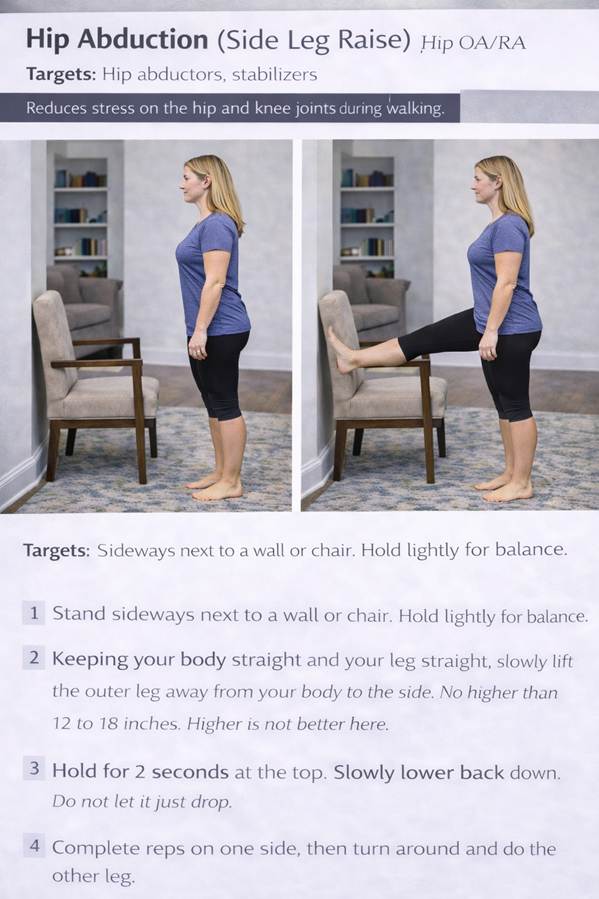
Hip Abduction (Side Leg Raise)
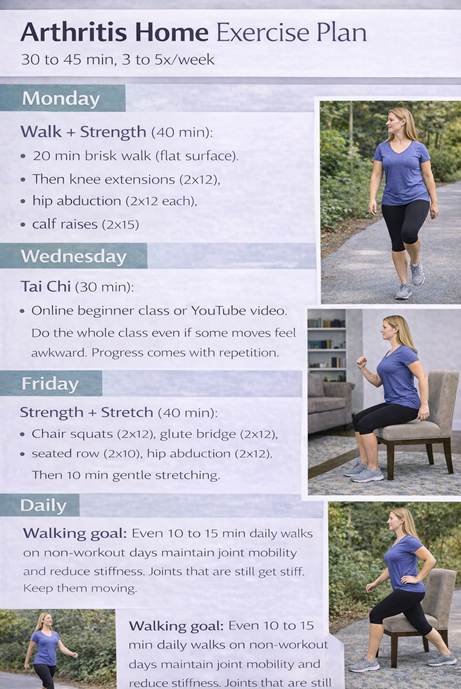
Arthritis Home Exercise Plan
💡 Pain During Exercise: Some mild discomfort during movement is acceptable with arthritis. Sharp, sudden joint pain means stop. Dull aching during exercise is normal and does not indicate harm. |
Chapter 14: Fibromyalgia and Chronic Pain
When everything hurts, the last thing you want to do is exercise. But it is also the thing that helps most.
Fibromyalgia is a condition of widespread chronic pain, fatigue, and sleep disruption. Exercise is one of the most evidence-based treatments available, but it must be started very slowly and built up gently.
🤩 Mind-Blowing Fact: Water-based exercise ranks second only to combined aerobic-flexibility training for fibromyalgia pain relief, with large effect sizes. The buoyancy of water takes pressure off joints, the warmth relaxes muscles, and you feel less like you are exercising. |
Fibromyalgia 8-Week Starter Plan
8-Week Plan | Start 10 min, build to 30 min |
Weeks 1 to 2 | 10 to 15 min, 3 days/week: Gentle walking at easy pace. It should feel like light effort (Borg 10 to 11). |
Weeks 3 to 4 | 15 to 20 min, 3 days/week: Increase duration only, not pace. Add 5 min gentle stretching after each session. |
Weeks 5 to 6 | 20 to 25 min, 3 to 4 days/week: Add very light resistance band work (2 exercises, 1 set of 8 reps). Stop if pain flares. |
Weeks 7 to 8 | 30 min, 3 to 4 days/week: Include walking, gentle resistance, and 10 min stretching or Pilates. |
Ongoing | Aim for 60 min aquatic sessions 1 to 2 times/week if pool available. Add online Pilates or gentle yoga at home. |
Chapter 15: Parkinson's Disease
Exercise is neuroprotective. Your brain literally responds to movement.
Exercise is one of the most important interventions in Parkinson's disease management. It improves balance, gait, strength, and quality of life, and may slow disease progression. Dance has shown some of the best results in clinical research. Yes, dancing. This is your permission slip.
Type | Recommended Activity | Frequency | Duration | Notes |
Aerobic | Brisk walking, cycling, swimming | 3 to 5 days/week | 30 to 60 min | HIIT may be especially beneficial |
Dance | Tango, ballroom, line dancing | 2 to 3 days/week | 45 to 60 min | Highest quality of life improvements |
Strength | Resistance bands, body weight | 2 to 3 days/week | 20 to 30 min | 60 to 80% 1-RM |
Balance | Tai chi, one-leg stands | 2 to 3 days/week | 20 to 30 min | Fall prevention is top priority |
💡 For Freezing Episodes: Rhythmic auditory cueing helps significantly. Walking to a metronome beat or using music with a strong beat (100 to 130 BPM) can help legs keep moving. |
⚠️ Safety Note: People with Parkinson's have increased fall risk. Exercise near a wall or with a spotter. A physical therapist consultation is highly recommended before starting independently. |
PART 4: SPECIAL SITUATIONS
Chapter 16: Exercise with Physical Disabilities
Different bodies need different approaches. All bodies benefit from movement.
🤩 Mind-Blowing Fact: The 2025 ACSM Expert Consensus Statement is clear: significant health benefits can be achieved with just 20 to 30 minutes of exercise, 2 to 3 times per week -- well below what healthy adults are recommended. |
Wheelchair Users and Spinal Cord Injury
Goal: At least 20 minutes of moderate to vigorous exercise twice per week, plus strength training twice per week.
💺 Wheelchair Push (Cardio) [SCI and Wheelchair Users] |
Targets: Aerobic workout using arm propulsion. Biceps, triceps, shoulders, core. 88. Propel your wheelchair at a brisk, sustained pace in a neighborhood, park, or hallway. 89. Aim for sustained effort for 10 to 20 minutes. Build duration over time, not speed. 90. Use the Borg Scale (aim for 12 to 14). Heart rate monitoring may not be accurate. 91. Vary your route to include small inclines for increased challenge. Reps: 20 to 30 min | Sets: 2 to 3x/week | Days/Week: 2 to 3 days |
Stroke Survivors
The AHA recommends aerobic exercise at least 3 days per week, 20 to 60 minutes per session (or multiple 10-minute bouts) plus resistance training 2 to 3 days per week.
Exercise | Adaptation | Notes |
Walking | Treadmill with handrail support, or outdoor with walking aid | RPE 11 to 12. Stop 10 BPM below ischemic threshold. |
Cycling | Recumbent stationary bike (more stable) | Good for leg weakness or balance issues. |
Resistance | Higher reps, lower weight. Focus on affected side. | 10 to 15 reps. Functional movements. |
Active Video Games | Wii Sports, Wii Fit, or similar | 1.3 to 5.6 METs. Improves arm function. |
Visual Impairment
💡 Audio-Guided Exercise: A recent clinical study found that audio-guided home exercise achieved over 95 percent adherence and significantly improved mobility in people with severe low vision or blindness. |
Safe home adaptations: keep furniture in consistent positions, use tactile markers on exercise spots, clear all pathways before exercising, exercise near a wall for safety, and use verbal instruction recordings for all exercises.
Lower Limb Amputation
Goal: At least 60 minutes of moderate to vigorous activity per week combined with either strength training (3 sets of 10 reps, twice per week) or balance training (20 minutes, 3 times per week). Programs combining aerobic, strength, AND balance show the best results.
Chapter 17: Your Job and Exercise
What you do for a living affects how much additional exercise you need.
Exercise by Occupation Type
Job Type | Risk Level | What to Do at Home |
Desk/Remote Worker | HIGH -- sits 6 to 8 hrs/day | Set timer every 30 min: stand and move 2 min. Full 150 min cardio/week required. |
Construction/Physical Labor | MODERATE -- active but not aerobic | Still need dedicated aerobic time (20 to 30 min walks). Stretching is critical. |
Healthcare/Service Workers | MODERATE -- on feet but repetitive | Add 2 dedicated strength sessions/week at home. |
Drivers/Transport | HIGH -- prolonged sitting + vibration | Core strengthening critical. Stretch hip flexors daily. Full 150 min/week needed. |
💡 Desk Worker 2-Minute Break Exercises: Every 30 minutes: 10 bodyweight squats, 10 calf raises, walk to another room and back, 30-second plank, 10 wall push-ups, or 20 marching steps. These micro-breaks meaningfully reduce the health risks of prolonged sitting. |
Chapter 18: No Time? No Problem!
You can break exercise into multiple short sessions throughout the day and get the SAME health benefit as one longer session.
🤩 Mind-Blowing Fact: Research shows 30 minutes per week of high-intensity activity may reduce all-cause mortality by approximately 40 percent. That is 4 minutes and 17 seconds per day. Your coffee is longer than that. |
The 10-Minute Power Circuit
⚡ 10-Minute Home Power Circuit [Any Fitness Level] |
Targets: Do each move for 45 seconds, rest 15 seconds, then move to next. 92. Marching in Place: Pick up knees, swing arms. Energetic but controlled. 45 seconds. 93. Chair Squats: Stand, lower to chair, stand up. No resting at bottom. 45 seconds. 94. Wall Push-Ups: Stand 2 feet from wall. Push in and out at controlled pace. 45 seconds. 95. Step Touches: Step one foot out to the side, bring other to meet it. Alternate sides. 45 seconds. 96. Calf Raises: Rise on toes, lower slowly. Use wall for balance if needed. 45 seconds. 97. Seated Marching (fast): Sit in chair, march legs quickly while pumping arms. 45 seconds. 98. Glute Bridges: Lie on floor, push hips up, hold 2 sec, lower. 45 seconds. 99. March and Cool Down: Slow marching in place. Let heart rate settle. 2 minutes. Reps: 10 minutes | Sets: 2 to 3x/day | Days/Week: Daily Modification: Do this 2 to 3 times a day and you have met your daily exercise goal. No gym. No equipment. No excuse. |
Chapter 19: Aquatic Exercise
Water makes everything easier on your joints. Science agrees.
Aquatic exercise is a clinically proven therapy for fibromyalgia, osteoarthritis, heart failure, Parkinson's disease, obesity, and multiple sclerosis. The water supports your body weight, reduces joint stress, provides natural resistance in every direction, and the warm temperature relaxes muscles.
Who Benefits Most from Aquatic Exercise
Condition | Key Benefit | Effect Size |
Fibromyalgia | Pain reduction, sleep, fatigue | Large (g = 0.72 to 0.82) |
Parkinson's Disease | Quality of life, balance, mobility | Large -- superior to land exercise |
Knee and Hip OA | Pain, stiffness, function | Moderate, sustained 3 months |
Heart Failure | Exercise capacity, 6-min walk | Superior to control programs |
Obesity | Weight, waist circumference | Mean loss of 2.69 kg and 2.75 cm |
Older Adults (Balance) | Balance, gait, fear of falling | 6.36 cm greater functional reach |
Pool Safety Rules
• Never exercise alone in a pool. Always have a buddy or lifeguard present.
• Do NOT enter a pool with open wounds, unhealed foot ulcers, or active skin infections.
• Use pool grab bars for entry and exit. Slippery pool decks cause more injuries than the water.
• Hydrate! You sweat in the water. You just cannot see it.
• For heart conditions: confirm medical clearance before aquatic exercise.
💡 No Pool? No Problem: Many YMCAs and municipal recreation facilities offer pool access for very low monthly fees. Senior pools often have warm water (30 to 32 degrees C) ideal for arthritis and fibromyalgia. |
Chapter 20: Staying on Track
Starting is the hardest part. Staying consistent is the second hardest. Here is how to do both.
Weekly Progress Tracker
Print this section or mark it in your calendar. Research shows that tracking exercise increases follow-through by more than 40 percent.
MON | TUE | WED | THU | FRI | SAT | SUN |
___ min | ___ min | ___ min | ___ min | ___ min | ___ min | ___ min |
Goal: 150+ minutes total. Strength: at least 2 days. Balance (65+): at least 3 days.
When You Fall Off Track
Missing a week of exercise because life happened does not undo your progress. Missing a month sets you back slightly. Missing a year sets you back significantly. The solution to all of these is the same: start again today. Not Monday. Today.
Research is clear that people who exercise occasionally -- even 1 to 2 sessions per week -- still have dramatically better health outcomes than people who do not exercise at all. Imperfect consistency beats perfect inconsistency every time.
15 Ways to Make Exercise Actually Happen
• Put it in your calendar as a non-negotiable appointment. It is a meeting with your future healthy self.
• Lay out your shoes and clothes the night before. This small act significantly increases follow-through.
• Start smaller than you think you should. 'Just 10 minutes' is not a failure. It is a starting point.
• Find a movement buddy. People who exercise with a partner are significantly more consistent.
• Use exercise as a reward, not a punishment. Walk your favorite trail. Dance to your favorite playlist.
• Break it into 10-minute chunks throughout the day. Three 10-minute walks equal one 30-minute session.
• Do it before checking your phone in the morning. Exercise wins before the day derails you.
• Track your progress visually. A streak of check marks is surprisingly motivating.
• Reward consistency. After 4 weeks straight, buy yourself something nice (not food).
• Forgive yourself quickly. One missed day is not a failure. Three missed weeks is a pattern. Fix the pattern.
You do not have to be fast. You do not have to be perfect. You just have to move. Every step is medicine. Every rep is an investment in a longer, stronger, happier life. Keep going. You have got this. |
Index
A
• Aerobic exercise defined -- Chapter 1
• Age-specific goals (chart) -- Chapter 1
• Ankle weights -- Chapters 2, 9
• Aquatic exercise -- Chapter 19
• Arthritis exercise plan -- Chapter 13
• Audio-guided exercise -- Chapter 16
B
• Balance training (seniors) -- Chapters 9, 10
• Beta-blockers and exercise -- Chapters 3, 5, 11
• Blood sugar monitoring -- Chapters 5, 12
• Bone-building exercises -- Chapter 7
• Borg Scale -- Chapters 3, 11, 12
• Brisk walking -- Chapters 1, 8, 9, 13
C
• Calf raises -- Chapters 8, 9, 18
• Cardiac rehabilitation home-based -- Chapter 11
• Chair-based exercises -- Chapter 10
• Chair squat -- Chapters 8, 18
• Children ages 3 to 5 -- Chapter 6
• Children ages 6 to 17 -- Chapter 7
• Chronic pain -- Chapter 14
• Cool-down importance -- Chapters 4, 11
D
• Daily plans (by group) -- Chapters 6 through 15
• Desk workers -- Chapter 17
• Diabetes exercise plan -- Chapter 12
• Disabilities exercise -- Chapter 16
• Diuretics and exercise -- Chapter 5
E
• Equipment needed -- Chapter 2
• Exercise breaks at work -- Chapter 17
F
• Fall prevention -- Chapters 9, 10
• Fibromyalgia -- Chapter 14
• Foot care (diabetes) -- Chapters 5, 12
H
• Heart disease plan -- Chapter 11
• Heart failure protocol -- Chapter 11
• Heart rate targets -- Chapter 3
• Hip abduction -- Chapters 9, 13
L
• LiFE program -- Chapter 10
• Limited mobility exercises -- Chapter 10
• Lower limb amputation -- Chapter 16
M
• Medications and exercise -- Chapter 5
• Minimum requirements -- Chapter 1
O
• Occupational exercise -- Chapter 17
• One-leg stand -- Chapter 9
• Osteoarthritis -- Chapter 13
• Otago Exercise Program -- Chapter 9
P
• Pain during exercise (arthritis) -- Chapter 13
• Parkinson's disease -- Chapter 15
• Physical disabilities -- Chapter 16
• Plank exercise -- Chapter 8
• Pool safety -- Chapter 19
R
• Resistance bands -- Chapters 2, 8, 10, 13
• Rheumatoid arthritis -- Chapter 13
S
• Safety rules -- Chapter 4
• Seniors 65+ plan -- Chapter 9
• Sit to stand exercise -- Chapter 9
• Stroke exercise -- Chapter 16
T
• Tai chi -- Chapters 9, 13, 15
• Talk test -- Chapter 3
• 10-minute circuit -- Chapter 18
• Time-saving exercise -- Chapter 18
W
• Walking benefits -- Chapters 1, 8, 12, 13
• Warm-up routine -- Chapter 4
• Wheelchair users -- Chapter 16
• Work and exercise -- Chapter 17
Move It or Lose It! -- The Ultimate At-Home & Neighborhood Exercise Guide
Based on clinically vetted guidelines from the AHA, ADA, ACR, ACSM, and peer-reviewed research through 2025 to 2026.
This guide is educational and is not a substitute for personalized medical advice. Always consult your physician before starting or changing an exercise program.
HSA/FSA Eligible
Doctors Are Human.
That's Why There's Medome.
Start your free trial today. No credit card required.
Start Your Free Trial
Join thousands protecting their health with AI that never forgets
Critical details get missed when your health information is scattered. Medome connects the dots across your complete record.
Start Your Free Trial
Quick Links
Medome Men
Home
Pricing
About
Health News
HealthSigns
FAQ
Contact Us
Terms of Service
Privacy Policy
Get In Touch
Email: service@medome.ai
Phone: (617) 319-6434
This is Dr. Steven Charlap’s cell. Please text him first, explaining who you are and how he can help you. Use WhatsApp outside the US.
Hours: Mon-Fri 9:00AM - 9:00PM ET