A Quick Note on the Science
For this article, gold standard randomized controlled trial (RCT) studies were prioritized. That means no shaky evidence, no "my cousin tried it once" stories, and no wellness influencers in lab coats. Just real science, presented in plain English.
So, What Even IS Melatonin?
Melatonin is a hormone your brain makes all by itself, mostly at night. A tiny gland called the pineal gland (about the size of a grain of rice and tucked deep inside your skull) starts cranking out melatonin when the sun goes down and the lights get dim. Think of it as your body's built-in "Hey, it is bedtime soon" announcement system.
But here is a fun twist: your gut, eyes, bone marrow, and even your immune cells make small amounts too. Melatonin basically has a side job in almost every part of your body.
Your body builds melatonin from an amino acid called tryptophan. Yes, the same stuff people blame when they fall asleep on the couch after Thanksgiving dinner. Tryptophan first turns into serotonin (the feel-good chemical), and then serotonin turns into melatonin. So in a weird way, happy chemicals lead to sleepy chemicals.
Here is the funny part: most people think melatonin is a sleeping pill. It is not. It does not actually knock you out the way a real sleep medicine would. Instead, it waves a little signal flag at your brain saying, "The sun has set. Please prepare for snooze mode." If your sleep problem is something else entirely, like stress or anxiety or a noisy neighbor, melatonin may shrug and let you down.
Despite all this, melatonin is wildly popular. Sales jumped from $285 million in 2016 to $821 million in 2020, and nearly 1 in 5 American kids and teens now take it regularly. That is a lot of gummies, and a lot of misunderstanding.
What Does Melatonin Actually Do?
Melatonin's main job is running your circadian rhythm — the science word for your built-in 24-hour clock. It tells your body when to feel awake and when to feel sleepy. But melatonin is kind of an overachiever and does more than just sleep stuff:
It acts like a tiny bodyguard called an antioxidant, protecting your cells from damage.
It gives your immune system a boost so you can fight off germs.
It may help protect your brain and nerves.
It helps keep your blood pressure from getting too high while you sleep.
It may even play a part in mood, growing up, and how your body uses sugar.
Not bad for a hormone that mostly works the night shift.
Foods That Naturally Contain Melatonin
Yes, real food contains melatonin. Mother Nature got there first. Foods with natural melatonin include:
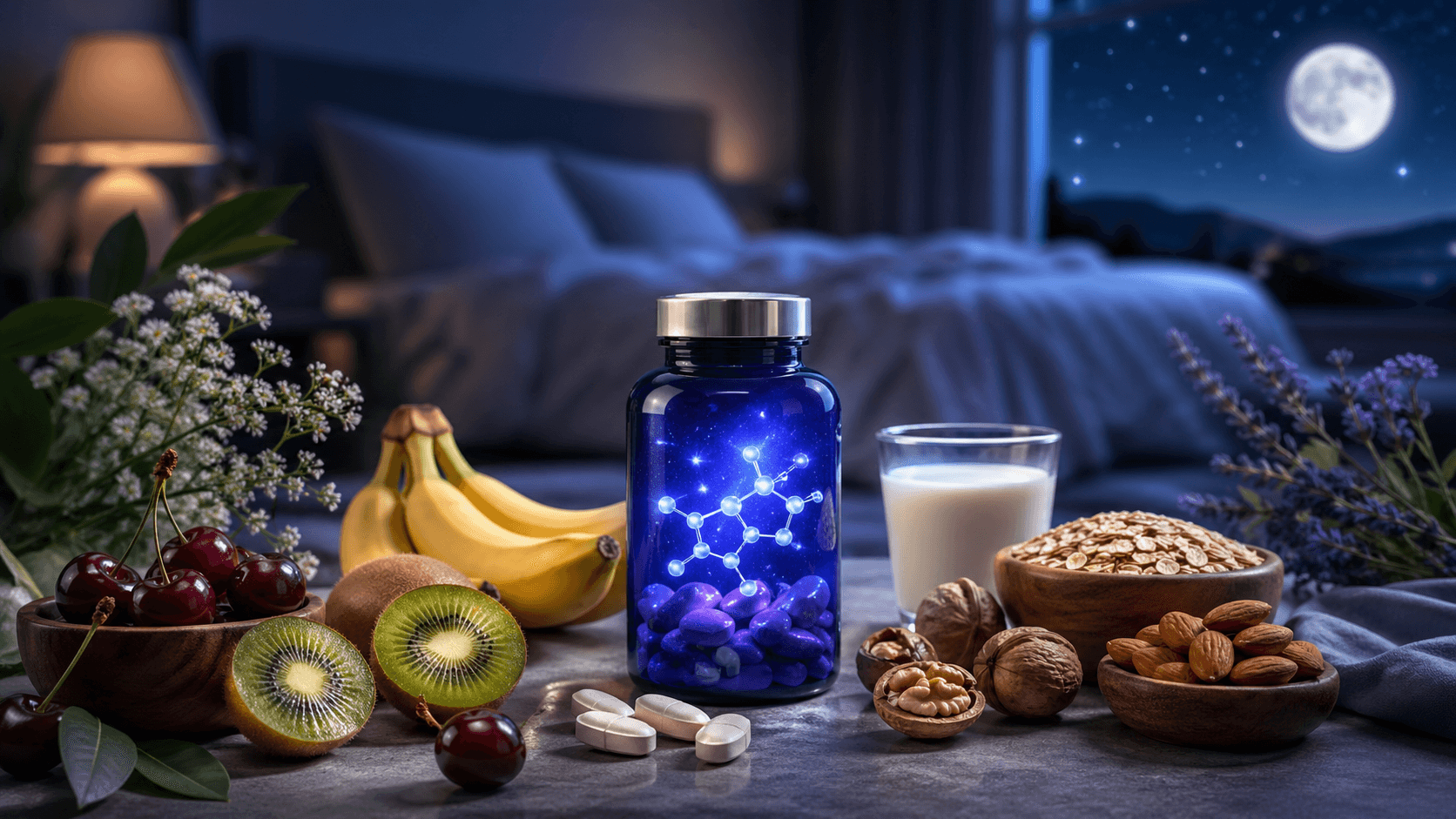
Tart cherries (especially Montmorency) and unsweetened tart cherry juice — the rock stars of food sources
Pistachios (the highest melatonin content of any nut) and walnuts
Eggs (one of the best animal sources)
Fatty fish like salmon
Milk and dairy products (especially "night milk," collected from cows at night)
Goji berries, grapes, pomegranates, kiwifruit, tomatoes
Mushrooms (porcini, white, brown, portobello, and reishi)
Olive oil, bananas, and pineapples
Lentils, beans, almonds, and various seeds
Dark green vegetables
Now, do not get too excited and start raiding the pistachio aisle. To match the dose in one tiny 0.3 mg supplement, you might need to munch on more than 1,500 pistachios. Walnuts? About 857 cups, which would also be over 500,000 calories. So while these foods are tasty and healthy, no single bowl of cherries is going to launch you into a coma.
That said, eating a Mediterranean-style dinner with melatonin-friendly foods a few hours before bed can support your body's natural sleep signals. Tart cherry juice, in particular, has small RCT evidence behind it for older adults with insomnia. It is not a miracle, but it is also not a midnight energy drink.
Do Melatonin Supplements Actually Work?
This is where things get interesting. The honest answer is "sort of, sometimes, depending on what is wrong with your sleep."
A 2024 systematic review and meta-analysis (the gold standard of evidence) reviewed 26 RCTs covering 1,689 patients. It found that melatonin can reduce the time it takes to fall asleep and slightly increase total sleep time. The effect peaked at about 4 mg per day. Surprisingly, the researchers also found that taking melatonin about 3 hours before your desired bedtime worked better than the popular 30-minutes-before-bed routine.
Another large review of 23 RCTs found that melatonin improved sleep quality scores on the Pittsburgh Sleep Quality Index, with a meaningful average improvement.
But here comes the reality check. When researchers measured sleep with objective tools like brain-wave machines and actigraphy, the effects of melatonin shrank a lot. People felt like they slept better, but the machines did not always agree. Translation: a lot of melatonin's magic may be happening in the part of your brain that judges your sleep, not in the actual sleep itself. Still helpful, but good to know.
When Supplements ARE a Good Idea
Based on RCT evidence, melatonin appears genuinely helpful for these specific situations:
Jet lag. If you fly from New York to Tokyo and your body still thinks it is dinnertime when it is actually 4 AM, melatonin can help reset your internal clock.
Shift work sleep problems. Nurses, pilots, and night shift warriors who need to sleep during the day may benefit.
Delayed sleep phase disorder. A condition where someone naturally falls asleep super late (think 4 AM). Teenagers, this is why your body really does want to stay up late — there is a real biological reason.
Older adults whose natural melatonin levels have declined with age. RCT evidence supports low doses of prolonged-release melatonin.
Blind people whose body clocks cannot use sunlight to reset. Melatonin can take the place of sunlight as the daily signal.
Children with neurodevelopmental conditions like autism spectrum disorder or ADHD. Multiple RCTs support short-term use, but always with a doctor's guidance.
Right before surgery. It can ease pre-surgery jitters and may even help with pain control after.
When Supplements Are NOT a Good Idea
This is where many people go wrong, often spectacularly. Melatonin is probably not the right tool if:
You have classic insomnia where you wake up at 3 AM and cannot fall back asleep. Melatonin helps with falling asleep, not staying asleep.
You have anxiety that is keeping you up. The pill will not fix the worry underneath.
You are using it as a long-term fix for chronic insomnia. CBT-I has way more evidence and is recommended as the first-line treatment by every major medical group.
You are taking it without a clear reason because someone on social media said so.
You are giving it to a healthy young child to make bedtime easier. The American Academy of Pediatrics says try a real bedtime routine first.
You are mixing it with alcohol or other sedating medicines. Both safety and effectiveness drop fast.
You are pregnant or breastfeeding. The safety data simply isn't there yet.
You have a seizure disorder, depression, autoimmune disease, or diabetes — without doctor input first.
Goldilocks Dosing: Not Too Much, Not Too Little
Here is something most people get wrong: when it comes to melatonin, more is not better. Your body only makes tiny amounts naturally — way less than 1 mg. But many bottles on store shelves contain 5 mg or even 10 mg. That is way more than your body would ever make on its own.
Research shows the sweet spot for sleep is about 4 mg. Going higher does not really add benefit, and might cause more side effects.
General guidelines for adults:
Falling asleep: 0.5 mg to 3 mg of regular-release melatonin, taken 1 to 3 hours before bedtime.
Staying asleep (especially older adults): 2 mg of slow-release melatonin, about 1 to 2 hours before bed.
Shifting your sleep earlier: 0.5 to 1 mg taken 5 to 6 hours before your current sleep time.
Jet lag: 0.5 to 5 mg at bedtime at your new destination, for a few days.
For kids with autism or ADHD, doctors usually start at 1 to 2 mg about 30 minutes before bed and slowly raise the dose if needed, up to about 5 mg. Always under medical guidance.
Quick Release vs. Slow Release: What's the Difference?
There are two main types of melatonin pills. They look similar but work very differently.
Quick release (or immediate release) works fast and wears off fast. Best if your problem is falling asleep or you are fixing jet lag.
Slow release (or prolonged release) trickles into your blood for a few hours. Better if your problem is waking up in the middle of the night and not being able to fall back asleep. This is the kind most studied in older adults.
Picking the right one matters. Using slow release for jet lag is like wearing snow boots to the beach.
How to Take Melatonin the Right Way
If your doctor gives you the green light, here is what RCT data suggests works best:
Start with a tiny dose. Most adults do fine on 0.3 to 1 mg. Those 5 and 10 mg gummies on the shelf are usually way more than your brain ever needed.
Take it earlier than you think. Recent RCT data suggests 1 to 3 hours before your desired bedtime works better for shifting your internal clock than the classic 30 minutes.
Use it for short stretches, not forever. Most studies tested melatonin for weeks or a few months, not years.
Pick a brand with the USP Verified Mark. This means an independent group has actually checked that the bottle contains what the label promises.
Dim the lights once you take it. Bright light, especially blue light from phones and TVs, can shut down the melatonin signal you just paid good money for.
Skip the gummies if you can. Pediatricians find absorption is less reliable in gummies, and they are also the form most likely to be mistaken for candy.
The Quality Control Problem (Yikes)
Here is something that might actually wake you up. In the United States, melatonin is sold as a dietary supplement, not a medicine. That means the FDA does not check it as carefully as a prescription drug. One published study found that the actual melatonin content in supplements ranged from 83% LESS than the label said to 478% MORE. That is wild.
⚠️ Some products even contained serotonin, which is a prescription chemical that should never show up in an over-the-counter supplement. The biggest variation was found in chewable tablets — exactly the form most kids use.
Translation: that 5 mg gummy on your nightstand might actually contain anywhere from a tiny dose to almost 30 mg of melatonin, with possibly some uninvited extras. This is why the USP Verified Mark matters so much. It is not a magic stamp, but it is the closest thing we have to a quality guarantee.
The Side Effects Nobody Warns You About
Melatonin is generally considered safe for short-term use, but it is not a vitamin. Possible side effects include:
Headaches (the most common complaint)
Daytime drowsiness or grogginess (the famous "melatonin hangover")
Dizziness and lightheadedness
Nausea or stomach upset
Vivid, weird, or unsettling dreams (some people enjoy this, others find it freaky)
Mood changes, including irritability
Bedwetting in children
A drop in body temperature
Possible changes in blood pressure
Across 37 careful studies, the side effect rates were tiny: daytime sleepiness about 1.66%, headache about 0.74%, and dizziness about 0.74%. No serious or life-threatening problems have been found with short-term use.
Still, the long-term safety picture for daily, year-after-year use simply does not exist yet. Melatonin is a hormone, and giving any hormone for years on end deserves more research than we currently have.
Populations That Need Extra Caution
Some groups should be especially careful with melatonin and never use it without a doctor's involvement.
🚨 Children and teens. Pediatric melatonin overdose calls to poison control jumped a stunning 530% from 2012 to 2021. Two children under age 2 died, and around 11,000 emergency department visits between 2019 and 2022 involved unsupervised melatonin ingestion in young children. Always lock up the bottle, skip the candy-looking gummies, and talk to a pediatrician first. Behavioral changes should be tried before pills.
Older Adults
Older folks may benefit from a small dose, but they are also more likely to fall, feel groggy in the morning, or have low blood pressure from it. Doctors usually start with a tiny dose, like 0.3 to 2 mg, often in a slow-release form. Higher doses can backfire and cause problems like feeling cold or being sleepy during the day.
Children with ASD or ADHD
These kids can really benefit, but they should be watched by a doctor. Studies show melatonin can help them fall asleep about 25 to 45 minutes faster and sleep about 30 to 90 minutes longer. The most studied doses are 1 to 5 mg. Side effects can include morning grogginess, headaches, and in some kids, more bedwetting.
Children Taking ADHD Medications
Stimulant medicines like methylphenidate can make it really hard to fall asleep. Adding a small dose of melatonin (around 1 to 3 mg) about 30 to 60 minutes before bed has been shown to help most kids in this group fall asleep faster.
People with Liver Problems
Your liver is where melatonin gets broken down. If your liver is not working great, melatonin can build up. People with liver disease should start with a really low dose, like 0.5 to 1 mg.
Pregnant or Breastfeeding People
Until we have more research, the safest move is to skip it unless a doctor specifically says yes. Most doctors say, "let us not be the experiment."
Other Groups Needing Care
People on blood thinners (like warfarin), with autoimmune disorders, taking antidepressants, with diabetes, with seizure disorders, or with low blood pressure all need to coordinate with their doctor before starting melatonin.
Medications That Don't Mix Well with Melatonin
Melatonin gets broken down by an enzyme in your liver called CYP1A2. Anything that messes with this enzyme can change how much melatonin sticks around in your body. The big ones to know:
Fluvoxamine (Luvox): The biggest one. It blocks CYP1A2 hard, which can make melatonin levels skyrocket. Combining the two can cause heavy drowsiness.
Warfarin (Coumadin): Melatonin may make this blood thinner stronger, raising bleeding risk. Close blood tests needed.
Blood pressure medicines: Melatonin already lowers blood pressure a bit. Combining could drop your numbers too low.
Sleeping pills (benzodiazepines and Z-drugs): Combining can pile on sleepiness.
Other antidepressants (SSRIs, tricyclics): Possible interactions, especially when stacked with multiple medicines.
Diabetes medicines: Since melatonin can change blood sugar, dose adjustments may be needed.
Immune-suppressing drugs: Melatonin boosts immunity, so it might fight against medicines designed to calm the immune system.
Seizure medications: Some can speed up melatonin breakdown, while melatonin itself may affect seizures. Talk to your neurologist.
Caffeine: Uses the same enzyme as melatonin, so heavy coffee drinking can affect how it works.
Birth control pills: May slow melatonin breakdown a bit, so lower doses may work fine.
The simple rule: always tell your doctor or pharmacist that you take melatonin, even though it is sold without a prescription.
Helpful Sidekicks
Some nutrients team up nicely with melatonin or help your body make more of its own.
Magnesium: Calms the nervous system and supports deep sleep. Many people are a little low.
Vitamin B6: Helps turn tryptophan into serotonin, then melatonin. Without it, your sleep assembly line slows down.
Tryptophan: The starting ingredient for melatonin. Doses around 1 gram have been shown to help people fall asleep faster.
Glycine: An amino acid that promotes calm and may improve sleep quality.
L-Theanine: Found in green tea. Helps you feel calm and may support better sleep.
Vitamin D: Low levels are linked to bad sleep. Getting some sun or taking a supplement can help.
One study found that a blend of tryptophan, glycine, magnesium, tart cherry powder, and L-theanine helped people fall asleep about 24 minutes faster. Not too shabby for a smoothie of supplements.
How to Reduce Your Need for Melatonin
If you are already using melatonin, you might be able to slowly use less by helping your body make its own:
Get bright light in the morning. Sunlight in the first hour after waking tells your body clock when day starts.
Eat foods full of tryptophan. Turkey, eggs, fish, milk, and seeds give your body the raw material.
Skip caffeine after lunch. It can hang around in your body for 6 to 8 hours.
Avoid alcohol close to bed. It might help you fall asleep, but it wrecks the second half of your night.
Don't eat huge meals right before bed. Your body is busy digesting when it should be winding down.
Get regular exercise. Just not super close to bedtime.
Slowly lower your dose. If you decide to stop, taper down rather than quitting all at once.
What Actually Works for Insomnia (Plot Twist)
Drum roll, please. If you have real, ongoing insomnia, the gold medal champion of treatments is not a pill at all. It is a structured talk therapy called Cognitive Behavioral Therapy for Insomnia, or CBT-I.
Multiple systematic reviews of RCTs show that CBT-I beats sleep medications in the long run, often with no side effects. The American College of Physicians, the American Academy of Sleep Medicine, the European Sleep Research Society, and pretty much every other major sleep group recommend CBT-I as the first-line treatment for chronic insomnia.
CBT-I usually involves 4 to 8 sessions and includes:
Stimulus control: Training your brain to associate the bed only with sleep. No scrolling Instagram, paying bills, or having existential crises in bed.
Sleep restriction: Spending less time in bed at first to build sleep pressure. Sounds wild, but it works really well.
Cognitive therapy: Changing the panicked 3 AM thoughts that keep you tossing and turning.
Sleep hygiene education: Cool dark room, regular schedule, no caffeine after lunch, no late-night doom scrolling.
There are even digital versions like Sleepio and CBT-I Coach that work through your phone. RCT evidence supports digital CBT-I as well, which is great news if you do not have a sleep specialist nearby.
When Prescription Medication Is Needed
When CBT-I is not enough, doctors have several prescription options:
Ramelteon: Works on the same brain receptors as melatonin and is FDA approved. Good for falling asleep and safe for older adults. Not addictive.
Suvorexant, lemborexant, and daridorexant (DORAs): Newer drugs that block the wake-up signal in your brain. Some of the best options for both falling asleep and staying asleep. Do not cause dependence.
Low-dose doxepin: At very small doses (3 to 6 mg), FDA approved for staying asleep. Well tolerated.
Eszopiclone, zolpidem, and other Z-drugs: Work, but can cause dependence and weird side effects like sleep walking or sleep eating. Use with care.
Trazodone: An older medicine often used off-label for sleep. Cheap and familiar to doctors, but the science on it is mixed.
Big picture: melatonin is a small player for general insomnia. It shines for circadian rhythm problems and sleep onset issues, especially in older adults. For sleep maintenance issues, the newer DORA drugs and low-dose doxepin tend to work better.
Other RCT-Supported Sleep Helpers
Regular daytime exercise (just not right before bed)
A consistent wake time, even on weekends, even when it hurts
A cool, dark bedroom (around 65 to 68 degrees Fahrenheit)
Limiting screens an hour before bed
Mindfulness meditation, which has growing RCT support for sleep
Morning sunlight exposure to anchor your internal clock
The Pros and Cons Cheat Sheet
Here is the quick version, side by side, for when you are too sleepy to read everything above.
The Good Stuff | The Not So Good Stuff |
|---|---|
Generally safe for short-term use in healthy adults | Bottle contents can vary wildly from the label |
Genuinely helpful for jet lag, shift work, and delayed sleep phase | Less helpful for staying asleep through the night |
Inexpensive and sold without a prescription | Often used at the wrong dose and the wrong time |
Not addictive (you will not crave it like coffee) | Long-term safety data is very limited |
Helpful for older adults and kids with ASD/ADHD (with doctor) | Cannot fix underlying anxiety, sleep apnea, or stress |
Lower doses (0.3 to 1 mg) often work as well as bigger ones | Side effects: headaches, grogginess, weird dreams |
May give you bonus antioxidant and immune benefits | Real interactions with several medicines |
Side effect rates are tiny in studies (under 2%) | Pediatric overdose calls have skyrocketed |
The Bottom Line
Melatonin is not a sleeping pill. It is a tiny chemical messenger that says, "The sun has set, time for the night shift." If your sleep problem matches what melatonin actually does (jet lag, a shifted body clock, age-related decline, certain pediatric sleep conditions), it can genuinely help. If your problem is anxiety, chronic insomnia, sleep apnea, or stress, melatonin will probably let you down.
The best evidence-based move for chronic insomnia is to try CBT-I. The best move for everyday sleep is boring but powerful: keep a consistent schedule, get morning sunlight, dim the lights at night, and put down the phone before bed. Boring? Yes. Effective? Also yes.
If you do try melatonin, follow the simple rules. Start small (0.3 to 1 mg). Pick a USP Verified product. Time it 1 to 3 hours before bed, not right at lights-out. Treat it as a short-term tool, not a forever solution. Talk to your doctor if you take other medicines, are pregnant, or are giving it to a child. And remember that food sources like tart cherries, walnuts, and tomatoes can give you a natural boost without any pills at all.
If you find yourself reaching for that bottle every single night for months on end, please talk to a doctor. There is almost certainly something better for you waiting on the other side of that conversation.
Sweet dreams, and may the science be with you.
HSA/FSA Eligible
Doctors Are Human.
That's Why There's Medome.
Start your free trial today. No credit card required.
Start Your Free Trial
Join thousands protecting their health with AI that never forgets
Critical details get missed when your health information is scattered. Medome connects the dots across your complete record.
Start Your Free Trial
Quick Links
Medome Men
Home
Pricing
About
Health News
HealthSigns
FAQ
Contact Us
Terms of Service
Privacy Policy
Get In Touch
Email: service@medome.ai
Phone: (617) 319-6434
This is Dr. Steven Charlap’s cell. Please text him first, explaining who you are and how he can help you. Use WhatsApp outside the US.
Hours: Mon-Fri 9:00AM - 9:00PM ET