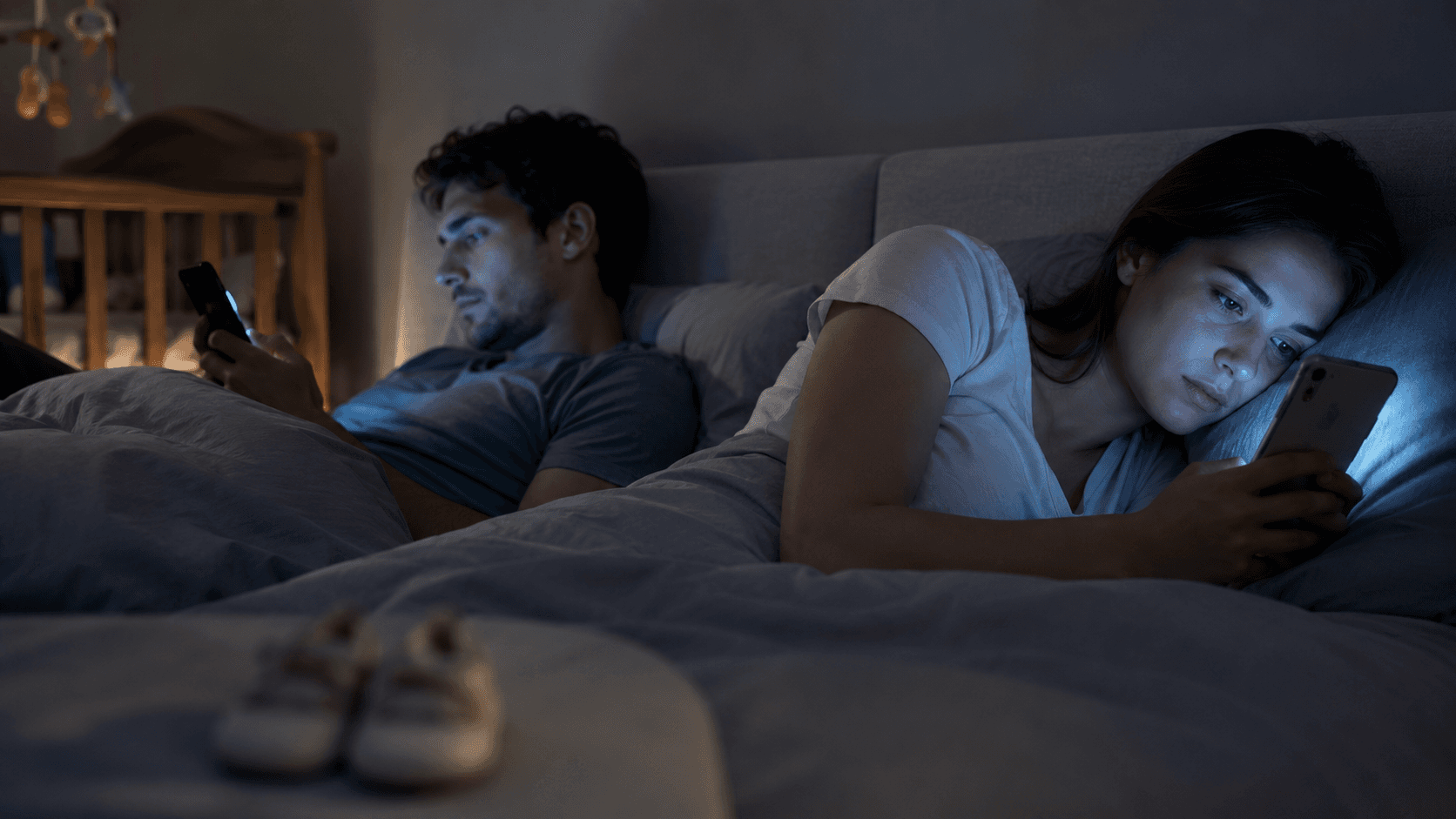
Here is a strange coincidence. The iPhone arrived in 2007. Right around then, birth rates in the United States and many other countries began sliding downward, especially among younger people. The drop has been steep enough that some researchers have started pointing a suspicious finger at the glowing rectangle in everyone's pocket.
The theory is cheeky but serious: maybe we are all so busy scrolling that we forgot to make the next generation.
The behavior theory (the strong one)
Most experts think the real story here is about behavior, not biology. And the behavior part is pretty intuitive once you say it out loud.
Smartphones are extraordinarily good at eating time. Studies show that the more hours people spend on their phones, the fewer hours they spend socializing in person. Less in person socializing means fewer first dates, fewer relationships, and yes, less physical intimacy. You cannot start a family with someone you never actually meet because you both stayed home doomscrolling.
There is also the simple matter of competition. A phone offers endless entertainment, connection that feels social, and a steady drip of little rewards, all without leaving the couch. For a tired young adult, that can quietly out compete the harder, riskier, more expensive project of dating, partnering, and raising kids.
To be fair, birth rates are tangled up with many other things too. The cost of housing, the price of childcare, more women pursuing careers and education, economic uncertainty, and shifting views on whether to have kids at all. Smartphones did not appear in a vacuum, and untangling one cause from the rest is genuinely hard. The phone evidence here is mostly population level, meaning scientists are spotting trends across whole countries rather than proving cause and effect in individuals.
The biology theory (the weaker, weirder one)
There is a second, more controversial idea: that phones might affect fertility directly, at the level of the body.
Some scientists have asked whether the radiation that phones give off could harm sperm. The results are a mixed bag. A large review of 39 studies found that, overall, human data did not strongly support a direct link between phone use and worse sperm quality. However, in lab experiments where sperm were directly exposed to phone radiation in a dish, the sperm did become less able to move and survive. The catch is that sperm sitting in a dish next to a phone is very different from sperm safely tucked inside the human body, so these lab results should be read with caution.
Another angle is sleep. One study found that men who used phones and tablets in the evening and after bedtime had lower sperm concentration and motility, which is the sperm's ability to swim. The likely culprit is not radiation but blue light. Screens at night can disrupt your sleep, and poor sleep throws off the hormones that control reproduction. So the phone might hurt fertility indirectly, by wrecking your rest, rather than by zapping anything.
So which theory wins?
Most researchers land firmly on the behavior side. The phone's biggest effect on birth rates is almost certainly that it changes how we spend our time and who we spend it with, not that it is frying anyone's biology.
Put simply, the problem is probably less about radiation and more about the fact that it is hard to fall in love with someone when you are both staring at a screen.
The bottom line
Smartphones are not the only reason fewer babies are being born, and the science here is still more "interesting pattern" than "proven cause." But the underlying lesson is one most of us already feel in our bones. Real, in person human connection is the thing that builds relationships and families, and our phones are very, very good at quietly stealing the time we used to spend on it.
You do not need a study to test the idea. Put the phone in another room for an evening and see who you end up talking to.
This article is for general education and isn't medical, psychological, or policy advice. The smartphone-and-birth-rate connection is a population-level correlation with many plausible explanations — economics, housing, changing values, and more — so no single cause explains the trend. If phone use is affecting your relationships, sleep, or mental health specifically, that's worth addressing for its own sake; the cluster's phone-that-pulls-you-in article covers the behavioral side. Decisions about whether and when to have children are deeply personal and belong to you, not a statistic.
HSA/FSA Eligible
Doctors Are Human.
That's Why There's Medome.
Start your free trial today. No credit card required.
Start Your Free Trial
Join thousands protecting their health with AI that never forgets
Critical details get missed when your health information is scattered. Medome connects the dots across your complete record.
Start Your Free Trial
Quick Links
Medome Men
Home
Pricing
About
Health News
HealthSigns
FAQ
Contact Us
Terms of Service
Privacy Policy
Get In Touch
Email: service@medome.ai
Phone: (617) 319-6434
This is Dr. Steven Charlap’s cell. Please text him first, explaining who you are and how he can help you. Use WhatsApp outside the US.
Hours: Mon-Fri 9:00AM - 9:00PM ET