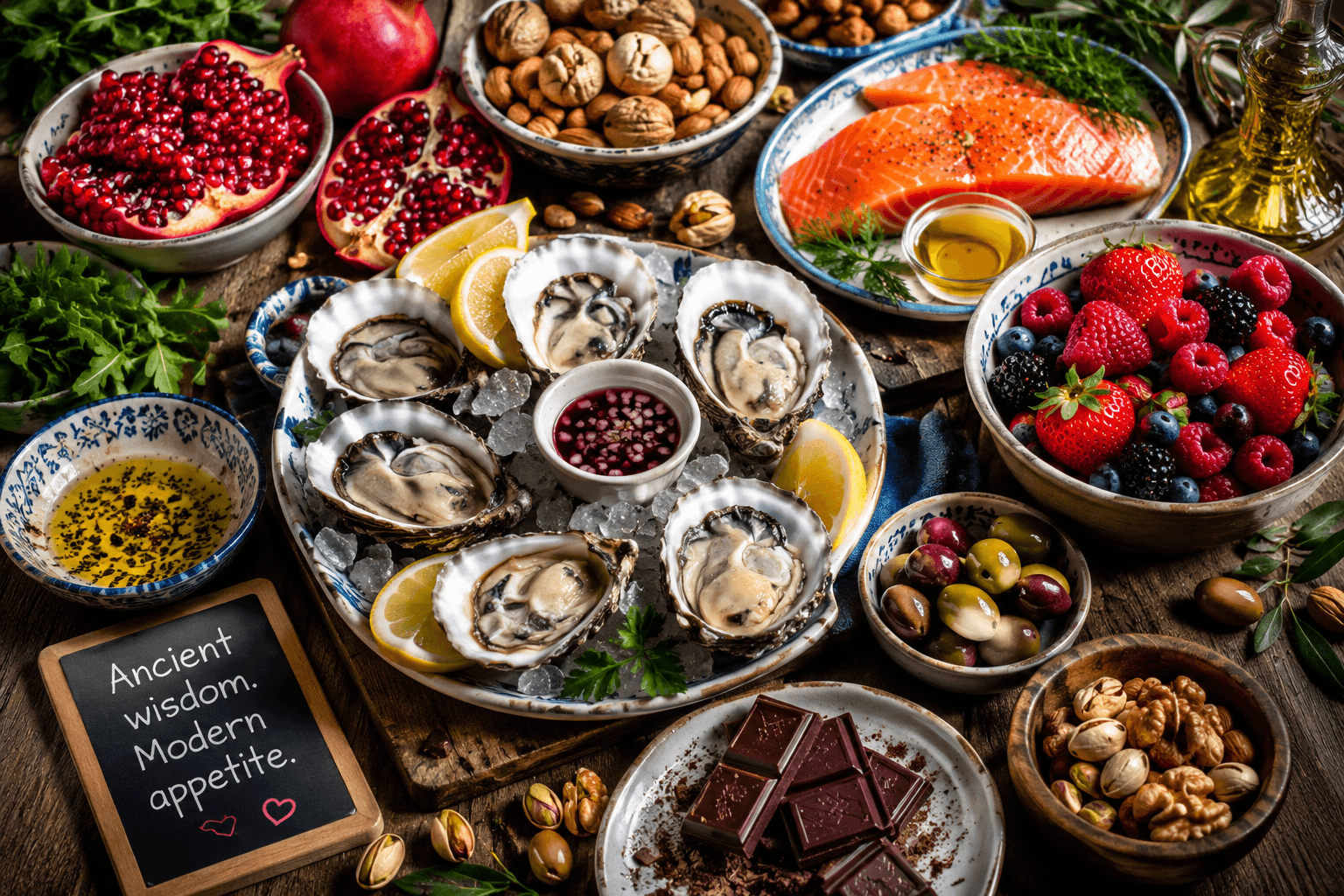
Humans have been hunting for "aphrodisiac" foods since forever. Oysters, chocolate, weird roots, rhino horn (please don't), you name it, someone has sworn it would light a fire. Here's the honest, slightly disappointing truth: no single food is a magic switch that flips you into overdrive twenty minutes after eating it. That's the beautiful lie. But here's the genuinely good news that's way more useful: what you eat, over time, really does shape the machinery your sex life runs on. The real "love potion" isn't sexy at all. It's your blood vessels. Let's talk about how food quietly tunes the engine, which foods actually earn their reputation, and which are mostly marketing.
Science explainer, not medical advice. And one real thing worth saying up front: trouble in this department can be an early sign of a health problem worth checking with a doctor. More on why in a minute.
The Secret Ingredient Behind Almost All of It
If you remember one thing, make it this: a lot of sexual function comes down to blood flow, and blood flow comes down to a tiny molecule called nitric oxide, or NO for short.
Think of nitric oxide as the "green light" chemical. When your body makes it, it tells your blood vessels to relax and widen, letting blood rush in where it's needed. An erection is basically a plumbing event: blood flows in, stays put, and does its job. Arousal in general leans heavily on good circulation. So anything that helps your body pump out more nitric oxide, and protect it once it's made, tends to help things downstairs.
Guess what a shocking number of "sexy foods" have in common? They boost nitric oxide. That's the hidden thread connecting berries, beets, dark chocolate, nuts, and more. Once you see it, the whole topic makes sense.
The Plot Twist: Your Body Is Giving You a Check-Engine Light
Now for the part almost nobody mentions, and it's important. The blood vessels that power an erection are small and sensitive, which means they often show trouble first, before the bigger arteries around your heart do. So difficulty in the bedroom can be an early warning sign of heart and blood-vessel disease brewing elsewhere. It's like a check-engine light for your whole circulatory system.
This flips the usual thinking. Diet doesn't help your sex life through some mystical magic. It helps for the exact same reason it helps your heart: healthy arteries, clean blood flow, low inflammation. What's good for your heart is good below the belt, because it's literally the same plumbing. It also means that if something's genuinely off, the smartest move isn't a mystery supplement off the internet. It's a conversation with a doctor, who might catch a bigger issue early.
⚠️ Erection trouble can be an early warning sign of heart disease — so treat it as a reason to see a doctor, not a reason to self-medicate with online supplements.
The arteries feeding an erection are narrower than the ones feeding your heart, so they tend to clog and misbehave first — which means new or persistent erectile difficulty can precede a heart attack or stroke by years. That makes it a genuinely useful early-warning signal. The wrong response is quietly ordering a "male enhancement" supplement off the internet, which can mask the signal (and some are spiked with hidden drugs that are dangerous alongside heart or blood-pressure medication). The right response: ask a doctor to check your heart health and blood sugar, not just the symptom. Food and lifestyle genuinely help — but they work by protecting the same arteries, which is exactly why this is a "get checked" moment, not a "grab a pill" one. The cluster's heart, diabetes, and Hard Reset guides cover the connection in depth.
The Real Winner: It's a Pattern, Not a Pill
If you want the single most evidence-backed "aphrodisiac," it's boring and wonderful: the Mediterranean diet. Lots of vegetables, fruit, fish, nuts, beans, olive oil, whole grains, not much red or processed meat.
The research here is strong. In a study of over 20,000 men, those eating the most Mediterranean-style had a noticeably lower risk of erectile problems, especially the younger guys. A big 2025 review pulling together many studies found that plant-forward eating, heavy on fruits, vegetables, and nuts, significantly lowered the risk of erectile dysfunction. This isn't one weird trick. It's your everyday plate, working in your favor month after month.
Why does it work? It's a team effort: olive oil and fish calm inflammation and help your blood vessels behave, while colorful plants deliver the raw materials your body uses to make that all-important nitric oxide.
The All-Star Foods (and What They Actually Do)
Certain foods really do pull their weight, mostly by feeding the blood-flow machine:
Flavonoid-rich fruits and veggies are the quiet heroes. In one study, men eating a decent daily dose of these compounds had about 32% lower risk of erectile trouble. Load up on berries, citrus, apples, and peppers. They help your body make more nitric oxide and protect it from breaking down.
Pomegranate has a genuinely cool party trick. In lab tests, pomegranate juice relaxed the relevant tissue impressively, and it seems to work through a slightly different pathway than the famous little blue pill, which hints it might help some people that medication doesn't. Promising, though still early.
Nuts (pistachios, walnuts, almonds) showed up strong, linked to significantly lower erectile-dysfunction risk. They're packed with an amino acid your body turns straight into nitric oxide, plus healthy fats.
Fatty fish like salmon delivers omega-3 fats that reduce inflammation and improve blood-vessel function. Bonus: omega-3s are also linked to better sperm quality in men.
Dark chocolate earns a spot thanks to cocoa compounds that trigger nitric oxide and gently lift your mood. The direct sex research is thin, but the blood-flow logic is solid. (Emphasis on dark and in reasonable amounts, not a daily candy bar.)
Oysters, the legend itself, actually have a real basis: they're the richest food source of zinc, a mineral your body needs to make testosterone. If you're low on zinc, fixing that can genuinely help desire and function. If you're not low, though, chugging oysters won't turn you superhuman.
The Herbal Wild West
Walk into a supplement shop and you'll see shelves of pills promising fireworks. Some have real (if modest) science. Many don't. Here's an honest scorecard:
Ginseng (especially Korean red ginseng) has some of the better evidence, helping mild-to-moderate erectile issues by boosting nitric oxide, plus fighting fatigue and stress.
Fenugreek is one of the more solidly supported herbs for nudging testosterone in men, and some data suggest a libido boost for women too.
Maca has decent reports for improving desire and well-being. Interestingly, it doesn't seem to work by changing testosterone. It appears to act more on brain chemistry, on the "desire" side of things.
Saffron shows up in trials with real improvements in sexual function scores, and it has a centuries-old reputation as a mood-and-libido lifter.
Tribulus terrestris is the cautionary tale. It's marketed everywhere as a testosterone booster, but careful reviews say it basically doesn't raise testosterone in humans. A classic case of hype outrunning evidence.
Big caveat on all of these: the supplement industry is loosely regulated, so what's on the label isn't always what's in the bottle, and doses are all over the place. Buyer beware, and talk to a doctor before adding anything, especially if you take other medications.
What About a Glass of Red Wine?
You've heard red wine is heart-healthy and maybe more. There's a kernel of truth. Red wine contains compounds that relax blood vessels and fight oxidative stress. And a large review found that light drinking was linked to lower erectile-dysfunction risk.
But read the fine print carefully. The relationship is a curve, not a straight line. A little may help, but heavy drinking clearly hurts your sex life and your health, wiping out any benefit and then some. So this is absolutely not a reason to start drinking or to drink more. If you don't drink, the payoff isn't worth it. If you do, keep it modest.
Teamwork Makes the Dream Work
One neat idea: foods work better in combination. Nitric oxide needs both a raw material and protection from breaking down, so pairing a nitric-oxide-boosting food with an antioxidant-rich one (say, nuts with berries, or a bit of dark chocolate) does more than either alone. Zinc from seafood pairs well with vitamin D from fatty fish. Omega-3s from salmon team up beautifully with the polyphenols in olive oil and vegetables. If this list sounds familiar, it should: it's basically just a Mediterranean plate again. The "best combination" isn't a secret stack. It's a normal, colorful, mostly-plants meal.
The Honest Fine Print
Time for grown-up honesty. A lot of the research on individual foods comes from lab studies, animal studies, or small trials, not giant airtight experiments. So treat bold claims about any single food with a healthy pinch of salt. Diet also can't out-muscle everything: being very overweight, having diabetes or heart disease, chronic stress, anxiety, and relationship strain are all major players, and no amount of pomegranate juice fixes those on its own. And worth remembering, desire (which lives mostly in the brain) and physical performance (mostly about blood flow) aren't the same thing. Most of the food evidence is about the plumbing side.
The Bottom Line
The great aphrodisiac hunt has a funny ending: the winner isn't some exotic ingredient, it's the plain old heart-healthy diet you've heard about a hundred times. Eat like your blood vessels matter, because for your sex life, they do. Pile on the colorful plants, fish, nuts, and olive oil, go easy on the processed junk and heavy drinking, and stay skeptical of pills promising magic. And if something feels genuinely off, don't quietly self-medicate with a shady supplement. See a doctor, because your body might be trying to tell you something bigger. The sexiest thing you can do for yourself, it turns out, is take care of your heart.
This article is for general education and isn't medical advice. The honest headline: no single food is a magic switch, but a Mediterranean-style, plant-forward diet genuinely supports the blood flow your sex life runs on — because it's the same circulation that protects your heart. Two things worth acting on: treat new or persistent erection trouble as a reason to see a doctor (it can be an early warning sign of heart or blood-sugar problems), and be skeptical of "enhancement" supplements, which are loosely regulated, sometimes mislabeled, and occasionally spiked with hidden drugs that are dangerous alongside other medications — check with a clinician before adding anything. The cluster's Hard Reset, heart, diabetes, and zinc-and-testosterone guides go deeper.
HSA/FSA Eligible
Doctors Are Human.
That's Why There's Medome.
Start your free trial today. No credit card required.
Start Your Free Trial
Join thousands protecting their health with AI that never forgets
Critical details get missed when your health information is scattered. Medome connects the dots across your complete record.
Start Your Free Trial
Quick Links
Medome Men
Home
Pricing
About
Health News
HealthSigns
FAQ
Contact Us
Terms of Service
Privacy Policy
Get In Touch
Email: service@medome.ai
Phone: (617) 319-6434
This is Dr. Steven Charlap’s cell. Please text him first, explaining who you are and how he can help you. Use WhatsApp outside the US.
Hours: Mon-Fri 9:00AM - 9:00PM ET