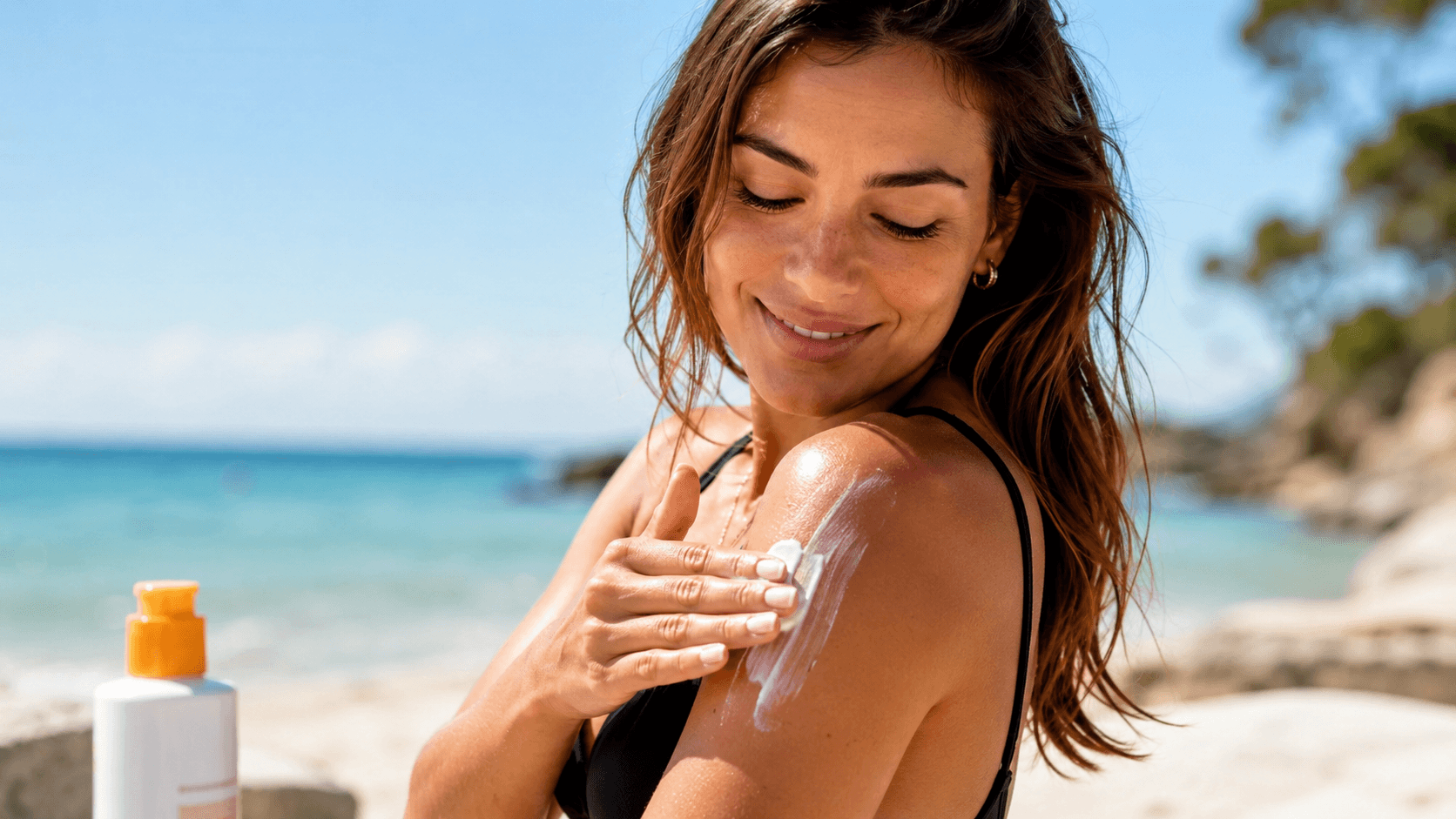
The sun is basically a giant nuclear reactor 93 million miles away, quietly showering you with invisible rays. Most of the time this is lovely. It grows our food, lifts our mood, and makes beach days possible. But a slice of that sunlight, the ultraviolet part, spends its free time picking fights with the DNA in your skin. Sunscreen is the cheap, boring armor that wins those fights. So let's talk about how UV actually hurts you, whether sunscreen really works, and how to use the stuff without falling for the myths.
This is a science explainer, not personal medical advice. If you've got a suspicious mole or specific skin concerns, that's a dermatologist conversation.
Meet the Two Villains: UVA and UVB
Ultraviolet light comes in two flavors that damage your skin in different ways. Think of them as two different criminals.
UVB is the smasher. These rays get absorbed straight into your DNA and physically warp it, jamming DNA building blocks together into little kinks. Your cells have a repair crew that fixes most of these, but when the crew misses one, the cell copies the mistake and locks in a mutation. These specific "UV fingerprint" mutations show up in the huge majority of the most common skin cancers. UVB is the main reason a bad sunburn is genuinely bad news, not just uncomfortable.
UVA is the sneak. There's about 20 times more UVA in sunlight than UVB, and it dives deeper into your skin. Instead of smashing DNA directly, it creates unstable molecules called free radicals that damage your DNA sideways, like rust quietly eating a car. UVA is a big driver of wrinkles and aging too, which is why dermatologists half-jokingly call it the "aging" ray.
And here's a bonus dirty trick: UV light also weakens your skin's immune defenses. Normally your immune system patrols for cells that have gone rogue and destroys them before they become cancer. UV partly disables those patrols, so damaged cells get a chance to slip through. So the sun doesn't just create the problem. It also tells your body's security guards to take a nap.
Two quick facts that make it real: an estimated 93% of melanoma cases and deaths in the US are blamed on UV, and there were over 4.3 million new non-melanoma skin cancers in a single recent year. This isn't a rare freak thing. It's extremely common.
One more useful nuance. Slow, steady sun over the years (think outdoor workers) is most tied to one kind of skin cancer, while the intense, occasional roasting that gives you a blistering sunburn is most strongly linked to melanoma, the scariest kind. So the "I only burn twice a summer" crowd isn't off the hook. Those burns matter a lot.
Okay, But Does Sunscreen Actually Work?
Fair question, and the honest answer has two parts.
The gold-standard evidence comes from an Australian study called the Nambour Trial, the only big randomized experiment on this. Researchers had over 1,600 adults either use sunscreen every single day or use it whenever they felt like it, then followed them for years afterward. The daily users ended up with far fewer invasive melanomas (just 3, versus 11 in the casual group) and about 38% fewer of the common squamous cell cancers. That's a strong, real result.
Now the messy part. Other, weaker studies sometimes fail to show a clear benefit, and one 2025 review found no obvious link between "ever using sunscreen" and melanoma. But before you toss your bottle, understand why those studies are tricky. It's a sneaky trap called confounding by indication. In plain English: the people who slather on sunscreen are often the exact people most at risk, the pale, freckly, sunburn-prone folks who spend tons of time outdoors. So sunscreen users can look like they get more skin cancer, not because sunscreen fails, but because sun-sensitive people were doomed to more risk and more likely to reach for sunscreen. Untangle that, and the evidence points toward protection. Modeling studies estimate that boosting sunscreen use could prevent hundreds of thousands of melanomas.
Chemical vs. Mineral: Two Ways to Fight a Photon
Walk down the sunscreen aisle and you'll hit two camps.
Chemical (organic) sunscreens use carbon-based ingredients with tricky names like avobenzone and oxybenzone. They work by soaking up UV rays and turning that energy into a tiny bit of heat. Most of them only cover part of the UV range, so brands mix several together to guard against both UVA and UVB. Upside: they rub in clear and feel light.
Mineral (inorganic) sunscreens use just two ingredients, zinc oxide and titanium dioxide. They both absorb UV and physically bounce some of it away, like tiny mirrors. Zinc oxide in particular covers a nice broad range. Upside: they're gentle and sit on top of the skin. Downside: the classic ghostly white cast.
So which is "better"? That depends, and it leads straight into the safety question everyone's been whispering about.
The "Chemicals in My Blood!" Scare, Calmly Explained
You may have seen scary headlines that sunscreen chemicals get absorbed into your bloodstream. Here's the real story, no panic required.
The FDA ran careful tests where people slathered on chemical sunscreen the way you're supposed to (a lot, often, over most of the body). Sure enough, all six chemical filters they tested showed up in people's blood above the FDA's "let's study this more" line. One ingredient, oxybenzone, showed up at wildly high levels and lingered for days. That's why the FDA has fully signed off on only the two mineral ingredients, zinc and titanium, as proven safe and effective, while asking for more data on the chemical ones. Zinc, for the record, has strong evidence that it stays on your skin and doesn't sink in.
But (and this is the important but) "detectable in blood" is not the same as "harmful." In lab and animal studies, a couple of chemical filters can act a little like hormones, which is the source of the worry. Yet when researchers compared the tiny amounts found in actual humans to the amounts needed to mess with hormones, almost everything was at least 100 times too low to matter. A study where people used chemical sunscreen head to toe for days found the ingredients in their bodies but no change to their reproductive hormones. The FDA has been crystal clear: these findings are a reason to keep studying, not a reason to stop using sunscreen. The known danger of skipping sun protection is real and large. The theoretical danger from absorption is small and unproven. If you're still uneasy, the answer is simple: reach for a mineral zinc sunscreen and relax.
The New Kid on the Block: Bemotrizinol
For over 25 years, the US hadn't approved a truly new sunscreen ingredient. Then came bemotrizinol (mercifully nicknamed BEMT), which has been used safely in Europe, Asia, and Australia for two decades and finally got the US green light. Why is it a big deal? It's kind of a unicorn:
It covers both UVA and UVB from a single ingredient, so you don't need a cocktail of chemicals.
It barely absorbs into the body. Its molecules are big and bulky, so they can't sink into skin the way oxybenzone does. In testing it stayed near-invisible in the bloodstream.
It doesn't act like a hormone in lab tests.
Basically, BEMT tries to combine the best of both worlds: the clear, cosmetically pleasant feel of a chemical sunscreen (no white cast, works on all skin tones) with the low-absorption safety of a mineral one. That's a genuinely nice upgrade.
SPF Math: The 97% vs. 98% Trick
Here's a number game people constantly get fooled by. You've probably heard "SPF 30 blocks 97% of rays and SPF 50 blocks 98%, so why bother with 50 for a measly 1% more?"
That framing is sneaky and wrong. Don't look at the percent blocked. Look at the percent that gets through to your skin. SPF 30 lets about 3.3% of burning rays through. SPF 50 lets about 2% through. That means SPF 50 lets in noticeably less than half again the rays of SPF 30. The gap is bigger than "1%" makes it sound.
And in the real world it matters even more, because almost nobody applies enough sunscreen (more on that in a second). When you under-apply, a higher starting SPF gives you a bigger safety cushion. In one outdoor test, SPF 15 let people burn about 20% of the time, SPF 30 dropped that to 4%, and SPF 50+ to just 1.5%. Dermatologists recommend at least SPF 30, broad spectrum. That "broad spectrum" label is key, because plain SPF only measures UVB protection. Broad spectrum means it fights UVA too.
The Plot Twist: Your T-Shirt Might Beat Your Sunscreen
Here's something the sunscreen industry doesn't advertise. When researchers pitted UV-protective clothing against good sunscreens, the fabrics won on every measure, especially against sneaky UVA. Why? Partly because clothing doesn't wear off, doesn't get sweated away, and doesn't depend on you applying a perfect, generous layer. A shirt just... keeps working.
That's why major health groups say the smart order is: clothing and shade first, sunscreen as backup for the skin you can't cover. Clothes now come with a UPF rating (the fabric version of SPF). And don't forget your head. A wide-brimmed hat (a good 3 inches of brim all the way around) shields your face, ears, and the back of your neck, all prime skin-cancer real estate. Sorry, baseball cap fans: those leave your ears and neck totally exposed. Bucket hats too.
Fake Tans: A Safer Glow, But Zero Shield
Want color without the DNA damage? Sunless tanners are a reasonable option. Their active ingredient, DHA, reacts with the dead cells on your skin's surface to make brown pigment, kind of like how bread browns when it toasts. It's the same basic chemistry. The FDA okays it for external use, and for most people the worst side effect is some skin irritation.
But here's the catch people miss: a fake tan gives you almost no sun protection. That bronze color is not armor. Worse, some lab studies hint that DHA might actually stress skin cells, raising the (still theoretical) worry that a spray tan could make you slightly more vulnerable to sun damage, not less. So enjoy the glow if you like it, keep the product away from your eyes and mouth, and never treat it as a substitute for real sun protection.
Your Actual Game Plan
Put it all together and here's the layered routine the experts recommend:
Seek shade during peak hours, roughly 10 AM to 4 PM, when UV is fiercest. And remember UV punches through clouds and car windows (UVA especially), so "it's overcast" is not a free pass.
Cover up with UPF clothing, a wide-brimmed hat, and UV-blocking sunglasses. This is your strongest layer.
Apply enough sunscreen. This is where everyone fails. Full-body coverage takes about one ounce, roughly a shot glass full. Most people use a quarter of that, which quietly turns their SPF 30 into something more like SPF 8. Reapply every 2 hours, and after swimming or sweating.
Check the UV Index (it's in most weather apps) and armor up more on high days.
🚫 Never use tanning beds — there is no such thing as a "safe base tan."
Indoor tanning is a proven cause of skin cancer, including melanoma, and using tanning beds before age 35 raises melanoma risk substantially. The idea of building a protective "base tan" is a myth: a tan is literally your skin's damage alarm going off — visible proof that UV has already scrambled your DNA. There is no safe amount of intentional tanning, indoor or out. If you want color, a sunless tanner (DHA) gives you the glow without the DNA damage, as long as you remember it provides zero actual sun protection. And if a spot on your skin is new, changing, asymmetric, or won't heal, that's a dermatologist visit — caught early, skin cancer is highly treatable.
The Bottom Line
The sun isn't your enemy, but its UV rays are relentless little vandals, smashing and rusting the DNA in your skin while telling your immune guards to look the other way. The good news is that protection is cheap, easy, and genuinely works. Cover up, find shade, wear a real hat, and use a solid broad-spectrum sunscreen (apply way more than you think you need). If ingredient worries nag at you, a mineral zinc formula or the new bemotrizinol sidesteps them nicely. Do the boring stuff now, and your future skin, less wrinkled and far less likely to end up in a dermatologist's biopsy report, will be very glad you did.
This article is for general education and isn't medical advice. The evidence is clear that broad-spectrum sun protection lowers skin-cancer risk, and both mineral (zinc, titanium) and the newer bemotrizinol are excellent low-absorption options if the chemical-filter headlines worry you. Two things worth acting on beyond daily sunscreen: skip tanning beds entirely, and get familiar with your own skin — a new, changing, or non-healing spot deserves a dermatologist's eye, because early skin cancer is highly curable. If you're at higher risk (fair skin, lots of moles, family history, or a history of bad sunburns), ask your doctor how often you should have a professional skin check.
HSA/FSA Eligible
Doctors Are Human.
That's Why There's Medome.
Start your free trial today. No credit card required.
Start Your Free Trial
Join thousands protecting their health with AI that never forgets
Critical details get missed when your health information is scattered. Medome connects the dots across your complete record.
Start Your Free Trial
Quick Links
Medome Men
Home
Pricing
About
Health News
HealthSigns
FAQ
Contact Us
Terms of Service
Privacy Policy
Get In Touch
Email: service@medome.ai
Phone: (617) 319-6434
This is Dr. Steven Charlap’s cell. Please text him first, explaining who you are and how he can help you. Use WhatsApp outside the US.
Hours: Mon-Fri 9:00AM - 9:00PM ET