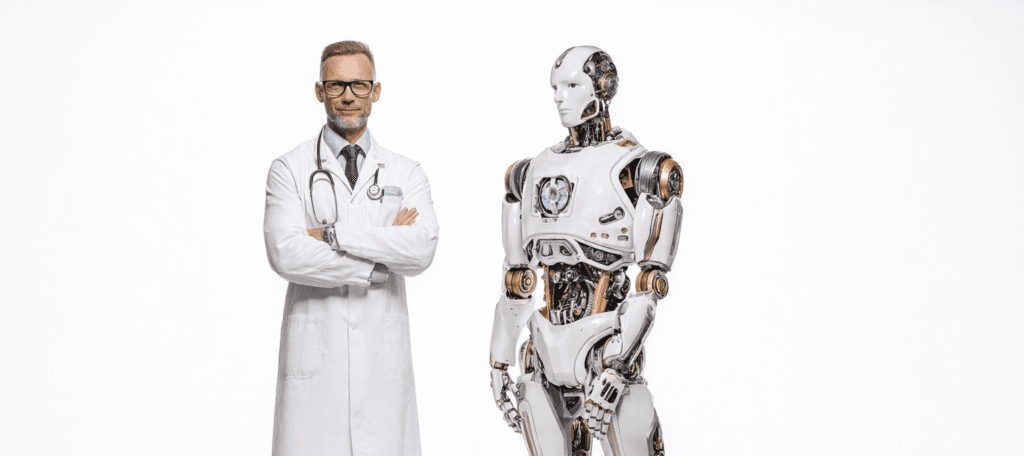
That’s A Good Thing. Why an AI-First Primary Care Model Is Overdue
Let’s be honest: the last time you saw your primary care doctor, they probably spent more time clicking through your electronic health record than making eye contact with you. The average physician visit lasts 18 minutes, and roughly half of that is documentation. Meanwhile, your doctor is juggling thousands of patients, often runs behind schedule, and hasn’t slept properly since medical school.
Enter artificial intelligence, not to replace your doctor, but to make your doctor actually great at their job again.
The Numbers Don’t Lie (Even If Your Insurance Company Does)
Critics love to point out that AI makes mistakes. Fair enough. But here’s an inconvenient truth: so do humans—a lot. A Stanford study found that ChatGPT alone achieved 92% diagnostic accuracy on complex cases. Physicians using traditional methods? Around 74%. The AI wasn’t perfect, but it was consistently better than tired humans working under impossible conditions.
In radiology and pathology, AI has reduced diagnostic time by up to 90% while improving accuracy. GPT-4 hit 94% accuracy in radiological differential diagnosis in 2025, an improvement from 67% just one year earlier. That’s not incremental progress; that’s a revolution happening in real-time.
And for those worried about AI getting worse over time: it doesn’t. It gets better. Every model update, every training refinement, every new dataset makes it sharper. Your physician, meanwhile, has been practicing the same way since residency and hasn’t read a journal article since their kid’s soccer season started.
“But What About People Who Can’t Afford It?”
This is where AI doesn’t just match traditional care, it destroys it. In December 2024, India launched the world’s first nationwide AI-enabled tuberculosis screening program. Within 100 days, they screened over 120 million people in underserved communities using AI-powered handheld X-rays. That’s not a pilot program; that’s a public health miracle.
The United States is projected to face a shortage of up to 124,000 physicians by 2036. Rural communities already struggle to access basic care. AI doesn’t need to commute. It doesn’t need housing incentives to practice in Montana. It works 24/7, speaks multiple languages, and can be deployed anywhere there’s an internet connection.
Studies show AI-powered risk stratification has improved hypertension control in low-income populations by 34% and increased medication adherence by 22%. For the first time in healthcare’s history, we have technology accessible enough to give everyone capabilities they don’t personally possess, and that previously required a specialist who might be 200 miles away.
The Cost Question (Spoiler: AI Wins)
Healthcare costs in America are climbing toward $7.7 trillion by 2032. One-third of Americans already find their healthcare unaffordable. McKinsey and Harvard researchers estimate AI could save the U.S. up to $360 billion annually. The NHS documented £250 million in savings between 2022 and 2024 just from AI chatbots and clinical coding automation.
Administrative tasks account for 15-30% of all healthcare spending, far higher than any other developed nation. AI can automate 20% of those tasks immediately. That’s not futurism; that’s available technology being criminally underutilized while your insurance company sends you another incomprehensible bill.
“But AI Is Biased!”
Yes. And so is your doctor. The difference is that AI bias can be systematically identified, measured, and corrected. Human bias operates in the shadows of clinical intuition. Medome.ai has built anti-bias algorithms for that sole purpose.
The FDA has approved over 882 AI-enabled medical devices as of 2024, with robust frameworks for bias detection throughout the AI lifecycle. Researchers are implementing fairness-aware algorithms, using diverse training datasets, and mandating transparent decision-making. Try getting a human physician to explain exactly why they made a diagnosis, they often can’t. AI can show its work.
The key is equity-centered design from the start: co-developing AI with affected communities, building diverse AI workforces, and treating bias mitigation as a feature, not an afterthought.
What AI-First Actually Looks Like: The Medome Model
Consider what companies like Medome.ai are building. Their platform doesn’t replace physicians, it makes them error-proof. The AI conducts thorough patient interviews, capturing every symptom and concern that might get lost in a rushed appointment. It performs comprehensive risk assessments before you even sit down. It catches every word your doctor says, creating accurate documentation in real-time so your physician can actually look at you instead of their keyboard.
But here’s the genius part: Medome offers a second opinion on every case. Not to override your doctor, but to ensure nothing gets missed. When human fatigue and cognitive overload inevitably kick in, usually around patient number 15 of a 30-patient day, after lunch has been skipped and decision-fatigue starts to kick-in, the AI is still sharp, still thorough, still catching the detail that could save your life.
Complete chart review and analysis? Done before your appointment starts. Your entire medical history synthesized and highlighted, with potential drug interactions flagged and relevant research surfaced. This isn’t science fiction, it’s what thoughtful AI integration looks like when designed by people who understand both medicine and technology.
The Human Touch Argument (And Why It’s Backwards)
Critics worry AI will destroy the physician-patient relationship. But look at what’s destroying it now: doctors spending 50% of their time on documentation, burning out at record rates, and seeing patients for 18-minute intervals where meaningful connection is mathematically impossible.
AI-first care doesn’t eliminate human connection, it creates space for it. When AI handles the administrative burden, the documentation, the chart review, and the risk screening, physicians can do what they are actually trained for: connecting with patients, exercising clinical judgment, and practicing medicine as a healing art rather than a data entry job.
AI can also identify when a physician is not necessary or an alternative over-the-counter therapy will suffice over a prescription med.
The Bottom Line
AI in primary care isn’t a threat, it’s a rescue mission. For overwhelmed physicians drowning in paperwork. For underserved communities lacking access to primary care and specialists. For patients who deserve more than 18 rushed minutes with someone who can barely remember their name.
The technology isn’t perfect. Neither is surgery, chemotherapy, or your doctor’s handwriting. But it’s improving at a pace that makes human learning look glacial. Every month, AI gets more accurate, more accessible, and more capable of catching what humans miss.
The question isn’t whether AI should be part of primary care. The question is how long we’re willing to let patients suffer while we debate a future that’s already here and waiting.
Your doctor is human. Your healthcare system is broken. AI is ready when you are. www.medome.ai
HSA/FSA Eligible
Doctors Are Human.
That's Why There's Medome.
Start your free trial today. No credit card required.
Start Your Free Trial
Join thousands protecting their health with AI that never forgets

Critical details get missed when your health information is scattered. Medome connects the dots across your complete record.
Start Your Free Trial
Get In Touch
Email: service@medome.ai
Phone: (617) 319-6434
This is Dr. Steven Charlap's cell. Please text him first, explaining who you are and how he can help you. Use WhatsApp outside the US.
Hours: Mon-Fri 9:00AM - 9:00PM ET