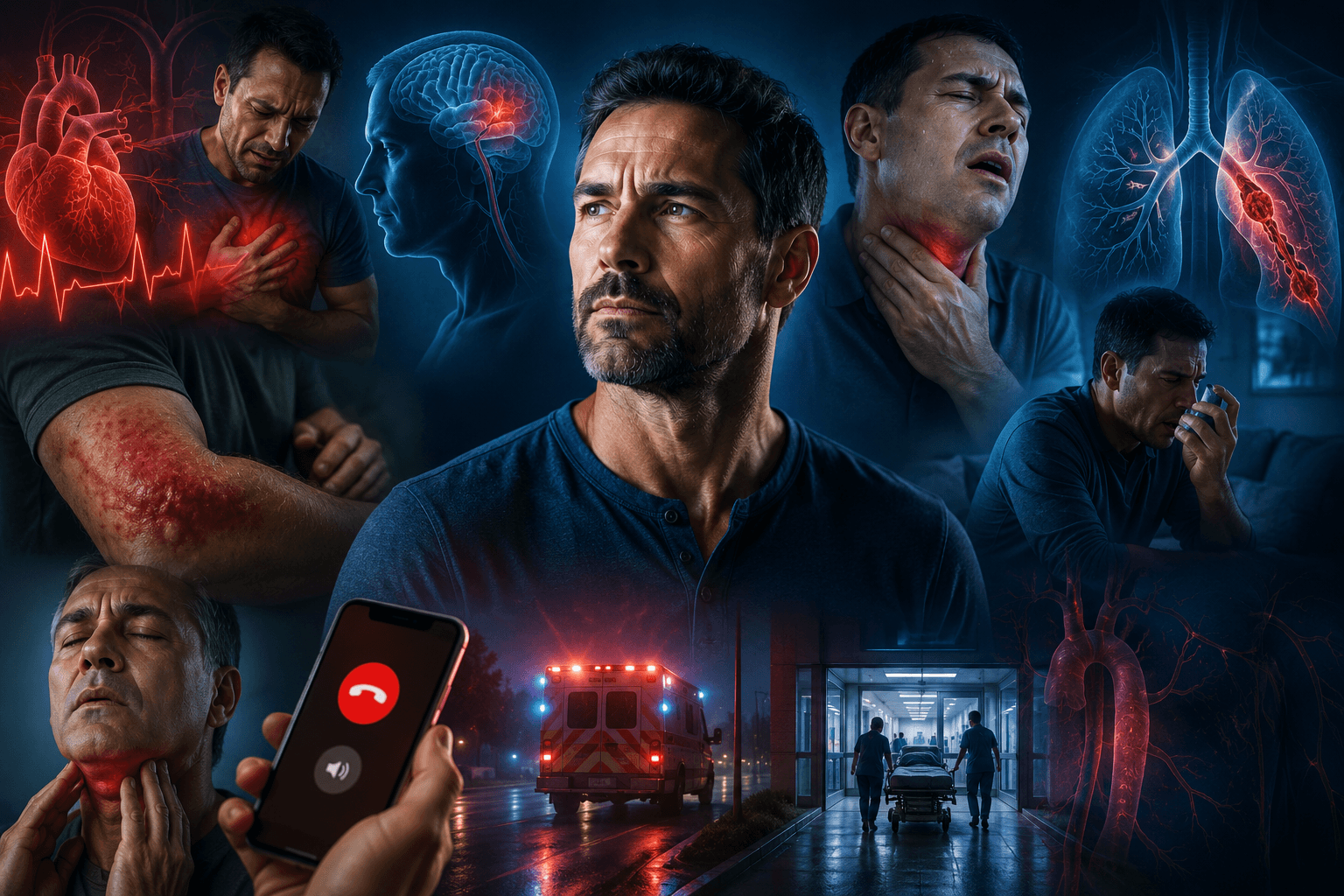
When to Call 911 or Go to the Emergency Room: A Man's Field Guide to the Warning Signs That Actually Matter
Most of us would rather do almost anything than go to the emergency room. Wait it out. Sleep it off. Tough it out. Google it. Anything.
That instinct is what kills people.
The hard truth: a meaningful share of cardiac, vascular, infectious, and surgical emergencies kill or maim because the person at the center of them waited too long. Not because the warning signs weren't there. Because the warning signs got dismissed.
This is the field guide for the ones that don't forgive delay. Read it once now so you recognize what you're looking at when it shows up. Read it again if you're a man over 40, or if you care about one.
Use this as a safety guide, not a diagnosis. If symptoms are severe, sudden, fast-moving, or frightening — get emergency help. Use your local emergency number if you're outside the U.S.
🚨 Call 911 right now if you have any of these.
Chest pressure, stroke signs, collapse, or sudden severe shortness of breath.
Confusion, fainting, extreme sleepiness, or a sudden change in alertness.
Severe allergic reaction, throat swelling, wheezing, dizziness, or collapse.
Uncontrolled bleeding, bloody vomit, major rectal bleeding, or coughing up blood.
Rapidly worsening infection, severe pain, or skin turning purple, black, or blistered.
The 5 Rules That Can Save Your Life
If any of these are happening, do not wait to "see if it gets better."
Fast worsening. Symptoms getting worse over hours, not days.
Hidden severe pain. Pain much worse than what you can see.
Confusion. Illness, chest pain, infection, or bleeding plus confusion or unusual sleepiness.
Sudden severe symptoms. Sudden chest pain, trouble speaking, severe headache, shortness of breath, or vision loss.
Bleeding that will not stop. Vomiting blood, rectal bleeding, coughing blood, or bleeding from a wound.
If you are looking up symptoms while in pain, do not wait. Call 911 or have someone drive you to the ER.
The Red Flag Conditions
What follows is the field guide. Each condition includes what it is, the signs that mean call 911 or go to the ER now, and the context that helps you know how seriously to take it. The conditions are grouped roughly by the system they affect — cardiac and vascular first, then bleeding, infection, allergy, exposures, and the rest.
Heart attack
Acute coronary syndrome — Call 911 immediately.
A heart attack happens when blood flow to part of the heart is blocked. Every minute matters.
Call 911 immediately if you have:
Chest pressure, tightness, squeezing, or heaviness lasting more than a few minutes, or that goes away and comes back.
Pain or discomfort spreading to the shoulder, arm, neck, jaw, back, or upper abdomen.
Shortness of breath, with or without chest discomfort.
Cold sweat, nausea, vomiting, or lightheadedness with chest symptoms.
A feeling of impending doom.
What many men get wrong: heart attack pain is usually more like pressure, squeezing, or a heavy weight on the chest. It is often not sharp or stabbing.
While waiting for 911: chew one regular aspirin, 325 mg, or four baby aspirin, 81 mg each, unless you are allergic or were told not to take aspirin. Do not drive yourself.
Aortic dissection
Tearing of the main artery — Call 911 immediately.
This is a tear in the wall of the aorta, the largest artery in the body. It can be fatal within minutes to hours.
Call 911 immediately if you have:
Sudden, severe, "ripping" or "tearing" chest or back pain.
Pain that starts in the chest and spreads to the upper or lower back.
Sudden onset pain, not a slow buildup.
Blood pressure that is very different between your two arms.
Sudden weakness or inability to move a leg.
Sudden difficulty speaking or vision changes.
Fainting or feeling like you are about to faint.
Cardiac arrest and dangerous heart rhythms
Collapse or dangerous rhythm — Call 911 + start CPR.
Cardiac arrest means the heart has stopped pumping effectively. Without CPR and defibrillation, death can occur within minutes.
Call 911 immediately if someone:
Suddenly collapses and is unresponsive.
Is not breathing or is only gasping.
Has no pulse, if you know how to check.
Start CPR immediately: push hard and fast in the center of the chest, 100 to 120 compressions per minute. Use an AED if one is available.
Warning signs before collapse: palpitations with lightheadedness, sudden rapid heartbeat with chest pain or shortness of breath, fainting during exercise, or unexplained fainting without warning.
Pulmonary embolism
Blood clot in the lungs — Call 911 or go now.
A pulmonary embolism is a blood clot that travels to the lungs. Symptoms can be vague, which makes it easy to miss.
Call 911 or go to the ER immediately if you have:
Sudden shortness of breath without a clear reason.
Sharp chest pain that gets worse when you breathe in.
Rapid heartbeat with shortness of breath.
Coughing up blood.
Fainting or near-fainting.
Leg swelling, pain, redness, or warmth in one leg.
Critical point: suspect PE when chest pain or shortness of breath has no obvious cause.
Tension pneumothorax
Collapsed lung under pressure — Call 911 immediately.
Air becomes trapped around the lung and presses on the lung and heart. This is life threatening.
Call 911 immediately if you have:
Sudden, severe chest pain on one side.
Rapidly worsening shortness of breath.
Feeling like you cannot get enough air despite trying.
Neck veins that look swollen or bulging.
Windpipe that appears shifted to one side.
Rapid heartbeat with dropping blood pressure.
Acute heart failure
Fluid backing up into the lungs — Go to the ER immediately.
When the heart cannot pump well, fluid can back up into the lungs. This can happen suddenly.
Go to the ER immediately if you have:
Severe shortness of breath, especially when lying flat.
Waking up suddenly at night gasping for air.
Frothy, pink-tinged sputum when coughing.
Rapid weight gain with swollen ankles or legs.
Inability to walk across a room without becoming severely short of breath.
Rapid or irregular heartbeat with any of the above.
Stroke
Brain attack — Call 911 immediately.
Stroke treatment must happen within hours. Every minute of delay means more brain cells die.
Use FAST. Call 911 immediately if you notice:
Face: one side of the face droops when the person smiles.
Arms: one arm drifts downward when both arms are raised.
Speech: speech is slurred, strange, or hard to understand.
Time: call 911 immediately and note when symptoms started.
Other warning signs: sudden numbness or weakness, confusion, trouble seeing, trouble walking, dizziness, loss of balance, or sudden severe headache with no known cause.
Do not wait to see if symptoms go away. Even brief symptoms may be a mini-stroke and can be followed by a full stroke.
Bloody vomit
Upper gastrointestinal bleeding — Go to the ER immediately.
Vomiting blood means bleeding somewhere between the mouth and upper small intestine.
Go to the ER immediately if you have:
Vomiting bright red blood.
Vomiting material that looks like coffee grounds.
Black, tarry, sticky stools, with or without vomiting blood.
Lightheadedness, dizziness, or fainting.
Rapid heartbeat or feeling faint when standing.
Danger signs of severe blood loss: fast heart rate, low blood pressure, confusion, pale clammy skin, or not urinating.
Bright red vomit can mean active heavy bleeding. Do not wait. Do not drive yourself.
Rectal bleeding and lower GI bleeding
Lower gastrointestinal bleeding — Go to the ER immediately.
Most small rectal bleeding is not dangerous, but some bleeding can be life threatening.
Go to the ER immediately if you have:
Large amounts of bright red blood from the rectum.
Blood clots passing from the rectum.
Rectal bleeding with dizziness, lightheadedness, or fainting.
Rectal bleeding with rapid heartbeat or feeling faint when standing.
Dark or maroon-colored stools.
Any rectal bleeding with pale skin, confusion, rapid pulse, or low blood pressure.
Less urgent but still important: small bright red blood on toilet paper, especially with straining, is often from hemorrhoids or a fissure but should still be checked.
Warning: painless, massive rectal bleeding can be diverticular bleeding and may be life threatening.
Uncontrolled external bleeding
Uncontrolled bleeding — Call 911 + apply pressure.
Severe bleeding from a wound or injury can be fatal within minutes if it is not controlled.
Call 911 and act immediately if:
Blood is spurting or pulsing from a wound.
Bleeding does not stop after 10 minutes of firm direct pressure.
Blood is soaking through bandages rapidly.
The person is becoming pale, confused, or losing consciousness.
There is a large pool of blood on the ground.
What to do: apply firm direct pressure with a clean cloth or clothing. If it soaks through, add more on top and keep pressing.
If bleeding is from an arm or leg and pressure is not working: apply a tourniquet above the wound, between the wound and the heart. Tighten until bleeding stops and note the time.
Coughing up blood
Bleeding from the airways or lungs — Go to the ER immediately.
Coughing up blood means bleeding somewhere in the airways or lungs.
Go to the ER immediately if you have:
Coughing up more than a teaspoon of blood.
Blood that is bright red and frothy.
Coughing up blood with shortness of breath or chest pain.
Coughing up blood with fever and weight loss.
Any amount of coughed-up blood if you are on blood thinners.
Coughing vs. vomiting blood: coughed-up blood is often bright red and frothy. Vomited blood may be darker or look like coffee grounds. If unsure, go to the ER.
Sepsis warning signs
Infection spreading through the body — Call 911 or go now.
Sepsis happens when an infection triggers a dangerous whole-body reaction. It can lead to organ failure. Treat it like a medical emergency.
Go to the ER if you have a known or possible infection plus any of these:
Confusion, disorientation, or trouble staying awake.
Fast breathing or feeling like you cannot catch your breath.
Heart racing at rest, especially over 100 beats per minute.
Fever, shaking chills, feeling very cold, or a very low temperature.
Skin that looks mottled, blotchy, blue, gray, or very pale.
No urination for more than 6 hours, or much less urine than usual.
A sudden feeling that something is very wrong or that you might die.
Highest-risk pattern: infection plus confusion, fast breathing, or low blood pressure. Fever may be absent, especially in older adults or people with weak immune systems.
Plain-language takeaway: If infection changes the brain, breathing, blood pressure, skin color, or urine output, get emergency care.
Necrotizing fasciitis
Deep tissue infection — Surgical emergency.
This is a fast-moving infection under the skin. It can destroy tissue quickly. Antibiotics alone may not be enough; surgery is often needed fast.
Go to the ER immediately if you have:
Pain that is far worse than the skin looks. This is the most important warning sign.
Redness, swelling, or pain spreading over hours.
Skin turning purple, dark, gray, or black.
Blisters, especially blood-filled blisters.
A crackling or popping feeling under the skin.
Numbness or loss of feeling in the painful area.
Fever with a wound that is getting worse despite antibiotics.
Why this gets missed: early skin changes may look like a routine skin infection, but the pain may be much more severe than expected.
Higher-risk groups: Diabetes, obesity, IV drug use, recent surgery, weak immune system, chronic liver disease, and poor circulation.
Fournier gangrene
Private-area infection can be dangerous — Go now.
Fournier gangrene is a necrotizing infection of the genitals or the area between the genitals and anus. It is a surgical emergency.
Go to the ER immediately if you have:
Rapidly worsening pain, swelling, or redness of the scrotum, penis, or perineum.
Scrotal swelling that is getting worse by the hour.
Genital skin turning dark, black, gray, or blistered.
Foul-smelling drainage from the genital area.
Fever with genital or perineal pain.
A crackling feeling in the scrotal or perineal skin.
Do not be embarrassed. Rapid genital or perineal infection can be life-threatening. Emergency teams see this and can help.
Higher-risk groups: Diabetes, obesity, alcohol use disorder, and weak immune system. Diabetes is common in Fournier gangrene cases.
Meningitis
Brain and spinal cord infection — Do not wait.
Bacterial meningitis can become deadly quickly. The classic signs do not always appear together, so do not wait for every symptom.
Go to the ER immediately if you have:
Severe headache plus fever plus stiff neck.
Any two of these: fever, headache, stiff neck, confusion.
Fever with a new rash that does not fade when pressed, especially tiny red or purple dots.
A sudden severe headache unlike any headache you have had before.
Light sensitivity with fever and headache.
Seizure with fever.
Important: a stiff neck may not show up early. Fever plus headache plus confusion is enough to get emergency care.
The “glass test”: For a suspicious rash, press a clear glass on the spots. If red or purple spots do not fade, get emergency help, especially with fever.
Testicular torsion
Emergency mimic of infection — Surgical emergency.
Testicular torsion is not an infection. It is a twisted blood supply to the testicle. It can be mistaken for epididymitis, but it needs emergency surgery.
Go to the ER immediately if you have:
Sudden, severe testicular pain, especially pain that wakes you from sleep.
A testicle that sits higher than normal or looks rotated sideways.
Nausea or vomiting with testicular pain.
Swelling of one testicle that came on suddenly.
Key difference: torsion usually starts suddenly and severely. Epididymitis often builds over days. If there is any doubt, go now.
Why speed matters: The chance of saving the testicle is best when blood flow is restored quickly, often within the first several hours.
Anaphylaxis
Severe allergic reaction — Call 911.
Anaphylaxis is a severe allergic reaction. It can close the airway or drop blood pressure. Epinephrine is the lifesaving first treatment.
Call 911 and use an epinephrine auto-injector if available when you have:
Swelling of the lips, tongue, throat, face, or eyes.
Trouble breathing, wheezing, or high-pitched noisy breathing.
Feeling faint, dizzy, weak, confused, or passing out.
Widespread hives or flushing plus breathing trouble or dizziness.
Rapid heartbeat with a strong feeling of doom after a sting, bite, food, or medication.
Do not rely on antihistamines alone. Medicines like diphenhydramine may help itching or hives, but they do not fix airway swelling, shock, or dangerously low blood pressure.
First action: Use epinephrine first if you have it, then call 911. Symptoms can come back, so medical observation is important.
Rabies exposure
Animal bite exposure — Same-day urgent evaluation.
Rabies is almost always fatal once symptoms start. The good news: treatment after exposure is highly effective when started before symptoms.
Get urgent medical care for post-exposure treatment if:
You were bitten or scratched by a bat, raccoon, skunk, fox, coyote, or other wild mammal.
You were bitten by a dog or cat that is acting strangely, is unknown, is stray, or cannot be watched for 10 days.
A bat was found in your room while you were sleeping, even if you do not see a bite.
Any animal bite or scratch happened and rabies cannot be ruled out.
Do this immediately: wash the wound with soap and running water for 15 minutes. Then contact emergency care, urgent care, or public health the same day.
What treatment may include: Rabies post-exposure care can include wound cleaning, rabies immune globulin, and a vaccine series. The exact plan depends on the exposure and vaccine history.
Rapidly spreading skin infection
Skin infection warning signs — Go now if fast-spreading.
Skin infections can usually be treated, but fast spread, fever, red streaks, or foul drainage can mean the infection is moving deeper or through the body.
Go to the ER if a skin infection shows:
Red streaks spreading away from the wound.
Redness expanding quickly. Mark the edge with a pen and check again in 1 to 2 hours.
Fever over 100.4°F (38°C) with a skin infection.
Pus or drainage increasing despite treatment.
A wound that smells foul or has gray, green, or unusual drainage.
Upgrade the concern: if pain is severe, the skin becomes purple or black, or the person becomes confused or short of breath.
Simple tracking step: Draw a line around the redness and write the time next to it. If it expands fast, seek urgent care.
Tick bite with warning signs
Tick-borne illness warning signs — Same-day care.
Most tick bites do not cause severe illness. But some tick-borne infections can become dangerous if treatment is delayed.
See a doctor urgently the same day if, days to weeks after a tick bite, you develop:
Fever, severe headache, and muscle aches.
A rash that starts at the wrists and ankles and spreads inward.
An expanding red rash at the bite site.
Confusion, trouble breathing, dark urine, severe weakness, or worsening illness.
RMSF rule: doctors should not wait for lab results if Rocky Mountain spotted fever is strongly suspected. Early treatment saves lives.
Ask specifically about: Rocky Mountain spotted fever, ehrlichiosis, anaplasmosis, babesiosis, and Lyme disease depending on geography, symptoms, and tick type.
Severe diarrheal illness
Go now if dehydrated or bloody.
Diarrhea can become dangerous when it causes dehydration, blood loss, high fever, or a severe infection such as C. diff or cholera.
Go to the ER if diarrhea comes with:
Severe dehydration: little or no urination, dizziness when standing, dry mouth, sunken eyes, or rapid heartbeat.
Bloody diarrhea with fever.
More than 6 watery stools per day plus inability to keep fluids down.
Diarrhea after recent antibiotic use with severe belly pain and fever.
Pale, milky “rice-water” stools after travel to an area with cholera risk.
Do not ignore dehydration. Confusion, fainting, or very low urine output are emergency signs.
Higher-risk patients: Infants, older adults, pregnant people, and people with kidney disease, weak immune systems, or heart disease can dehydrate faster.
Difficulty breathing with infection
Breathing trouble with infection — Call 911 if severe.
Trouble breathing during an infection can signal pneumonia, sepsis, asthma/COPD flare, blood oxygen problems, or another emergency.
Go to the ER, or call 911 if severe, when you have:
Shortness of breath at rest or with very little activity.
Lips, face, or fingertips turning blue or gray.
Chest pain with fever and cough.
Coughing up blood.
Inability to speak in full sentences because of breathlessness.
Oxygen saturation under 94% with symptoms or a downward trend. 92% or lower is more concerning; 88% or lower is an emergency.
Pulse oximeters can be wrong. Cold hands, nail polish, movement, device quality, and skin tone can affect readings. Symptoms matter more than the number.
Call 911 now: Call 911 for severe breathlessness, blue/gray lips, confusion, fainting, or inability to speak.
Deep neck or dental infection
Airway danger.
Infections under the jaw, in the floor of the mouth, or deep in the throat can block the airway. Breathing or swallowing trouble is an emergency.
Go to the ER if you have:
Swelling under the jaw or in the floor of the mouth that makes it hard to swallow, breathe, or open your mouth.
Severe sore throat with drooling, inability to swallow saliva, or a muffled “hot potato” voice.
High-pitched noisy breathing, hoarse voice, or trouble breathing with severe throat pain.
Dental infection with fever, facial swelling, or difficulty opening the mouth.
Airway first: if swelling affects breathing, voice, drooling, or swallowing saliva, call 911.
Conditions doctors worry about: Ludwig angina, peritonsillar abscess, epiglottitis, and spreading dental infection.
Genital and urinary emergencies
Urinary and genital emergencies — Do not delay.
Some urinary and genital symptoms mean an infection may be blocked, spreading, or affecting the bloodstream or joints.
Go to the ER if you have:
Inability to urinate with lower belly pain, especially with fever.
High fever with side or back pain and shaking chills.
Fever, chills, vomiting, confusion, or severe weakness with a urinary infection.
Penile discharge with high fever and joint pain or joint swelling.
Why this matters: urinary infections can spread to the kidneys or bloodstream. Sudden inability to urinate can also be dangerous.
Possible problems: Acute urinary retention, kidney infection, acute prostatitis with obstruction, urosepsis, or disseminated gonococcal infection.
What to Remember in One Table
If you take nothing else from this guide, take this. When in doubt, the safe move is always to get checked.
Situation | Most important red flag | Best next step |
|---|---|---|
Possible sepsis | Infection plus confusion, fast breathing, low urine, or very sick appearance. | Call 911 or go to ER now. |
Skin or wound infection | Pain much worse than the skin looks, fast spread, purple/black skin, blisters. | Go to ER now. |
Genital/perineal infection | Fast worsening pain or swelling, dark skin, foul drainage, fever. | Go to ER now. |
Possible meningitis | Fever with headache, confusion, stiff neck, non-fading rash, or seizure. | Go to ER now. |
Sudden testicular pain | Severe sudden one-sided pain, nausea/vomiting, higher or rotated testicle. | Go to ER now. |
Severe allergic reaction | Throat/tongue swelling, wheeze, fainting, hives plus breathing trouble. | Use epinephrine if available and call 911. |
Animal bite or bat exposure | Wild mammal, bat in bedroom while asleep, unknown/stray dog or cat. | Wash 15 minutes and get same-day medical/public health guidance. |
Tick bite illness | Fever, severe headache, muscle aches, rash, confusion, trouble breathing. | Same-day urgent care; ER if severe. |
Diarrhea illness | Bloody diarrhea, dehydration, cannot keep fluids down, antibiotic-associated fever/pain. | Urgent care or ER depending on severity. |
Respiratory infection | Shortness of breath at rest, blue/gray lips, chest pain, coughing blood, low oxygen. | Call 911 if severe; otherwise ER now. |
Crisis Resources
🚨 Keep these saved in your phone before you need them.
Emergency: 911
Poison Control: 1-800-222-1222
988 Suicide and Crisis Lifeline: call or text 988
Crisis Text Line: text HOME to 741741
The Bottom Line
Most of medicine is about gradual problems and slow improvements. Emergency medicine is about the small minority of problems that don't give you time to think it over.
The single most important skill you can develop here isn't memorizing every symptom on this page. It's the ability to recognize that something is suddenly, severely, frighteningly wrong — and to act on that signal without negotiating with yourself.
If something is fast-moving, severely painful, sudden, or accompanied by confusion or breathing trouble, the right answer is 911 or the ER. Not Google. Not waiting until morning. Not toughing it out.
Tough is going to the ER while feeling stupid for going to the ER. Tough is the guy who lived because he didn't talk himself out of it.
Be that guy.
This article is for general education and isn't medical advice. The information here is meant to help you recognize when emergency care is appropriate — it cannot replace evaluation by a qualified clinician. If you are unsure whether your symptoms are an emergency, the safer move is always to seek care.
HSA/FSA Eligible
Doctors Are Human.
That's Why There's Medome.
Start your free trial today. No credit card required.
Start Your Free Trial
Join thousands protecting their health with AI that never forgets

Critical details get missed when your health information is scattered. Medome connects the dots across your complete record.
Start Your Free Trial
Get In Touch
Email: service@medome.ai
Phone: (617) 319-6434
This is Dr. Steven Charlap's cell. Please text him first, explaining who you are and how he can help you. Use WhatsApp outside the US.
Hours: Mon-Fri 9:00AM - 9:00PM ET