Here's a riddle. What's the most common mental health problem in men?
The honest answer is that it depends on what you're measuring.
By raw numbers, the winner is alcohol use disorder. Over a third of American men will meet criteria for it in their lifetime.
By hidden damage, it's depression. It gets systematically missed in men because the diagnostic system was built around how women experience it.
By body count, it's suicide. Men die by suicide three to four times more often than women.
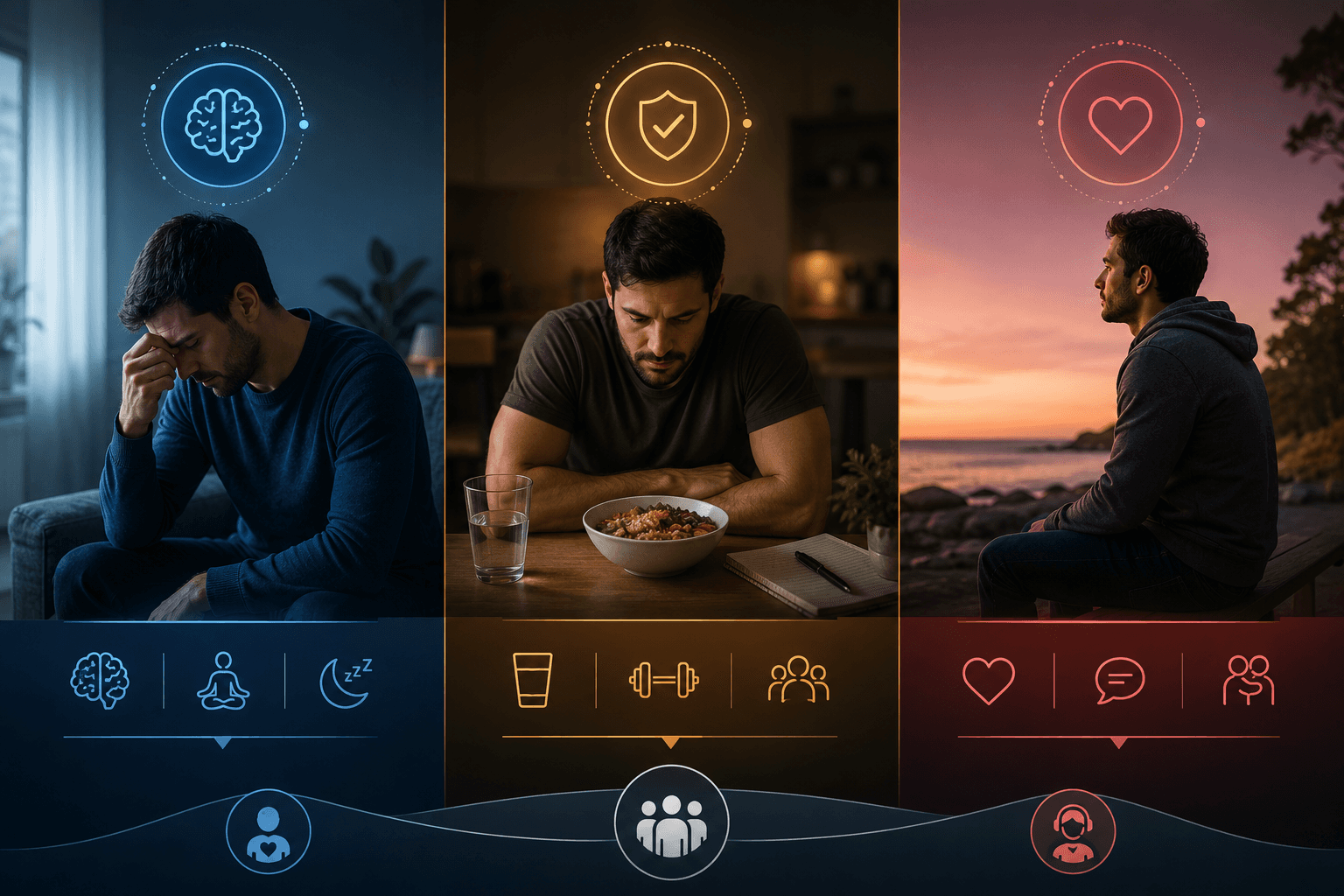
But here's what nobody tells you about those three statistics. They aren't three separate problems. They're one problem wearing three disguises.
A man starts drinking to manage feelings he can't name. The drinking makes the feelings worse. The worsening feelings drive more drinking. And somewhere in that spiral, the exit door starts to look like the only option.
Understanding this cycle, and knowing exactly where to interrupt it, is the difference between a crisis and a recovery.
🚨 If you're in immediate crisis right now, call or text 988. The Suicide and Crisis Lifeline is trained for this. They answer. You don't have to be sure you "qualify" to reach out.
For everyone else, let's keep going.
Part 1: Alcohol, The Socially Acceptable Disaster
The Numbers
Alcohol use disorder (AUD) is the most prevalent mental health condition in men. In the U.S., 36% of men will meet criteria for it at some point in their lives. Globally, men's rates are roughly twice those of women. Peak risk lands between ages 18 and 25.
AUD can shave more than 20 years off a man's life expectancy.
And yet only 1 in 6 American adults has ever been asked by a health professional about their drinking. That's like installing a fire alarm in every building and never checking the batteries.
How to Spot It
The simplest screen on the planet is one question: "How many times in the past year have you had 5 or more drinks in a day?" Even once is worth a real conversation. That single question catches about 85% of men with a drinking problem.
For more detail, the AUDIT-C is three questions and takes 30 seconds. A score of 4 or higher in men means it's worth looking closer.
The DSM-5 lists 11 criteria for AUD. The big ones:
You drink more or longer than you meant to. You want to cut down and can't. You spend a lot of time drinking or recovering from drinking. You crave it. It's leaking into your work, school, or family. You keep going despite the damage. You give up things you used to like. You drink in situations that aren't safe. You need more to feel the same effect. You get withdrawal when you stop.
Two of these means mild. Four to five means moderate. Six or more means severe.
The Pros of Alcohol (Yes, Sort Of)
Let's be honest about why men drink. There are real reasons. They just don't survive a closer look.
Social lubrication. Alcohol lowers your inhibitions. For men who weren't given the tools to express emotion (which is most of us), that feels like a superpower.
Stress relief. Alcohol activates GABA receptors in your brain. For about 20 minutes, you genuinely do feel calmer.
Cultural belonging. Beer with the guys. Wine at dinner. Whiskey after work. Alcohol is woven into how men connect. Saying no can feel like opting out of being one of the boys.
The Cons (Which Crush the Pros)
It's a depressant. Literally. Alcohol suppresses central nervous system activity. The temporary lift is followed by a rebound that makes depression worse. It's like borrowing happiness from tomorrow at 400% interest.
It wrecks your sleep. You fall asleep faster, but the architecture of sleep falls apart. You wake up more tired than if you'd stayed up.
It shrinks your brain. Chronic heavy drinking causes measurable volume loss in the prefrontal cortex. That's the part of your brain that handles decision making, impulse control, and (ironically) the ability to stop drinking.
It raises cancer risk. Alcohol is a Group 1 carcinogen, the same category as tobacco and asbestos. Cancers of the mouth, throat, esophagus, liver, colon, and breast all go up with regular drinking.
It blocks depression treatment. Antidepressants work less well in people who are actively drinking.
It dramatically raises suicide risk. Acute intoxication impairs judgment and ramps up impulsivity. That combination is lethal when someone is already in crisis.
Part 2: Depression, The Shape-Shifter
Here's the most important sentence in this whole article.
When researchers include male-type depression symptoms in the diagnostic criteria, the sex difference in depression prevalence completely disappears. The rate becomes 30.6% in men versus 33.3% in women. Statistically identical.
Read that again.
Standard criteria diagnose men with depression at roughly half the rate of women. That doesn't mean men are less depressed. It means the diagnostic system asks the wrong questions.
How Depression Actually Looks in Men
Standard depression symptoms look like: sadness, crying, guilt, worthlessness, loss of interest.
Men's depression often looks like: irritability, anger, aggression, risk taking, drinking too much, working too much, total emotional shutdown.
A man who's drinking more than he should, snapping at his family, driving like he's invincible, and working 80 hour weeks is just as depressed as a woman crying in bed. Only one of them ends up diagnosed.
The Depression and Alcohol Loop
These two conditions feed each other. The data is bleak.
Men with alcohol or drug dependence are 4 to 9 times more likely to have major depression.
36% of men with major depression also have an alcohol use disorder. For women with depression, that number is 19%.
Alcohol disrupts serotonin, dopamine, and GABA. All three play directly into mood.
Depression drives drinking as self medication.
The combination amplifies suicide risk beyond what either condition produces alone.
Sometimes a few weeks of sobriety lifts the depression on its own. Sometimes it doesn't, and the depression needs its own treatment. Either way, going after both at once works better than going after them one at a time.
Part 3: Suicide, The Final Common Pathway
The Numbers That Should Stop You Cold
Men die by suicide at rates 2 to 4 times higher than women. In the U.S., the ratio is closer to 3.5 to 4.
Suicide is the 8th leading cause of death for American men. It doesn't even crack the top 10 for women.
Rates among men aged 45 to 64 climbed from 21 to 30 per 100,000 between 1999 and 2017.
90% of men who die by suicide had a diagnosable psychiatric condition at the time, most often untreated depression.
More than half of people with serious suicidal thoughts in a given year received zero mental health services.
The Firearm Reality (Not a Political Statement, A Public Health One)
This is the single most modifiable risk factor for male suicide. Look at the facts.
Firearms are used in about half of all U.S. suicides.
85 to 90% of firearm suicide attempts result in death. For medication overdoses, the fatality rate is 1 to 2%.
30% of people who seriously considered suicide said the period of acute crisis lasted less than one hour.
Less than 10% of people who survive a suicide attempt later die by suicide.
Voluntary firearm divestment cuts firearm suicide risk by half or more.
Put those facts together and something extraordinary emerges. Most suicidal crises are brief. The lethality of the method chosen depends on what's right there. Firearms are almost always fatal. Other methods usually aren't. And most people who survive don't try again.
This means that putting time and distance between a person in crisis and a firearm can save their life. Not forever. Just long enough for the crisis to pass.
If you're worried about a man you love, and he owns guns, the most important thing you can do (beyond getting him professional help) is to ask if he'd be willing to store them with a trusted friend, a gun shop, or law enforcement temporarily. Frame it as time bound. "Just for a few weeks while things settle." Most people in crisis are not in crisis next month. The whole goal is getting them to next month.
Warning Signs (The Male Version)
Men almost never say "I want to die." Watch instead for these:
Giving away prized possessions. Especially tools, firearms, vehicles, or anything with meaning.
Sudden calm after a long stretch of depression. This can mean a decision has been made.
Increased drinking or drug use.
Withdrawal from friends and activities.
Talking about being a burden. "Everyone would be better off without me."
Reckless behavior. Driving dangerously, picking fights, taking risks that don't fit who he usually is.
Researching methods or acquiring means.
Settling affairs. Updating wills, paying off debts, unusual goodbyes.
What Actually Prevents Suicide
The science is clear. Several strategies have replicated evidence:
Training primary care doctors to spot and treat depression. This is the single strongest prevention strategy. Most men who die by suicide saw a doctor (not a psychiatrist) in the months before. That waiting room is, statistically, where prevention happens.
Means restriction. Reducing access to lethal methods during crises. This works because most crises are brief.
Follow up after a hospital discharge. Caring contact (a text, a call, even a postcard) from someone who knows what you've been through reduces repeat attempts at one year.
CBT for suicide. Cognitive behavioral therapy specifically focused on suicidal thoughts cuts repeat attempts by at least 50%.
Safety planning. A structured written plan you fill out when you're not in crisis. Lists your personal warning signs, things that help you cope, the people you can call, the professionals you can reach, and how to reduce access to lethal means.
Ketamine and esketamine. For someone in acute crisis with treatment resistant depression, these can reduce suicidal thoughts within hours instead of weeks. Mayo Clinic data showed an 84% drop in ER visits for suicidal thoughts after acute ketamine treatment.
Part 4: Drugs That Hurt and Drugs That Help
Drugs That Make Depression and Drinking Worse
Alcohol. Yes, still. The biggest single contributor.
Benzodiazepines (Xanax, Valium, Ativan). Sedation, emotional blunting, dependence. They also impair your ability to read other people's emotions, which is the exact skill a struggling man most needs to keep.
Opioids. Emotional numbing and social withdrawal. Lonely men who drink also tend to use these more often.
Some blood pressure drugs. Clonidine in particular.
Corticosteroids (prednisone). Can trigger mood changes, sometimes severe.
Isotretinoin (Accutane). Reported association with depression, especially in young men.
Drugs That Help Depression
SSRIs (sertraline, fluoxetine, escitalopram). The most common first line. Generally well tolerated.
SNRIs (venlafaxine, duloxetine). Sometimes better when pain is part of the picture.
Bupropion (Wellbutrin). Activating rather than sedating. Doesn't cause sexual side effects. Also helps with quitting smoking. For many men this is a friendlier first try than an SSRI.
For treatment resistant depression and acute suicidal thoughts:
Esketamine (Spravato). FDA approved nasal spray. Cuts suicidal thoughts within 4 to 6 hours. Done in office with monitoring.
IV ketamine. Same rapid effect on suicidal thoughts. Used at specialty clinics. Real evidence behind it.
⚠️ Critical: all standard antidepressants take 2 to 6 weeks to work. That gap is a high risk period in someone with suicidal thoughts. Plan for it. Have a safety net during the wait.
Drugs That Help With Alcohol Use Disorder (FDA Approved)
Naltrexone (50 mg once a day). Blocks the opioid receptors that reward you for drinking. Reduces cravings. You can start it while still drinking. Number needed to treat to prevent a return to heavy drinking is 11.
Acamprosate (666 mg three times a day). Modulates glutamate, helps maintain sobriety. Safe in liver disease (unlike naltrexone). Downside is the three times a day dosing and a side helping of diarrhea.
Disulfiram (250 mg daily). Makes you violently ill if you drink. Works best when someone trusted supervises the dose. Not for people with certain heart conditions or severe liver disease.
Drugs That Help the Combination
Sertraline plus naltrexone. Best studied combo for depression plus alcohol use disorder together. Outperforms either alone.
Extended release trazodone. Helps depression, sleep, anxiety, and alcohol craving all in one. Promising newer data.
Topiramate. Off label, but at least as effective as naltrexone in head to head trials.
Gabapentin. Modest effect, sometimes combined with naltrexone. Some abuse potential.
Part 5: Food, Exercise, and the Stuff That Doesn't Need a Prescription
Food
Chronic alcohol use creates real nutritional gaps. The most important ones:
Thiamine (vitamin B1). Heavy drinkers run low. Severe deficiency can cause a serious brain condition called Wernicke encephalopathy. Any heavy drinker getting help should get B1 supplementation right away.
Folate. Depleted by alcohol. Low folate makes depression worse.
Zinc. Low levels linked to depression.
Omega 3 fatty acids. Lower in depressed patients. Supplementation has moderate benefit.
Fiber. About 90% of people with alcohol use disorder don't get enough. Low fiber is linked to higher anxiety and lower sociability. Yes, your gut bacteria influence your mood. Yes, it's that direct.
The dietary pattern with the most consistent evidence for both depression prevention and AUD recovery is the Mediterranean diet. Vegetables, fruit, fish, olive oil, nuts, beans, whole grains. Not glamorous. Just consistently effective.
What to avoid: ultra processed food, sugar sweetened drinks, inflammatory diet patterns, and obviously alcohol itself.
Exercise
Exercise is the closest thing to a universal treatment across this entire triad.
For depression in men with AUD, exercise produces a large effect, on par with medication.
For alcohol outcomes, exercise nearly doubles the odds of staying sober and eases withdrawal symptoms.
For suicide risk, exercise reduces depression, which is the single biggest modifiable risk factor for suicide.
What kind? Both aerobic exercise and yoga work. Yoga sometimes shows stronger effects on depression in AUD patients. The optimal pattern: more than 12 weeks of consistency, sessions of an hour or more, moderate to high intensity.
The catch is real. When you're depressed and hungover, exercise is the last thing you want to do. This is where behavioral activation comes in. You commit to the schedule, not the feeling. The motivation shows up after you do, not before.
Part 6: How to Talk About It
If You're the One Struggling
You don't have to use the words "depressed" or "alcoholic" to start a conversation. Start with what you notice:
"I've been drinking more than I want to." "I can't sleep." "I'm angry all the time and I don't know why." "Nothing feels good."
Frame it as problem solving, not weakness. "I want to figure out why I'm not at my best" is a perfectly valid reason to see a doctor or therapist. The treatment works the same whether you walked in for emotional reasons or strategic ones.
Use technology if face to face feels impossible. Apps that track progress, set goals, and let you take action often work better for men than traditional talk therapy as a first step.
Know that the first step is the hardest. Almost every man who makes it through the door says afterward it was worth it. The barrier is getting in, not what happens once you're there.
If You're Trying to Help
Don't diagnose. Observe. "I've noticed you've been drinking more" is better than "I think you're an alcoholic."
Don't lead with "are you suicidal?" Ask about sleep, drinking, work, who he's been spending time with. Listen for what's missing.
If you're worried about access to lethal means, ask. Frame it as time bound: "Would you be willing to store your guns with [trusted friend] for a few weeks until things settle?" Avoid words like "restrict" or "confiscate." Make it about getting through a rough patch, not about giving anything up forever.
Normalize the conversation. Say something about yourself first if you can. "I've been pretty wiped out lately. How about you?" gives him permission to be honest in a way that direct questions don't.
Know the Resources
988 Suicide and Crisis Lifeline. Call or text. Free. Confidential. 24/7.
Crisis Text Line. Text HOME to 741741.
Veterans Crisis Line. Call 988 and press 1.
The Bottom Line
This triad of alcohol use disorder, depression, and suicide is not three separate problems. It's one interconnected system that feeds on itself. Alcohol worsens depression. Depression drives drinking. Both increase suicide risk. And every cultural message men receive (be strong, don't ask for help, handle it yourself) pours gasoline on the fire.
The good news: every point in the cycle is also a place where you can interrupt it.
Reduce drinking, and depression eases. Treat depression, and alcohol cravings drop. Get the firearm out of the house during a crisis, and you might just survive it. Exercise regularly, and all three improve. Fix nutrition, and your brain chemistry stabilizes. Reach out to one real person, and isolation, depression, and drinking all start to retreat.
You don't have to fix everything at once. You just have to interrupt the cycle at one point. The rest follows.
If you take nothing else from this guide, take this. The most dangerous myth in men's health isn't that real men don't cry. It's that real men don't need help.
They do. We all do. And asking for it isn't weakness. It's the most strategically sound move you'll ever make.
🚨 If you're in crisis right now, please reach out. Call or text 988. Help exists, even when it doesn't feel like it. You don't have to figure this out alone.
This article is for general education and isn't medical advice. Persistent drinking problems, depression, or thoughts of self harm deserve real conversations with real doctors or therapists. The smallest possible step counts. Send one text. Make one call. Tell one person. The next step almost always shows up after the first one.
HSA/FSA Eligible
Doctors Are Human.
That's Why There's Medome.
Start your free trial today. No credit card required.
Start Your Free Trial
Join thousands protecting their health with AI that never forgets

Critical details get missed when your health information is scattered. Medome connects the dots across your complete record.
Start Your Free Trial
Get In Touch
Email: service@medome.ai
Phone: (617) 319-6434
This is Dr. Steven Charlap's cell. Please text him first, explaining who you are and how he can help you. Use WhatsApp outside the US.
Hours: Mon-Fri 9:00AM - 9:00PM ET