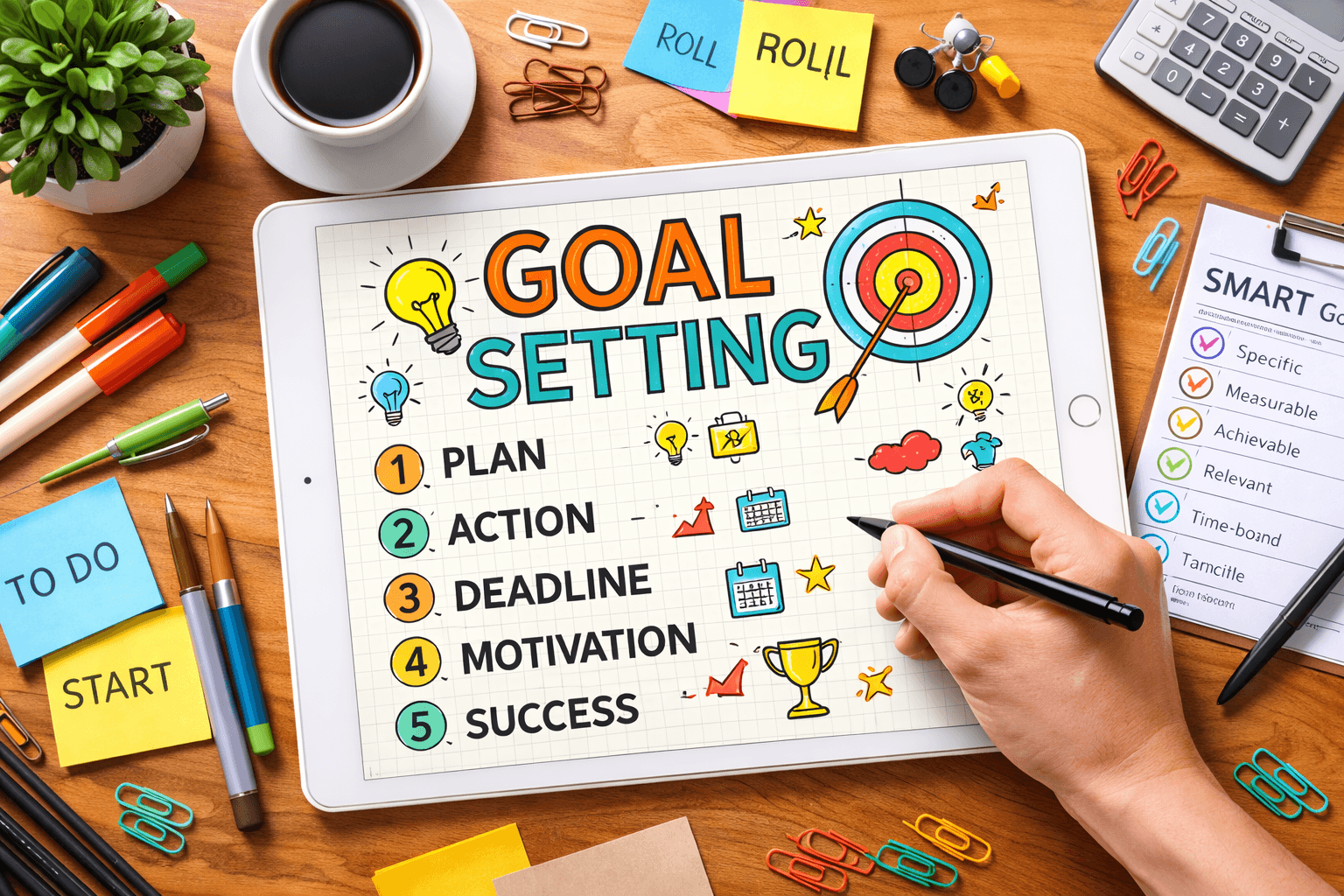
A Comprehensive Guide to Goal Setting for Better Health
Copyright 2025 Medome.ai. All rights reserved.
IMPORTANT NOTICE: This guide is for educational purposes only and is not a substitute for professional medical advice, diagnosis, or treatment. Always consult a qualified healthcare provider before making changes to your health routine.
Introduction: Why Everyone Has Failed at New Year's Resolutions (Including You)
Let's be honest. Every January, millions of people write down goals like "lose 30 pounds," "run a marathon," and "finally become a morning person." By February, most of those goals are buried under a pile of takeout containers and snooze button regrets. Sound familiar?
Here is the thing: you are not lazy, weak, or lacking willpower. You just never got the instruction manual. Goal setting is a real science, and most people skip straight to writing their goals without understanding how the brain actually works. That is like trying to bake a cake by throwing ingredients at the oven and hoping something good happens.
This guide covers everything you need to know about setting and achieving health goals that stick. Here is a preview of what you will find inside:
What You Will Find in This Guide |
|---|
The science of how your brain processes goals — and how to trick it into cooperating |
Eight proven goal-setting strategies, from SMART goals to mental contrasting |
Specific plans for health conditions including diabetes, heart disease, chronic pain, and obesity |
How to use digital apps and wearables effectively (and why most people quit them by day 100) |
The social secrets of goal achievement — why your friends matter more than you think |
Who should be extra careful with goal setting (and why some people need special guidance) |
15+ stories of real, fictional, and everyday people succeeding and struggling with goals |
A 5-phase personal goal plan you can start today |
A clear guide on when to see a doctor about your goal pursuit |
Ready? Let's build a better brain for goal setting, one page at a time.
Part 1: The Science Behind Goal Setting
Your Brain Has Opinions About Your Goals
Your brain is basically a very complicated prediction machine that runs on a chemical called dopamine. Dopamine is the brain's reward chemical, but here is the twist: it fires not just when you get a reward, but when you expect one. This means your brain can get excited about a goal you have not yet achieved, which is partly why imagining success can feel so good — sometimes even better than actually doing the work.
Several regions of the brain work together to support goal-directed behavior. The prefrontal cortex handles planning and decision-making. The striatum (deep inside your brain) handles learning from rewards. The nucleus accumbens acts as a "value calculator," figuring out which goals are worth pursuing. The anterior insula and dorsal anterior cingulate cortex team up as your brain's control center, detecting when you need to pay more attention and telling other parts of the brain to get focused.
THE DOPAMINE STORY: THREE KEY MOMENTS
ACTION SIGNAL: When you do a goal-related behavior, dopamine fires to record what you did and how much it was worth.
OUTCOME SIGNAL: When you get a reward (or don't), dopamine records whether things went better or worse than expected.
LEARNING SIGNAL: Over time, these dopamine blips wire your brain to repeat what worked and avoid what didn't.
Bottom line: Regular small wins keep dopamine flowing and keep you motivated. This is why breaking big goals into smaller steps works so well.
What the Research Actually Shows
Scientists have been studying goal setting for decades, and the results are mostly good news — with some important catches.
What Goal Setting Helps | How Much It Helps | Notes |
|---|---|---|
Behavior change (overall) | Small to moderate effect | Works best when goals are hard and public |
Quality of life in rehab | Moderate improvement | Especially in recovery settings |
Self-efficacy (confidence) | Moderate to large | You believe in yourself more |
Diabetes management (HbA1c) | Modest but real | Collaborative goal setting works best |
Progress monitoring | Large effect on tracking | Tracking goals consistently is powerful |
Weight loss | 5-10% body weight typical | With 14+ sessions and self-monitoring |
The science also shows that goal setting can backfire. Failing to reach a very high goal can hurt your mood, motivation, and self-esteem. Perfectionism — setting standards so high that nothing ever feels good enough — is linked to depression, anxiety, and even worse performance over time.
QUICK SCIENCE SUMMARY
Goal setting produces real benefits — but only when goals are realistic, collaborative, and paired with tracking and coping strategies. The brain uses dopamine to learn from successes and failures. Small, regular wins keep the system running. Overly ambitious, rigid goals can actually make things worse. Balance ambition with kindness to yourself.
Part 2: SMART Goals — The Famous Framework (And Its Dirty Secret)
If you have ever sat through a health class, a workplace training, or a conversation with a very enthusiastic health coach, you have heard about SMART goals. SMART stands for Specific, Measurable, Achievable, Relevant, and Time-bound. It is everywhere. And it is not entirely wrong. But here is the dirty secret the internet does not tell you: the SMART framework was not actually built on scientific research.
WHAT SMART ACTUALLY STANDS FOR
S — Specific: Be clear about exactly what you want to do.
M — Measurable: Have a way to know if you are making progress.
A — Achievable: The goal should be challenging but possible.
R — Relevant: The goal should matter to your life and values.
T — Time-bound: Set a deadline so you know when you are aiming for.
What SMART Gets Right
SMART goals do help people get organized. Saying "I want to exercise more" is a wish. Saying "I will walk for 30 minutes every Monday, Wednesday, and Friday before dinner for the next 8 weeks" is a plan. Studies show that specific goals work better than vague ones, and time-bound goals tend to get done because deadlines create urgency.
In one quality improvement study at a military medicine clinic, doctors used SMART goals to help patients with type 2 diabetes manage their blood sugar. Over three months, patients' average HbA1c dropped from 9.18% to 7.84%. That is a meaningful medical improvement from a structured goal-setting tool alone.
What SMART Gets Wrong
The SMART framework is often applied inconsistently. Researchers reviewing studies on SMART goals found that the framework is not grounded in psychological theory, does not account for what type of goal matters most, and can actually lead people to set goals that are technically SMART but personally meaningless — or dangerously rigid.
The biggest problem: SMART goals do not tell you how to deal with obstacles, how to stay motivated when things go sideways, or when it is time to change the goal. Think of SMART goals as a helpful starting point, not a complete solution.
SUCCESS STORY — Maria's Blood Sugar Victory (Real Story)
Maria was a 52-year-old woman with type 2 diabetes whose blood sugar numbers had been stubbornly high for years. She had tried vague plans like "eat less sugar" with little success. Her doctor introduced SMART goals. Together, they created a specific, measurable target: reduce daily carbohydrate intake to under 150 grams and walk for 20 minutes after dinner five days a week for three months. Maria tracked her progress in a small notebook. At her three-month check-up, her HbA1c had dropped by more than a full percentage point. The specificity of knowing exactly what to do — and when — made all the difference.
STRUGGLE STORY — The Perfectionist Planner (Illustrative)
Imagine someone we will call Tyler. Tyler set a SMART goal to lose 40 pounds in four months, work out six days a week, cut all processed food, and meditate daily — all at once. Everything about the goal was technically SMART. But it was also completely overwhelming. By week two, Tyler missed one gym session, felt like a failure, and used that as permission to abandon everything. Research calls this "all-or-nothing thinking," and it is one of the most common reasons goal setting backfires. The lesson: SMART goals work best when they are also KIND goals — challenging but not crushing.
How to Use SMART Goals Well
Start with ONE goal at a time, not five.
Make sure the goal connects to something you genuinely care about (not just what you think you should care about).
Build in flexibility — "most days" is often better than "every day."
Review the goal monthly and adjust it if life changes.
Pair SMART goals with an if-then plan (covered in Part 3) for best results.
SMART Goals: Good For | SMART Goals: Not Enough For |
|---|---|
Getting organized and specific | Dealing with unexpected obstacles |
Creating clear targets and deadlines | Addressing low motivation or ambivalence |
Measuring clinical outcomes like HbA1c | Handling perfectionism or burnout |
Communicating goals to healthcare teams | Knowing when to quit or adjust a goal |
Part 3: If-Then Planning — The Brain Hack That Actually Works
Here is a scenario: You have excellent intentions to go to the gym. You fully plan to go. And then 5:30 PM rolls around, you are tired, traffic is terrible, there is leftover pizza in the fridge, and suddenly the couch is winning. Sound familiar? Researchers call this the "intention-behavior gap" — the space between what we intend to do and what we actually do.
Implementation intentions — also called if-then plans — are one of the most powerful tools science has found to close that gap. Studies across 141 experiments found that if-then planning produces a moderate-to-large improvement in follow-through, with an average effect size of about 0.50 to 0.60.
HOW IF-THEN PLANNING WORKS
Identify a specific situation (the IF): a time, place, or event.
Decide in advance what you will do in that situation (the THEN).
Say it out loud or write it down: "IF [situation], THEN I will [action]."
Mentally rehearse the plan a few times.
Example: "If it is 7:00 AM on weekdays, then I will put on my walking shoes and walk for 20 minutes before I look at my phone."
Why it works: By pre-specifying the cue, your brain creates a direct link between the situation and the action. When the cue appears, the behavior fires more automatically — like a shortcut that bypasses the part of you that wants to negotiate.
Real-World If-Then Examples
The Situation (IF…) | The Action (THEN…) |
|---|---|
It is 8:00 AM | I will take my blood pressure medication with breakfast |
I finish my lunch at work | I will walk around the building for 10 minutes before returning to my desk |
I feel a craving for soda | I will drink a glass of water and wait 10 minutes |
I get home from work on Monday | I will change directly into my gym clothes before I sit down |
I feel too tired to exercise | I will do just five minutes — I can always stop after five |
SUCCESS STORY — Medical Students and the 'If-Then' Effect (Research Study)
In a study of physicians and medical students, researchers found that implementation intentions significantly changed doctor behaviors around clinical guidelines — an area notorious for good intentions and poor follow-through. Doctors who formed specific if-then plans about when and how to order preventive screenings were far more likely to actually do so compared to doctors who just had good intentions. The lesson: professionals with years of training and excellent motivation still benefit enormously from if-then planning.
The Flexibility Bonus
One common worry is that if-then plans make you too robotic. Research from brain imaging studies found something reassuring: if-then plans increase automaticity for the planned situation, but they do NOT reduce your ability to respond flexibly to unexpected situations. Your brain can still adapt. The plan just takes care of the easy cases so your mental energy is saved for harder ones.
Best Uses for If-Then Planning: Taking medications at the right time and dose, starting exercise when motivation is low, eating healthier at specific trigger moments (meals out, stress eating, boredom), managing chronic disease behaviors (blood glucose checking, insulin timing), and preventive health behaviors (sunscreen, seatbelts, dental flossing).
Part 4: Action Planning and Coping Planning
The When, Where, How — and What to Do When Everything Goes Wrong
Action planning and coping planning are genuinely two of the most useful tools in the goal-setting toolkit.
ACTION PLANNING VS. COPING PLANNING
Action planning answers: When will I do this? Where will I do it? How exactly will I do it?
Coping planning answers: What obstacles might get in my way? How will I handle each one?
Together, they cover both the best-case scenario (action planning) and the reality of life (coping planning).
Research involving nearly 20,000 participants found that coping planning is the critical ingredient for long-term behavior maintenance. Action planning alone helps you get started, but coping planning is what keeps you going when real life collides with your beautiful intentions.
Action Planning in Practice
Bad action plan: "I will exercise more this week."
Good action plan: "I will go to the YMCA on Tuesday and Thursday at 6:30 AM, use the treadmill for 30 minutes at a moderate pace, then do two sets of 10 bicep curls with 15-pound weights."
The good plan specifies exactly WHEN (Tuesday and Thursday at 6:30 AM), WHERE (the YMCA), and HOW (30 minutes on the treadmill, then weights). It removes all ambiguity, which means your brain does not have to negotiate with itself in the moment.
Coping Planning in Practice
Likely Obstacle | My Coping Strategy |
|---|---|
Feeling too tired after work | Do a 10-minute home stretch routine instead — something beats nothing |
Gym is closed or I am traveling | Hotel room workout: 20 jumping jacks, 10 pushups, 10 squats, repeat 3x |
Social event with unhealthy food | Eat a healthy snack before I go and plan to pick one treat, not an entire buffet |
Forgot to take medication in the morning | Take it when I remember, note the time, and set a phone alarm going forward |
Motivation is completely gone | Call a friend who is also working on health goals and do a 10-minute accountability check-in |
SUCCESS STORY — James and the Rainy Day Plan (Everyday Story)
James, a 44-year-old teacher with high blood pressure, had tried and failed at exercise routines multiple times. The problem was always the same: his plan assumed perfect conditions. When things got complicated — a sick kid, a late meeting, bad weather — his plan collapsed because he had no backup. His doctor helped him build a coping plan for each likely obstacle. When his gym was closed: a 20-minute home routine. When he was exhausted: a 10-minute walk. When a week went sideways: a restart plan for the following Monday. Over six months, James reduced his blood pressure meaningfully — not because every day was perfect, but because he had a plan for when it was not.
Who Benefits Most from Action and Coping Planning: People who have strong intentions but struggle to follow through, anyone managing a chronic condition like diabetes, heart disease, or high blood pressure, people with busy unpredictable schedules, anyone who has tried and failed at health goals before, and people starting a new exercise routine or dietary change.
Part 5: Motivational Interviewing — Talking Yourself (and Others) Into Greatness
Motivational Interviewing, or MI, is a rigorously tested clinical technique with strong evidence across diabetes, heart disease, substance use, and physical activity.
The core insight behind MI is that you cannot lecture someone into change. You cannot scare someone into lasting change. You cannot nag someone into change. Real, lasting change happens when a person discovers their OWN reasons to change and builds their OWN plan to get there.
THE FOUR STEPS OF MOTIVATIONAL INTERVIEWING
ENGAGE: Build a real relationship first. People change for people they trust.
FOCUS: Find out what matters most to this person — not what matters to you.
EVOKE: Draw out the person's own reasons and motivation for change ("change talk").
PLAN: Collaboratively build a specific, realistic action plan tied to what the person values.
Key principle: Roll with resistance. If someone pushes back, do not push harder. Explore the ambivalence with curiosity instead of confrontation.
Brief Action Planning (BAP): The Quick Version
For busy healthcare settings, Brief Action Planning is a condensed version of MI that fits into a regular office visit:
"Is there anything you might be willing to do for your health in the next week or two?"
Collaboratively develop a specific SMART action plan based on the patient's answer.
Ask for a commitment statement: "So you are planning to walk 20 minutes after dinner on weekdays — is that right?"
Scale confidence: "On a scale of 0 to 10, how confident are you that you can do this?"
If confidence is below 7: "What would make it easier? What could get in the way?" Adjust the plan.
Follow up at the next visit to review progress and celebrate wins.
SUCCESS STORY — The EPICC Trial (Clinical Research)
In the EPICC (Empowering Patients in Chronic Care) randomized clinical trial, adults with type 2 diabetes were randomly assigned to either collaborative goal setting with motivational interviewing principles or standard diabetes education. The MI-based group showed significantly lower HbA1c levels after the intervention AND sustained improvements in diabetes-related distress at 10 months. The control group received more information — but information alone is not motivation.
Self-Determination Theory: The Science Behind MI
Motivational interviewing is built on Self-Determination Theory, which identifies three basic human psychological needs: autonomy (feeling in control of your own choices), competence (feeling capable and effective), and relatedness (feeling connected to others). Goals that satisfy these three needs tend to produce lasting change. Goals that feel imposed from outside tend to produce temporary compliance at best.
When Motivational Interviewing Is Especially Helpful: When someone is ambivalent about changing, chronic conditions (diabetes, cardiovascular disease, high blood pressure, obesity), mental health conditions where motivation is low, substance use reduction, and when standard advice and education has already been tried and hasn't worked.
IMPORTANT CAUTION: Motivational interviewing requires skill. If you are trying to apply it to yourself, the closest approximation is journaling about your own values and motivations — writing out WHY you want to change, in your own words, connecting it to what you genuinely care about.
Part 6: Self-Monitoring — Yes, You Have to Keep Track. Sorry.
Nobody likes being told to track things. But the research is overwhelmingly clear: self-monitoring — keeping track of your own behaviors and progress — is one of the most powerful tools for goal achievement. A meta-analysis of 138 studies with nearly 20,000 participants found that self-monitoring interventions increased tracking frequency with a huge effect size (1.98), and those who tracked more frequently were significantly more likely to reach their goals.
In plain English: people who keep track do better. A lot better.
What You Can Track (and How): Diet (food diary, app logging, food photography), exercise (fitness tracker, step counter, workout journal), blood sugar (glucose meter, continuous glucose monitor), blood pressure (home monitor, doctor visit log), weight (weekly weigh-in — not daily, as daily fluctuations are normal and misleading), medications (pill organizer, phone alarm), mood and energy (brief daily journal, 1-to-10 scale), and sleep (wearable device, sleep journal).
Feedback Makes Tracking Actually Useful
Tracking alone is not enough. You need feedback — information about how you are doing relative to your goal. Research on physical activity interventions found that adding feedback to self-monitoring produced a large effect size (d = 0.73). Feedback can come from a graph on your phone showing your step count trend, your doctor reviewing your blood pressure log, a wearable device showing minutes of active movement, or a progress bar in an app.
The important thing is that feedback should be frequent (daily or weekly), visual when possible, and connected to your specific goal.
Effects Are Even Bigger When Progress Is Shared
Studies found that the benefits of self-monitoring are enhanced when outcomes are reported publicly or physically recorded in a visible location. This is the science behind fitness accountability apps, weight loss support groups, and the classic trick of putting your progress chart on the refrigerator.
SUCCESS STORY — The Diabetes Prevention Program (Research)
In the landmark Diabetes Prevention Program (DPP), participants at high risk for diabetes tracked their food intake and physical activity regularly as part of a comprehensive lifestyle program. Those in the intensive lifestyle arm lost an average of 5-7% of body weight and reduced their risk of developing type 2 diabetes by 58%. Participants who consistently tracked their diet and exercise had significantly better outcomes than those who tracked sporadically. Tracking turned vague intentions into visible data — and visible data is motivating.
STRUGGLE STORY — When Tracking Becomes an Obsession (Cautionary Tale)
Consider a fictional character we will call Diana. Diana was working on weight loss and downloaded a calorie-counting app. At first, it helped. But Diana became increasingly anxious about every meal, terrified of going over her daily limit. She started skipping social events because she could not track the food. She weighed herself multiple times a day. Diana had slipped from healthy self-monitoring into obsessive monitoring — a real risk documented in research. If tracking starts causing significant anxiety, dread, or changes in social behavior, it is time to recalibrate or seek support.
SELF-MONITORING: WHEN TO PULL BACK
Stop or modify tracking if any of the following happen: you feel significant anxiety or dread before tracking, you are avoiding social situations because of tracking concerns, you check your weight or metrics more than once a day obsessively, tracking is leading to severe restriction or disordered eating patterns, or the tracking itself is causing more stress than the behavior it is tracking. Tracking is a tool, not a life sentence. Adjust the intensity to serve your health, not rule it.
Part 7: Mental Contrasting — Daydream Your Way to Success (The Right Way)
Here is something surprising: research shows that purely positive visualization — imagining your success in vivid detail with no thought of obstacles — can actually decrease motivation and goal achievement. Your brain, comfortably basking in the imagined victory, relaxes and decides the work is basically done. This is called "positive fantasizing," and it is the reason vision boards on their own rarely work.
Mental contrasting flips this on its head. Instead of just imagining success, you deliberately pair the positive vision with honest thinking about what stands in your way.
MENTAL CONTRASTING PLUS IF-THEN PLANNING (MCII)
IMAGINE the best possible outcome of achieving your goal. Be vivid. How will you feel? What will be different?
IDENTIFY the most important obstacle standing between you and that outcome. Be honest.
CONTRAST the two: your positive future versus your present obstacle.
FORM an if-then plan to address that specific obstacle.
This combination — called MCII (Mental Contrasting with Implementation Intentions) — has emerging evidence for improving health-related goal pursuit.
SUCCESS STORY — Hermione Granger: Mental Contrasting Since 1997 (Fictional, But On-Point)
Hermione Granger from the Harry Potter series is a master of mental contrasting without knowing it. She consistently imagines the outcome she wants, identifies the specific obstacles in her way, contrasts those realities, and then immediately forms specific plans — including contingencies. She does not just daydream about success. She prepares for failure at the same time. In the real world, this approach is associated with greater goal commitment and better problem-solving. Hermione would have excellent HbA1c numbers.
Mental contrasting works best for people who have moderate to high motivation — those who actually want the goal. If someone has very little desire to change, mental contrasting may just reinforce that the goal is not worth it. In that case, motivational interviewing (Part 5) should come first.
Mental Contrasting Quick Guide | |
|---|---|
Best for | People who want to achieve a goal but keep getting stuck on barriers |
Not ideal for | People with very low motivation (start with MI first) |
Works especially well with | If-then planning (MCII combination) |
Time needed | 10 to 15 minutes of focused reflection is often enough |
Can be done by | Anyone, independently, with no special training |
Part 8: When to Quit — The Science of Knowing When to Let Go
Nobody likes to talk about quitting. We celebrate perseverance. But here is what the research actually shows: the inability to disengage from unattainable goals is directly linked to psychological distress, learned helplessness, and worsening health outcomes. Sometimes, the bravest and smartest thing you can do is revise or release a goal that is no longer serving you.
FOUR GOAL ADJUSTMENT STRATEGIES
GOAL SCALING: Reduce the difficulty while keeping the direction. "Run a marathon this year" becomes "Run a 5K this year."
GOAL SUBSTITUTION: Replace the original goal with a related, achievable alternative. "Lose 50 pounds in 6 months" becomes "Lose 1-2 pounds per week sustainably."
TEMPORAL ADJUSTMENT: Extend the timeline. "By December" becomes "By next June."
GOAL ABANDONMENT: Fully disengage from a goal that no longer makes sense and redirect your energy to something meaningful.
The Perfectionism Trap
Perfectionism — the belief that anything less than perfect is unacceptable — is one of the biggest barriers to healthy goal adjustment. Research shows that perfectionism and depression reinforce each other over time: depression makes you set unattainably high goals, those goals are not met, the failure worsens depression, and so the cycle continues.
A 2022 study reviewing 67 longitudinal studies found that perfectionistic concerns showed a reciprocal relationship with depressive symptoms — each feeding the other over time. The pursuit of perfection is associated with WORSE academic and health outcomes than the pursuit of excellence. Excellence allows for adjustment. Perfection does not.
STRUGGLE STORY — Derek's Impossible Marathon Goal (Illustrative)
Derek, a 38-year-old with chronic knee pain, decided to train for a marathon. By week six, his knee pain was severe enough to limit daily walking. His doctor told him directly that a marathon would risk significant injury. But Derek could not bring himself to quit. He kept training, missed work due to pain, and eventually developed a serious knee injury requiring months of physical therapy. After recovery, Derek successfully set a new goal — a 5K after his knee healed — and completed it proudly. The revised goal served his health. The original one did not.
Signs that it may be time to adjust or release a goal:
You have tried consistently for months and made no progress despite genuine effort
The goal no longer aligns with your health status, abilities, or circumstances
Pursuing the goal is causing physical pain, injury, or significant emotional distress
The opportunity cost is interfering with other important areas of your life
Your doctor has advised that this specific goal is dangerous for your condition
Part 9: Goal Setting by Health Condition
Type 2 Diabetes
Diabetes is one of the most well-studied conditions for goal-setting interventions. Collaborative goal setting consistently outperforms lecture-based diabetes education for both blood sugar control and emotional wellbeing.
Diabetes Goal-Setting Essentials | |
|---|---|
What to track | Blood glucose readings, HbA1c trends, carbohydrate intake, physical activity, medication timing |
Recommended first goal | 5-10% reduction in body weight if overweight (reduces HbA1c by 0.6-1.0%) |
Best approach | Collaborative goal setting with motivational interviewing or brief action planning |
Confidence check | If confidence in your plan is below 7 out of 10, modify the plan before you start |
Digital tools | Apps that pull data from continuous glucose monitors show superior outcomes to paper logs |
Emotional wellbeing | Address diabetes distress (the emotional burden of managing diabetes) — it is real and affects outcomes |
Cardiovascular Disease and High Blood Pressure
For heart health, the combination of implementation intentions, coping planning, and self-monitoring produces meaningful reductions in cardiovascular risk factors. Key goals include physical activity (most evidence-based intervention for heart health), dietary sodium reduction, medication adherence, and smoking cessation.
SUCCESS STORY — Bob Harper: Goal Reconstruction After Crisis (Well-Known Person)
Fitness celebrity Bob Harper suffered a massive heart attack in 2017 at age 51, collapsing in a New York gym. His recovery required a complete goal reconstruction. Instead of training for performance, his new goals focused on cardiac rehabilitation, gradual return to movement, medication adherence, and mental health. Harper has spoken publicly about how the experience forced him to reconnect his goals with what his body actually needed rather than what his identity demanded.
Obesity and Weight Management
Weight management has the most extensive goal-setting evidence base of any health area. Research consistently shows that a realistic initial target is 5-10% of baseline body weight over 6 months, and intensive programs with 14 or more sessions in the first 6 months produce the best outcomes.
Weight Loss Amount | What It Improves | Required Effort |
|---|---|---|
5% | Blood pressure, cholesterol, blood sugar, joint pain, sleep | Moderate lifestyle change, achievable |
5-10% | HbA1c, cardiovascular risk, quality of life | Sustained behavior change needed |
10-15% | Fatty liver, sleep apnea, significant cardiovascular benefit | Intensive program often required |
>15% | All of the above plus possible reduction in all-cause mortality | Often requires pharmacotherapy or surgery |
Chronic Pain
Goal setting for chronic pain requires a fundamental reframe. The goal is NOT to eliminate pain — in many cases, that is not possible. The goal is to improve function and quality of life despite pain. Research shows that patient-led goal setting, where people choose goals based on their own valued activities, produces significantly better outcomes than clinician-imposed goals.
Chronic Pain Goal-Setting Principles | |
|---|---|
Shift focus | From 'reduce pain' to 'improve what I can do despite pain' |
Choose goals tied to valued activities | What do you want to be able to do? |
Use pacing | Gradually increase activity levels — do not go from 0 to 100 |
Anticipate flares | Build coping plans for bad pain days |
Validate the emotional side | Pain is exhausting and demoralizing — acknowledge that |
Consider CBT | Cognitive behavioral therapy for pain has the best evidence base for non-medication pain management |
Mental Health Conditions
Goal setting in mental health requires the most careful approach of any population. Research on recovery-oriented goal planning emphasizes that the process should be genuinely collaborative, patient-led, and understood as a long-term shared journey rather than a checklist.
Keep goal structures flexible, not rigid
Value engagement in the process, not just goal attainment
Be trauma-informed: trauma history affects goal-setting capacity and should be respected
For depression specifically: avoid goals with very high bars, as failure deepens depressive cycles
For anxiety: gradual exposure goals (doing a little more each week) work better than sudden large goals
Part 10: Digital Tracking Tools — Apps, Wearables, and Why 70% of People Quit by Day 100
A median of 70% of users stop using health apps within the first 100 days. Not years. Days. That does not mean apps are useless. It means most apps are poorly designed for long-term engagement, and most users do not know how to get the most out of them.
Digital vs. Paper Tracking: What the Research Says
Digital Tracking Advantages | Paper Tracking Advantages |
|---|---|
Higher adherence (80-90% vs 55% at 6 months) | No technology needed — always accessible |
More recording days (92 vs 29 over 6 months) | Works for people uncomfortable with technology |
Preferred by users (79% satisfaction vs paper) | No battery, no app updates, no crashes |
Automatic data capture reduces user burden | Can be more thoughtful and reflective |
Visual graphs and trend displays | Cheaper and completely private |
Integration with healthcare providers possible | Works in any environment, including no cell service |
Bottom line: Digital tracking wins on adherence and convenience. But the BEST tracking method is the one you will actually use consistently. Paper beats a fancy app you abandon in week two.
The Seven Features of Great Health Apps
After analyzing over 35 studies on health app engagement, researchers identified seven design themes that consistently keep users engaged:
Feature | What This Means |
|---|---|
Personalization | The app adapts to YOUR goals, YOUR habits, YOUR schedule — not a generic template |
Reinforcement | Rewards, badges, progress bars, and positive feedback for any progress made |
Communication | Timely, relevant push notifications — not just generic reminders every day at the same time |
Navigation | Simple, intuitive design with clear prompts and minimal cognitive effort to use |
Credibility | Evidence-based content, professional endorsement, transparent data policies |
Message quality | Clear, concise, encouraging language that respects your intelligence |
Aesthetics | Visually clean, professional, pleasant to look at — because appearance matters for engagement |
SUCCESS STORY — The Heartline Study: Seniors and Smartphones (Research)
The Heartline Study, published in 2025, achieved 93% active weekly engagement from adults aged 65 and older after one full year using a digital health platform. Two years in, 86% were still actively engaged. This is extraordinary given that most health apps lose 70% of users in three months. How did they do it? They applied behavioral science principles systematically: personalized content, meaningful purpose, intuitive design, gamification that felt collaborative rather than competitive, and a design that assumed users needed help and offered tutorials at every step. Age is not the barrier. Poor design is.
Why People Quit Apps (And How to Prevent It)
Technical problems: Bugs, crashes, slow performance. Solution: Test the app before committing and check user reviews.
Privacy worries: Concerns about where health data goes. Solution: Read the privacy policy before downloading. Seriously.
Poor experience: Too complicated, too time-consuming, too boring. Solution: Choose the simplest app that does what you need.
Irrelevant content: Generic advice that does not apply to your situation. Solution: Prioritize apps with strong personalization features.
Cost and time: Too expensive or too time-consuming to use. Solution: Start with free apps and track only the essentials.
Goal achieved (or abandoned): Either you met your goal or you gave up on it. Solution: Set a plan for what happens AFTER you hit your first goal.
Top Strategies to Stay Engaged with Health Apps: Choose ONE app and commit to it for at least three months before switching. Set up personalized reminders at times that actually match your routine. Connect to a human: a coach, a friend using the same app, or a healthcare provider who reviews your data. Use an app that visualizes your progress clearly. Celebrate early milestones, even small ones.
Part 11: The Social Side of Goals — Other People Are Surprisingly Useful
Here is a humbling statistic: motivation and good intentions only account for about 28% of the variance in whether someone actually achieves their goal. The other 72% comes down to execution — and one of the most powerful execution tools turns out to be other people.
Shared Reality: The Hidden Power of People Who "Get It"
A 2023 study with 1,326 participants found that experiencing shared reality with instrumental others — people whose support makes your goal more likely to succeed — was linked to greater goal success, both immediately and three to four weeks later. The mechanism was self-efficacy: when someone truly important to you believes in your goal, you believe in yourself more.
SUCCESS STORY — Oprah Winfrey and Bob Greene (Well-Known Person)
Oprah Winfrey's long, public journey with weight and health goals is one of the most documented goal-pursuit stories of our time. A central feature of her more successful periods was her relationship with personal trainer Bob Greene, who became a genuine partner in her health goals — not just a hired instructor. In interviews, Oprah has described how having someone who genuinely understood her specific challenges, history, and values made a significant difference in her commitment. Research consistently shows that this kind of instrumental, shared-reality relationship outperforms generic social support.
The Obligation Intention: Adding Accountability to Your If-Then Plan
One of the most powerful combinations in goal research is what researchers call an "obligation intention" — taking a standard if-then plan and adding a social commitment to it. Instead of "If it is 7 AM, then I will walk for 20 minutes," you add a person: "If it is 7 AM, then I will walk for 20 minutes WITH my neighbor Rosa." Now two things happen: the automatic behavior trigger kicks in, AND you have a social obligation that makes it much harder to skip.
How to Build Your Social Support Network for Goals | |
|---|---|
Identify instrumental others | Who actually makes your goal more likely to succeed? A friend who exercises? A family member who cooks healthy meals? A doctor who reviews your data? |
Create shared reality | Share your specific goal — not just the broad intention — with that person. Let them understand what you are really trying to do and why. |
Use obligation intentions | Build specific people into your if-then plans where possible. |
Think abstractly about support | Research shows that thinking about WHY your support matters boosts motivation more than thinking about the specific practical things your supporter does. |
Relationship quality matters | Studies show that people in satisfying relationships have better daily goal progress. Investing in your relationships is, quite literally, investing in your health. |
SUCCESS STORY — The Walking Club That Saved Helen's Heart (Everyday Story)
Helen, a 67-year-old retired librarian with heart disease, had been told by her cardiologist to walk 30 minutes daily. For months she tried and failed on her own. Then her daughter found a local senior walking group that met three mornings a week. Within weeks, Helen's attendance was nearly perfect — not because her health motivation had changed, but because missing the walk now meant letting down six people she had come to consider friends. One year later, her cardiologist noted a significant improvement in her cardiovascular function and reduced need for one of her medications. The social commitment did what the medical advice alone could not.
When Social Support Backfires
Not all social support helps. Well-meaning family members who comment negatively on every food choice, friends who set unrealistic group challenges, or workout partners who make you feel inadequate can all undermine goal pursuit. Research shows that unsupportive social environments — nagging, criticism, and external pressure — are associated with goal abandonment and reduced self-efficacy. Choose your goal partners carefully.
Part 12: Who Should Be Extra Careful — Contraindications, Cautions, and Special Populations
Goal setting is broadly beneficial, but it is not universally safe for everyone in the same way. Certain populations need modified approaches, and some contexts require professional guidance before starting any goal-setting program.
🚫 ABSOLUTE CONTRAINDICATIONS: STOP AND GET PROFESSIONAL HELP FIRST
Active suicidal thoughts or self-harm ideation: Goal setting is NOT the right first step. Please seek immediate professional support.
Active psychotic episodes or significant disorientation from reality: Structured goal setting can increase distress. Stabilization comes first.
Acute medical crisis (heart attack, diabetic emergency, severe infection): Stabilize medically before any behavioral goal planning.
Active eating disorders with severe food restriction or dangerous purging: Weight and food monitoring can cause serious harm. Specialized eating disorder treatment is essential.
Severe depression with inability to function in daily life: Goal setting that produces failures can deepen depression. Medical treatment is the priority.
Proceed With Modified Approaches
Population | Specific Caution | Modified Approach |
|---|---|---|
People with depression | High goals + failure = deepened depression | Start small; emphasize effort over outcome; celebrate any progress |
Perfectionists | Rigid goal adherence causes distress | Focus on process goals; practice goal scaling; use self-compassion tools |
Chronic pain patients | Pain-focused goals can increase suffering | Redirect to function goals; use pacing; avoid all-or-nothing thinking |
Mental health recovery | Demanding goal structures increase distress | Flexible, collaborative, recovery-oriented process |
Older adults with cognitive changes | Complex goals increase confusion | Simplified goals; caregiver involvement; routine-based cues |
Children and adolescents | External pressure backfires especially hard | Fully autonomous goal selection; fun and intrinsic reward focus |
Body dysmorphia/eating disorders | Weight and appearance tracking is harmful | Avoid body-focused goals entirely; work with specialists |
Perfectionism vs. Excellencism: Know the Difference
Perfectionism (Harmful) | Excellencism (Healthy) |
|---|---|
Standards are rigid and non-negotiable | Standards are high but adjustable |
Anything less than perfect is failure | Good progress is genuinely valued |
Associated with worse outcomes and downward spirals | Associated with better outcomes and continued growth |
Driven by fear of failure or external judgment | Driven by genuine love of mastery and growth |
Quitting or adjusting feels like defeat | Adjusting feels like wisdom and self-knowledge |
Part 13: The Goal Hall of Fame (and Hall of Shame) — 15+ Stories of Success, Struggle, and Lessons Learned
Success Stories
SUCCESS #1 — Serena Williams: Goals Through Pregnancy, Injury, and Comeback
Serena Williams is one of the greatest athletes in history, but her goal-setting story is primarily about extraordinary adaptation. After winning the 2017 Australian Open while two months pregnant, she faced a complicated delivery, postpartum blood clots, and a near-death experience. Her recovery required complete goal restructuring from performance optimization to health and survival, then gradual athletic rehabilitation. Her documented process involved working with medical teams to set staged, incremental goals with clear benchmarks and coping plans for each phase. Her return to Grand Slam finals was a masterclass in staged goal adjustment after health crisis.
SUCCESS #2 — Michael J. Fox: Living Meaningfully With Parkinson's Disease
When Michael J. Fox was diagnosed with young-onset Parkinson's disease at age 29, he faced a forced and complete reconstruction of every health-related goal he had ever set. Rather than pursuing remission (not currently possible with Parkinson's), Fox publicly redirected his goals toward advocacy and research funding. He founded the Michael J. Fox Foundation, which has become the world's largest private funder of Parkinson's research. His goal reorientation exemplifies what researchers call successful goal substitution — replacing an unattainable goal (stop the disease) with a related, deeply meaningful alternative (accelerate the cure).
SUCCESS #3 — Frida Kahlo: Creating Goals Around Physical Limitation
Frida Kahlo endured extraordinary physical suffering throughout her life, including a near-fatal bus accident at 18 that left her with dozens of injuries. Confined to bed for months, she redirected her goals entirely: rather than mourn her previous physical life, she began painting using a mirror mounted above her bed. Kahlo's story illustrates what research confirms: when physical goals become genuinely unattainable, redirecting toward valued alternatives is not defeat. It is the healthiest possible response.
SUCCESS #4 — Malala Yousafzai: Recovering and Redirecting After Traumatic Injury
Malala Yousafzai survived a gunshot wound to the head in 2012, requiring extensive medical rehabilitation. She has described the rehabilitation process as requiring her to be completely present with small, daily goals — regaining speech, regaining mobility, regaining strength — before she could rebuild toward larger purpose-driven goals. Her recovery exemplifies the staged goal planning framework: health first, then function, then mission.
SUCCESS #5 — Lisa, Everyday Nurse Practitioner
Lisa, a 41-year-old nurse practitioner with high blood pressure and a family history of heart disease, knew the science but struggled to apply it to herself. Her turning point came when she did a motivational interviewing exercise on herself — journaling her own values, writing out WHY she genuinely wanted to be healthier, and building a set of if-then plans for her three biggest obstacles. Within four months, her blood pressure was within normal range without medication changes. "I treated myself like a patient," she said. "It actually worked."
SUCCESS #6 — Rocky Balboa: Coping Planning in Action (Fictional)
Rocky Balboa does not succeed because nothing goes wrong. He succeeds because he has a plan for when things do go wrong. In Rocky IV, he trains at altitude, in the cold, with no technology — when the normal environment is unavailable, he has a contingency plan. Trainers and researchers who study athletic performance recognize the Rocky films as unusually accurate about the psychology of sustained effort over time.
SUCCESS #7 — Tom, the Anti-New-Year's-Resolution Guy
Tom, a 35-year-old accountant, had made and broken the same New Year's resolution to lose weight for seven consecutive years. In year eight, he made a single change: he stopped making resolutions on January 1 and instead booked a 30-minute appointment with his doctor in February. Together, they set a goal of losing 7% of his body weight over six months using the Brief Action Planning approach. By August, he had lost 8% of his weight. He now calls January 1 his "planning day" rather than his "starting day." The two-month gap between inspiration and action was the most important change he made.
SUCCESS #8 — Mr. Rogers: A Life of Consistent Small Goals
Fred Rogers maintained remarkable health and emotional wellbeing well into his 70s. His approach was consistently documented as one of small, daily goals aligned completely with his personal values: swimming every morning, maintaining consistent weight, keeping in close touch with people he cared about, writing personal letters. Rogers famously kept his weight at exactly 143 pounds for decades. His approach exemplifies what research now confirms: small, consistent, value-aligned goals maintained over years produce far better health outcomes than large, dramatic overhauls.
Struggle Stories — Important Lessons
STRUGGLE #1 — Thomas Edison's Inventory of Failure
What is less often discussed about Edison is that his persistence only worked because he had clear, specific goals for each attempt and kept meticulous records of every failure — essentially a form of systematic self-monitoring combined with iterative goal adjustment. He reframed failures as learning — not failed goals but successful tests of what did not work. Treating setbacks as information rather than evidence of personal failure is a key distinguishing feature of people who eventually succeed.
STRUGGLE #2 — Sisyphus: The Unattainable Goal Metaphor (Mythological)
In Greek mythology, Sisyphus was condemned to roll a boulder up a hill for eternity, only to watch it roll back down just before the top. Researchers and clinicians recognize the Sisyphus pattern in patients who pursue the same unattainable goal repeatedly, experiencing repeated failure, and yet cannot disengage. This inability to disengage from unattainable goals is clinically linked to learned helplessness and depression. When your boulder keeps rolling back, it may be time to find a different hill.
STRUGGLE #3 — Kevin Durant's Goal Collapse After Achilles Injury
When Kevin Durant tore his Achilles tendon during the 2019 NBA Finals, the injury fundamentally shattered a set of performance goals he had built over an entire career. His recovery period was described in interviews as deeply disorienting — not just physically, but psychologically. Durant has been open that rebuilding psychological purpose — figuring out what he was playing for when "championship this year" was no longer possible — was the hardest part of recovery. His openness about the mental dimensions has made him an unexpected mental health advocate.
STRUGGLE #4 — Amanda's Overly Ambitious Clean Eating Plan
Amanda, a 28-year-old teacher, decided on a Monday to eliminate all processed food, all sugar, all gluten, all dairy, and all alcohol simultaneously, starting immediately. By Thursday, she had a piece of birthday cake at a colleague's party and decided the entire plan was ruined. By the following Monday, she had abandoned everything. Amanda's story is almost universal in goal-setting research: the "all-or-nothing" trap is one of the most documented mechanisms of goal failure. Changing one dietary behavior at a time produces dramatically better long-term results than attempting total dietary transformation. A single slice of birthday cake is a decision. It is not a catastrophe.
STRUGGLE #5 — Walter White: Goals Without Values Alignment (Fictional Warning)
Walter White's goal is technically SMART. But it has zero alignment with his actual values — his stated love for family, his intellectual integrity, his pride in chemistry as a discipline. Research on Self-Determination Theory is very clear: goals that are misaligned with genuine personal values produce psychological distress even when achieved. Walter achieves his goals and loses everything. Before setting any goal, the question worth asking is not just "can I achieve this?" but "does achieving this actually reflect who I want to be?"
STRUGGLE #6 — The January Gym Rush (Universal)
Every fitness trainer in the world knows the January Gym Rush: a massive influx of new members in the first week of January, followed by a steady exodus through February, and near-complete return to baseline by March. The problem is not motivation — the motivation in January is real. The problem is that most of these goals violate every principle of effective goal setting simultaneously: too ambitious, too vague, no coping plan, no if-then structure, no meaningful tracking, and no connection to deeply held personal values.
STRUGGLE #7 — Nicholas, the Over-Tracker
Nicholas, a 32-year-old engineer, tracked calories to the gram, weighed himself at 6 AM daily, monitored sleep stages, heart rate variability, blood oxygen, stress levels, and step counts across four different apps. He spent 45 minutes a day analyzing his own data. Within six months, his anxiety had significantly worsened, he had become socially withdrawn, and his doctor noted his health monitoring behaviors were themselves causing measurable health harm. Nicholas exemplifies "overmedicalization" of self-tracking. More data is not always better data. Choose your tracking metrics deliberately and limit them to what is directly actionable.
Part 14: Your Personal 5-Phase Goal Plan
You now have the science. You have the strategies. You have the stories. Here is where it all comes together into a plan you can actually use.
THE 5-PHASE GOAL ACHIEVEMENT PLAN
Phase 1 (Weeks 1-2): Preparation and Values Clarification
Phase 2 (Weeks 2-3): Goal Formulation
Phase 3 (Weeks 3-4): Action and Coping Planning
Phase 4 (Ongoing): Execution and Monitoring
Phase 5 (Monthly): Review and Adjustment
Phase 1: Preparation and Values Clarification (Weeks 1-2)
Before you write a single goal, spend time with these questions. Write your answers down.
What do I genuinely care about? (Not what I think I should care about — what actually matters to me?)
What health change would make the biggest difference in my daily quality of life?
What have I tried before? What worked? What did not? Why did it stop working?
What is my readiness level from 1 to 10? (If below 6, motivational interviewing or journaling about values comes first.)
Who in my life could be an instrumental other — someone whose support would genuinely help?
Phase 1 Success Marker: You can complete this sentence clearly: "I want to improve [specific health area] because [genuine personal reason], and I am willing to start by [one realistic first step]."
Phase 2: Goal Formulation (Weeks 2-3)
Now write your goal. Use the SMART framework as a template, but check it against these additional criteria:
Question to Ask Yourself | What to Do If the Answer Is No |
|---|---|
Is this goal connected to something I genuinely value? | Go back to Phase 1 and reconnect with your why |
Is this goal challenging but realistic given my current health? | Scale back until confidence is at least 7/10 |
Am I setting just ONE main goal to start? | Remove goals until you have one clear priority |
Is there a measurable way to track progress? | Add a specific metric: times per week, weight, HbA1c, etc. |
Is this goal about process as well as outcome? | Add a process goal: "I will walk 5 days a week" alongside "I will lose 10 pounds" |
Phase 3: Action and Coping Planning (Weeks 3-4)
For each goal, complete both an action plan AND a coping plan:
Action Plan | Coping Plan |
|---|---|
WHEN will I do this? (Specific day, time) | OBSTACLE 1: What might get in the way? |
WHERE will I do this? (Specific location) | STRATEGY 1: Exactly what I will do instead |
HOW will I do this? (Specific actions) | OBSTACLE 2: What else might get in the way? |
WHO will I do this with? (If applicable) | STRATEGY 2: Exactly what I will do instead |
HOW will I track this? (App, journal, etc.) | RESTART PLAN: If I miss a week, I will… |
Phase 4: Execution and Monitoring (Ongoing)
Execute your plan and track consistently using your chosen method
Review your tracking data at least once per week — not to judge yourself, but to notice patterns
Look for your if-then triggers and honor them as automatically as possible
When you miss, use your coping plan — do not improvise in the moment
Celebrate any progress, however small — this is not cheerleading, it is neuroscience (dopamine reinforcement)
Reach out to your instrumental other at least once a week for accountability
Phase 5: Review and Adjustment (Monthly)
Assess goal progress honestly: How many days did you follow through? What pattern do you see?
Celebrate genuine wins — be specific about what you accomplished
Identify one persistent barrier and build a better coping strategy for it
Ask: Is this goal still the right goal for where I am right now?
If you have consistently fallen short despite real effort: use goal scaling, substitution, or timeline adjustment
If you have consistently succeeded: upgrade the goal by 10-15% to maintain challenge
THE MOST IMPORTANT RULE OF PHASE 5
A goal that consistently requires adjustment is not a failing goal. It is a living goal. The purpose of the monthly review is not to shame yourself for what you did not do. It is to make the plan smarter so it works better next month.
Part 15: When to Call a Doctor
Goal setting is powerful, but it is not medicine. There are situations where the right move is to stop reading and pick up the phone.
🚨 CALL 911 OR GO TO THE EMERGENCY ROOM IMMEDIATELY
Chest pain, arm pain, jaw pain, or sudden shortness of breath (possible heart attack)
Sudden severe headache unlike any you have had before (possible stroke)
Blood sugar above 400 or below 70 with confusion, inability to eat/drink, or loss of consciousness
Suicidal thoughts with a plan or intent to act
Severe allergic reaction to any medication
⚠️ CALL YOUR DOCTOR WITHIN 24-48 HOURS
Goal pursuit is causing significant physical pain, injury, or physical symptoms (sleep changes, appetite changes, fatigue)
You cannot disengage from a goal that your doctor has told you is dangerous
Self-monitoring has become obsessive and is interfering with daily life
Tracking behaviors are leading to restricted eating, excessive exercise, or disordered eating patterns
Significant depression or anxiety is making it impossible to function day-to-day
Goal-related stress is triggering substance use or other harmful coping behaviors
📅 SCHEDULE AN APPOINTMENT SOON
You have tried consistently for 3-4 months and made no progress despite real effort
You have lost 10% body weight unintentionally (could indicate health issue, not just lifestyle success)
Perfectionism is interfering with relationships, work, or daily function
Chronic goal failure is creating a sense of hopelessness about your ability to change
You have a new or changing health condition that affects what goals are realistic for you
Your mental health is affecting your ability to engage in goal setting at all
Finding the Right Professional
Primary Care Physician: Starting point for physical health goals, chronic disease management, and referrals
Certified Diabetes Educator (CDE): Specialized support for diabetes self-management goals
Registered Dietitian (RD): Evidence-based nutritional goal setting and dietary modification
Psychologist or Licensed Therapist (CBT-trained): Perfectionism, anxiety, depression, eating disorders
Psychiatrist: When medication may be needed for mental health conditions affecting goal pursuit
Health Coach (certified): For general lifestyle goals when clinical support is not required
Physical Therapist: Goal setting around physical function, pain, and exercise capacity
Quick Reference Summary: All 8 Strategies at a Glance
Strategy | Best For | Evidence | How to Use | Cautions |
|---|---|---|---|---|
SMART Goals | All adults; healthcare settings | Moderate (practical, not research-based) | Set Specific, Measurable, Achievable, Relevant, Time-bound goals for one priority | Avoid setting too high; must pair with other strategies |
If-Then Planning | Anyone with intention-action gap | Strong (d = 0.50-0.60) | "If [situation], then I will [action]." Mentally rehearse. | Less useful for complex, unpredictable goals |
Action + Coping Planning | Chronic conditions; busy lives | Strong (19,883 participants) | Specify when/where/how AND anticipate obstacles with specific coping responses | Requires effort to anticipate barriers honestly |
Motivational Interviewing | Ambivalent individuals; chronic disease | Moderate-Strong (EPICC trial) | Collaborative; evoke own motivation; build autonomous plans | Requires trained provider for full MI |
Self-Monitoring | All health behavior goals | Strong (d = 0.73 with feedback) | Track consistently; review weekly; pair with visual feedback | Avoid obsessive tracking; harmful with eating disorders |
Mental Contrasting (MCII) | Moderate-high motivation people | Emerging evidence | Vivid positive future + honest obstacle identification + if-then plan | May reduce motivation if obstacles feel insurmountable |
Goal Adjustment | Chronic illness; perfectionists; repeated failure | Strong theoretical + empirical | Scale, substitute, extend timeline, or abandon unattainable goals | Don't use to avoid appropriate challenge |
Social Support | All populations | Strong (shared reality studies) | Identify instrumental others; use obligation intentions; choose supporters carefully | Wrong support can undermine goals |
Copyright 2025 Medome.ai. All rights reserved. This document is for educational purposes only and does not constitute medical advice. Always consult a qualified healthcare provider before making significant changes to your health regimen.
Medome.ai Health Intelligence Series | medome.ai
HSA/FSA Eligible
Doctors Are Human.
That's Why There's Medome.
Start your free trial today. No credit card required.
Start Your Free Trial
Join thousands protecting their health with AI that never forgets
Critical details get missed when your health information is scattered. Medome connects the dots across your complete record.
Start Your Free Trial
Quick Links
Medome Men
Home
Pricing
About
Health News
HealthSigns
FAQ
Contact Us
Terms of Service
Privacy Policy
Get In Touch
Email: service@medome.ai
Phone: (617) 319-6434
This is Dr. Steven Charlap’s cell. Please text him first, explaining who you are and how he can help you. Use WhatsApp outside the US.
Hours: Mon-Fri 9:00AM - 9:00PM ET