A Note on the Evidence
This guide is built on randomized controlled trial (RCT) evidence — the gold standard of medical research. Every medication discussed has been tested in trials with names like HORIZON, FREEDOM, ARCH, and FIT. Where the evidence is weaker or observational, we say so.
Your skeleton is the most loyal friend you've ever had. It carries you to the fridge at 2 a.m. without complaint, holds you up while you doom-scroll, and never asks for credit. So why don't we talk to it more?
This article is a love letter to your bones. We'll cover what they're made of, how they break down, what makes them weak, and — most importantly — what you can actually do about it. By the end, you'll know the difference between osteopenia and osteoporosis, why some medications help while others sneak in and steal calcium like raccoons in the night, and what the heck a "T-score" actually means.
What Are Bones, Really?
Bones look dead. They're not. They're more like a bustling 24-hour construction site staffed by tiny cell crews who never agree on anything. Let's meet them.
The Three Bone Cells (a.k.a. The Skeleton Crew)
Osteoblasts — the builders. They lay down fresh bone matrix (mostly collagen) and then sprinkle calcium and phosphate on top until it hardens. Think of them as the bricklayers.
Osteoclasts — the demolition team. They munch away at old or damaged bone using acid and enzymes. Without them, broken bones couldn't heal and bones couldn't reshape.
Osteocytes — the bosses. These are old osteoblasts that got buried inside the bone matrix and now run the show. They sense stress on your bones and tell the builders and demolition team where to work.
"Bones are basically a 24/7 group chat between three types of cells, except the demolition team always replies 'k.'"
Bone Remodeling: The Forever Loop
Every single day, your skeleton tears itself apart and rebuilds. This is called bone remodeling. About 10% of your skeleton is replaced every year. By the time you've finished reading this article, you'll have rebuilt a tiny bit of yourself. (You're welcome for that mildly philosophical thought.)
In your 20s and 30s, the builders and the demolition team work at roughly the same pace, so your bones stay strong. Around your mid-30s, the demolition team starts winning. After menopause in women — when estrogen drops — the osteoclasts go full Hulk Smash for about 5 to 10 years, and bone loss can speed up dramatically.
Two Types of Bone
Your bones aren't just one solid lump. They come in two flavors:
Cortical (compact) bone — the dense, hard outer layer. Makes up about 80% of your skeleton. Think of it as the hard candy shell.
Trabecular (spongy) bone — the lacy, mesh-like inner part, mostly in your spine, pelvis, and the ends of long bones. About 20% of your skeleton. Think of it as the chocolate filling. Trabecular bone gets remodeled way faster, which is why your spine is often the first place you see bone loss show up.
The Bone Bank Account Analogy
Think of your skeleton as a savings account. From birth through your 20s, you're making big deposits. By around age 30, you've hit your peak bone mass — your maximum balance. After that, you're slowly making withdrawals. Some people hit retirement with a healthy nest egg. Others run out of cash and end up with bones like Swiss cheese. Genetics writes about 60 to 80% of your bone mass story; lifestyle writes the rest. Lifestyle is the part you can edit.
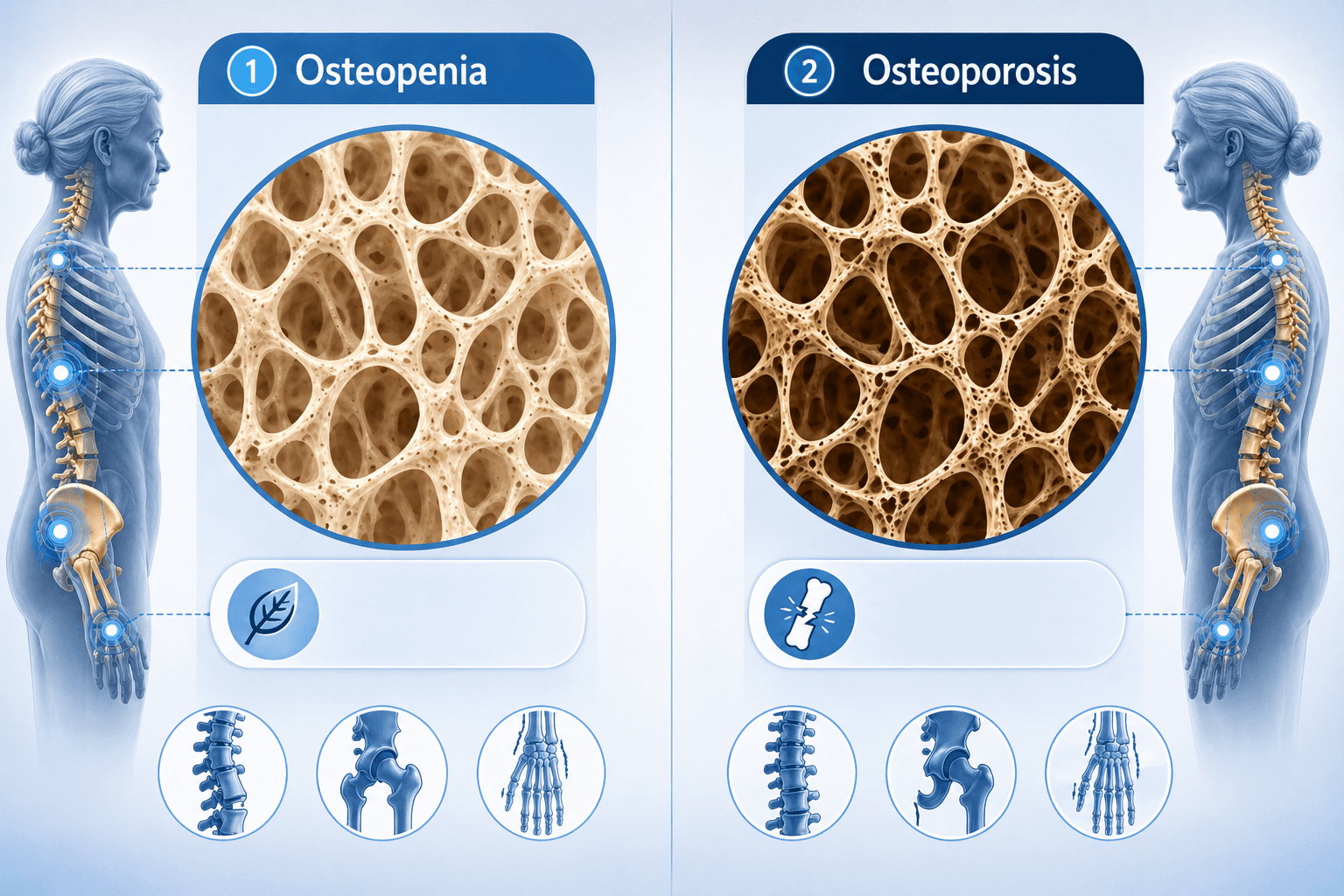
Osteopenia & Osteoporosis: The Sponge Spectrum
Imagine three sponges in your kitchen drawer:
The brand-new sponge → normal bone.
The sponge you've been using for six months → osteopenia. The holes are getting bigger.
The sponge that's been under the sink since 2019 → osteoporosis. Throw it out before it crumbles.
That's the whole concept, more or less. The medical version is just numbers attached to those sponges.
The T-Score: Your Bone Report Card
The standard test for bone density is called a DXA scan (dual-energy X-ray absorptiometry). It's painless, takes about 15 minutes, and uses less radiation than a cross-country flight. The result you care about is your T-score, which compares your bone density to that of a healthy 30-year-old of the same sex.
T-Score | What It Means | Bone Sponge Status |
|---|---|---|
≥ –1.0 | Normal | Fresh from the package |
–1.0 to –2.5 | Osteopenia (low bone mass) | Used a few months |
≤ –2.5 | Osteoporosis | Should've been replaced last year |
≤ –2.5 + fragility fracture | Severe (established) osteoporosis | It's literally falling apart |
You may also see a Z-score, which compares you to someone your own age. The Z-score is mainly used in younger adults and kids — for postmenopausal women and men over 50, the T-score is what doctors use to make decisions.
Why "Osteopenia" Isn't Just "Osteoporosis Lite"
Here's the wild thing: most fragility fractures actually happen in people with osteopenia, not osteoporosis. Wait, what?
Yep. That's because there are way more people in the osteopenia category than in the osteoporosis category. So even though each individual osteopenic person has a lower fracture risk than each osteoporotic person, the sheer volume of osteopenic folks means more total fractures come from that group. This is why doctors no longer treat osteopenia as a "you're fine, just wait" diagnosis. Some osteopenic patients absolutely need medication — we just need a smarter way to figure out which ones. (Spoiler: that's where FRAX comes in.)
"Osteopenia is not just a softer version of osteoporosis. It's a fork in the road — and which way you go depends on what else is going on with you."
The Different Types of Osteoporosis
Osteoporosis isn't one thing. There are several kinds, depending on what's causing it. Knowing the type matters because the treatment changes.
Primary Osteoporosis
This means the bone loss isn't caused by another disease or drug — it's just your body doing its thing.
Type I — Postmenopausal Osteoporosis. Hits women in the first 5 to 10 years after menopause. The drop in estrogen unleashes the osteoclasts. Trabecular bone (the spine!) takes the biggest hit, which is why vertebral compression fractures are so common in this group. About 1 in 2 women over 50 will have a fragility fracture in their lifetime.
Type II — Senile (Age-Related) Osteoporosis. Affects both men and women, usually after age 70. The bone loss is more gradual and affects both cortical and trabecular bone. Hip fractures are the classic problem here. Men hit this party about 10 years later than women — but when they do, the consequences are often worse: men have higher mortality after a hip fracture than women do.
Secondary Osteoporosis
This is bone loss caused by something else — a disease, a medication, a hormone problem, or a nutrient issue. About 30% of women and 50 to 80% of men with osteoporosis actually have a secondary cause hiding underneath. Common culprits:
Category | Examples |
|---|---|
Endocrine | Hyperthyroidism, hyperparathyroidism, Cushing's, low testosterone, type 1 diabetes |
GI / Nutrition | Celiac disease, Crohn's, ulcerative colitis, gastric bypass, low calcium or vitamin D |
Kidney / Liver | Chronic kidney disease, chronic liver disease |
Rheumatic | Rheumatoid arthritis, ankylosing spondylitis, lupus |
Blood disorders | Multiple myeloma, mastocytosis, thalassemia |
Lifestyle | Smoking, excessive alcohol, eating disorders, immobility |
Glucocorticoid-Induced Osteoporosis (GIOP). This deserves its own spotlight because it's the #1 drug-induced cause of osteoporosis. If you take prednisone (or any other steroid pill) at doses of ≥5 mg/day for more than 3 months, you're at significant risk. The bone loss is fastest in the first 3 to 6 months, and fracture risk jumps even before BMD drops noticeably. This is one of the few situations where doctors will often start medication based on age and steroid dose alone, without waiting for a bad DXA scan.
Drug-Induced Bone Loss (Beyond Steroids). Lots of medications can quietly nibble at your bones over time. None of these mean you should stop your medication — but you and your doctor should know.
Drug Class | Examples | Why It Hurts Bones |
|---|---|---|
Glucocorticoids | Prednisone, dexamethasone | Suppress osteoblasts, increase osteoclast activity |
Aromatase inhibitors | Letrozole, anastrozole, exemestane | Drop estrogen to almost zero |
Androgen-deprivation therapy | Leuprolide, goserelin | Drops testosterone in prostate cancer |
Anti-seizure drugs | Phenytoin, carbamazepine, phenobarbital | Speed up vitamin D breakdown |
Long-term PPIs | Omeprazole, pantoprazole | Reduce calcium absorption |
SSRIs | Sertraline, fluoxetine | Affect serotonin signaling in bone |
Heparin (long-term) | Unfractionated heparin | Activates osteoclasts |
Thiazolidinediones | Pioglitazone | Shifts stem cells away from bone-making |
Excess thyroid hormone | Too much levothyroxine | Speeds up bone turnover |
Depo-Provera | Medroxyprogesterone shot | Suppresses estrogen |
⚠️ Never stop any of these medications on your own. The fix is usually adding bone protection (calcium, vitamin D, sometimes a bisphosphonate), not removing the original drug. Always talk to your doctor.
Idiopathic Osteoporosis
"Idiopathic" is doctor-Latin for "we don't know why." This category covers cases in young adults, premenopausal women, and adolescents who develop osteoporosis without an obvious cause. It's rare and frustrating, but worth mentioning so you know it exists.
The Real Challenges
Osteoporosis is sneaky. It's been called "the silent disease" for a reason. Here are the biggest challenges patients and doctors actually face.
Challenge 1: You can't feel bone loss. Bones don't ache as they thin. There's no "uh oh, my hip feels 12% less dense today" sensation. Most people only find out they have osteoporosis after a fracture — and by then, the disease is already advanced. About two-thirds of vertebral fractures aren't even diagnosed when they happen, because the back pain gets blamed on "I must've slept funny."
Challenge 2: The fracture cascade. Once you've had one fragility fracture, you're 5x more likely to have another. The first 12 to 24 months after a fracture is called the "imminent fracture risk window," and it's the most dangerous stretch. Yet only about 20% of people who have a fragility fracture get evaluated and treated for the underlying osteoporosis. This treatment gap is one of the biggest unsolved problems in modern medicine.
Challenge 3: Hip fractures are catastrophic. A hip fracture isn't just a broken bone. In adults over 65:
About 20 to 30% die within a year of the fracture.
About 50% never regain their previous level of independence.
About 25% need long-term nursing home care.
Hip fractures are why osteoporosis matters so much. Preventing them is the whole point of treatment.
Challenge 4: Vertebral fractures pile up quietly. Each vertebral fracture chips away at your height (about ¼ to ½ inch per fracture) and curves your upper spine forward (kyphosis, the "dowager's hump"). They cause chronic back pain, breathing problems, GI issues, and a real loss of quality of life. The kicker: most happen without any obvious injury — just bending over to pick up a grocery bag, or even coughing too hard.
Challenge 5: Treatment sticks are hard to land. Even when osteoporosis is diagnosed and a medication is prescribed, only about 50% of patients are still taking it a year later. The reasons: complicated dosing instructions, fear of rare side effects (we'll get to that), confusion about how long to take it, and the fact that you can't feel the medication working.
Challenge 6: The osteopenia gray zone. What do you do with the millions of people who fall in that –1.0 to –2.5 T-score range? Treating everybody is overkill. Treating nobody misses real fractures. The answer is risk-based assessment using tools like FRAX, but applying it consistently is harder than it sounds.
Treatments That Actually Work
Now for the good news. We have excellent medications for osteoporosis. They've all been tested in randomized controlled trials.
The Lifestyle Foundation (For Everyone)
Before, during, and after any medication, the basics still matter:
Calcium: 1,000 to 1,200 mg/day, ideally from food. (Too much from supplements may raise heart and kidney-stone risk.)
Vitamin D: 800 to 1,000 IU/day for most adults; targets a blood level of ≥20 to 30 ng/mL.
Weight-bearing exercise: walking, dancing, jogging, hiking, racquet sports — most days of the week.
Resistance training: 2 to 3 times per week. RCTs (e.g. the LIFTMOR trial in postmenopausal women with low BMD) show that high-intensity resistance and impact training improves spine and hip BMD significantly.
Balance exercises: tai chi, yoga (with caution), heel-to-toe walking. Falls cause about 95% of hip fractures, so fall prevention is half the battle.
Stop smoking. Limit alcohol to ≤2 drinks/day for men, ≤1 for women.
Antiresorptive Medications: The Big Two
Most osteoporosis drugs are antiresorptive — they slow down the demolition team (osteoclasts). The bones become denser and stronger because the builders are doing more building than the breakers are breaking.
Bisphosphonates — the workhorses. These are usually first-line. They stick to bone and gradually get absorbed by osteoclasts, then quietly tell those cells to retire.
Drug | How It's Given | Vertebral Fx ↓ | Hip Fx ↓ | Key RCT |
|---|---|---|---|---|
Alendronate (Fosamax) | 70 mg pill weekly | ~44% | ~40% | FIT trial (1996, 1998) |
Risedronate (Actonel) | 35 mg pill weekly | ~36% | ~26% | VERT, HIP trials |
Zoledronate (Reclast) | 5 mg IV once a year | ~56% | ~42% | HORIZON-PFT (2007) |
Ibandronate (Boniva) | 150 mg pill monthly | ~50% | Not proven | BONE trial |
In the HORIZON Pivotal Fracture Trial, 7,765 postmenopausal women with osteoporosis got either yearly IV zoledronate or placebo for 3 years. Zoledronate reduced spine fractures by 70%, hip fractures by 41%, and all clinical fractures by 33%. A separate HORIZON Recurrent Fracture Trial in patients who'd just had a hip fracture showed zoledronate cut new fractures by 35% — and even reduced death by 28%. That's not a typo. Yearly IV bisphosphonate in older adults with recent hip fracture saved lives.
Rules of the road for oral bisphosphonates:
Take first thing in the morning, on a totally empty stomach, with 6 to 8 oz of plain water (no coffee, no juice).
Stay upright for at least 30 minutes after.
Don't eat or take other meds for 30+ minutes.
If you skip these rules, you can irritate your esophagus. Not fun.
Denosumab (Prolia) — a shot twice a year. Denosumab is a monoclonal antibody that blocks RANKL, a protein osteoclasts need to function. It's given as a 60 mg shot under the skin every 6 months. In the FREEDOM trial (7,868 women, 3 years), denosumab reduced vertebral fractures by 68%, hip fractures by 40%, and non-vertebral fractures by 20%. The 10-year FREEDOM Extension showed continued BMD gains for the entire decade.
⚠️ Critical: If you stop denosumab, your bone loss rebounds rapidly within 6 to 12 months, and the risk of multiple vertebral fractures spikes. Never just stop denosumab. If treatment ends, you must transition to a bisphosphonate (usually a zoledronate infusion). This is one of the most important rules in osteoporosis care.
The Bone-Builders: Anabolic Therapies
Some patients need more than just slowing bone loss — they need to build new bone. That's where anabolic agents come in. They're more expensive, given by injection, and reserved for very high-risk patients (multiple vertebral fractures, very low BMD, recent fracture, etc.).
Drug | How It Works | Dosing | Vertebral Fx ↓ | Key RCT |
|---|---|---|---|---|
Teriparatide (Forteo) | Synthetic parathyroid hormone (1–34) | 20 mcg daily injection, up to 24 months | ~74% | Fracture Prevention Trial (2001) |
Abaloparatide (Tymlos) | PTHrP analog | 80 mcg daily injection, up to 18 months | ~87% | ACTIVE (2017) |
Romosozumab (Evenity) | Anti-sclerostin antibody | 210 mg monthly injection × 12 | ~73% | FRAME, ARCH (2017–2018) |
The ARCH trial changed the game. ARCH compared romosozumab (then alendronate) vs. alendronate alone in 4,093 postmenopausal women with severe osteoporosis. After 24 months, the romosozumab-first group had 48% fewer vertebral fractures and 38% fewer hip fractures than the alendronate-only group. The catch: more cardiovascular events showed up in the romosozumab group, so it's not given to anyone with a recent heart attack or stroke.
⚠️ After any anabolic agent ends, you must follow with an antiresorptive (bisphosphonate or denosumab). Otherwise, the new bone you just built will start melting away within a year. Anabolic + antiresorptive in sequence is the powerful combo.
Other Players
Raloxifene (Evista) — the SERM. A "selective estrogen receptor modulator" — meaning it acts like estrogen on bones (good) but blocks estrogen on breast tissue (also good, for breast cancer prevention). The MORE trial showed about a 40% drop in vertebral fractures, but no proven hip fracture protection. Raises blood clot risk and worsens hot flashes. A reasonable choice in younger postmenopausal women whose main risk is spine fractures and who also want some breast cancer risk reduction.
Hormone therapy. The Women's Health Initiative (WHI) showed estrogen prevents fractures — but it also showed real cardiovascular and breast cancer risks at the doses studied. Today, hormone therapy is mostly reserved for younger postmenopausal women who need it for hot flashes and bone protection together, not as a stand-alone osteoporosis treatment.
Calcitonin. A nasal spray. Weaker than the others, with potential cancer risk concerns. Largely sidelined now.
Drug Holidays — When to Take a Break
Bisphosphonates have a unique feature: they linger in your bones for years after you stop them. So after 5 years of pills (or 3 years of yearly infusions), if your fracture risk has dropped, your doctor may suggest a "drug holiday." During the break, you don't take the medication, but the protective effect slowly fades.
Studies (like the FLEX extension of the FIT trial and the HORIZON extension) showed that for women at low or moderate risk after 5 years, stopping was reasonable. For those still at high risk — multiple fractures, T-score still very low, or recent fracture — staying on therapy was better.
⚠️ Drug holidays apply only to bisphosphonates. They do not apply to denosumab. Repeat after me: denosumab does not get a drug holiday.
Side Effects: The Real Talk
Patients often hear scary stories about osteoporosis drugs and decide to skip treatment — and then they fracture. Let's put the real risks in perspective.
The Common Stuff (Annoying, Usually Manageable)
Heartburn / esophageal irritation with oral bisphosphonates — solved by following the dosing rules.
Flu-like symptoms in the 1 to 3 days after IV zoledronate — common with the first dose, much milder with later doses; pre-treat with acetaminophen.
Joint and muscle aches — reported by some users on bisphosphonates.
Skin rashes / eczema with denosumab.
The Rare Scary Stuff (Worth Knowing, Not Worth Panicking About)
Osteonecrosis of the jaw (ONJ). A condition where part of the jawbone fails to heal after a dental procedure. At osteoporosis doses, this is very rare — about 1 in 10,000 to 1 in 100,000 patient-years. (Cancer doses, which are 10 to 12 times higher, carry much higher ONJ risk.) Tell your dentist you're on these drugs. Get any major dental work done before starting if possible.
Atypical femur fractures (AFF). Unusual stress fractures of the thigh bone. Happens with very long-term bisphosphonate use (8+ years). The risk is about 1 in 1,000 after 8 to 10 years of use. The same drug prevents far more fractures than it causes — but this is why drug holidays exist. Asian women have a notably higher AFF risk per year of use.
"For every 1 atypical femur fracture caused, bisphosphonates prevent roughly 100 osteoporotic fractures. The math is overwhelmingly in your favor — for the first 5 years."
Severe low calcium. Mostly a denosumab problem in patients with kidney disease or untreated vitamin D deficiency. Always check calcium and vitamin D before any antiresorptive.
Heart concerns with romosozumab. The ARCH trial showed a small uptick in heart attacks and strokes vs. alendronate. Don't use in anyone who's had one in the past year.
Who Should Get Tested?
Screening guidelines from the U.S. Preventive Services Task Force and major societies:
All women age 65 and older.
All men age 70 and older.
Postmenopausal women under 65 with risk factors (low body weight, parental hip fracture, smoking, etc.).
Men 50 to 69 with risk factors.
Anyone with a fragility fracture after age 50.
Anyone on long-term steroids, aromatase inhibitors, or androgen-deprivation therapy.
Repeat scans every 1 to 2 years if borderline, or every 5+ years if results are reassuring. Once you're on treatment, BMD is usually re-checked every 1 to 3 years to track response.
The Big Bone Takeaway
If you remember just three things from this article:
Bones are alive, constantly remodeling, and their fate is shaped by everything you do — and don't do — every day.
Osteopenia is a fork in the road, not a verdict. With smart lifestyle changes (and sometimes meds), most people can stop or even reverse the slide.
Modern osteoporosis treatments work. The RCT evidence is rock-solid. The biggest tragedy is that most people who would benefit aren't getting them.
Your skeleton is going to keep showing up for you whether you treat it well or not. But the deal is way better when you treat it well.
"Be the kind of person your bones would brag about at the cell-cell mixer."
Sources for the curious: this article draws on landmark RCTs including FIT, VERT, HIP, BONE, HORIZON-PFT, HORIZON-RFT, FREEDOM and its 10-year extension, the Fracture Prevention Trial, ACTIVE, FRAME, ARCH, MORE, FLEX, the HORIZON extension, and LIFTMOR — published primarily in NEJM, JAMA, Lancet, and JBMR.
HSA/FSA Eligible
Doctors Are Human.
That's Why There's Medome.
Start your free trial today. No credit card required.
Start Your Free Trial
Join thousands protecting their health with AI that never forgets

Critical details get missed when your health information is scattered. Medome connects the dots across your complete record.
Start Your Free Trial
Get In Touch
Email: service@medome.ai
Phone: (617) 319-6434
This is Dr. Steven Charlap's cell. Please text him first, explaining who you are and how he can help you. Use WhatsApp outside the US.
Hours: Mon-Fri 9:00AM - 9:00PM ET