(And Why That Should Terrify You)
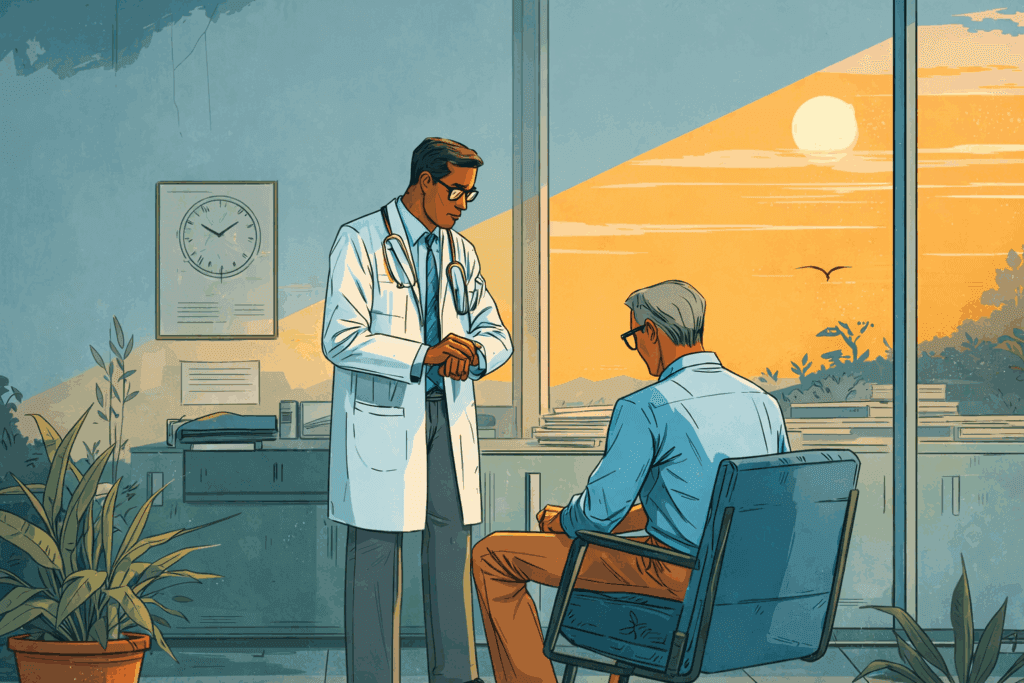
Your doctor has 15 minutes.
In that time, they need to greet you, review your chart (which they’re seeing for the first time), listen to your symptoms, perform an exam, make a diagnosis, explain the treatment plan, answer your questions, document everything for legal purposes, and somehow make you feel heard.
No pressure.
The average primary care physician is responsible for 2,300 patients. They’re drowning in administrative work, fighting with insurance companies, and trying not to burn out. Most of them went into medicine to help people. Now they spend more time looking at screens than at faces.
This isn’t their fault. It’s the system. But here’s the uncomfortable truth: the system doesn’t care about you.
You are responsible for you. And there are five questions that could save your life. Questions your doctor simply doesn’t have time to answer properly.
1. “What ideas do you have about what’s going on?”
In the UK, GPs are trained to ask this question. It’s part of a framework called ICE: Ideas, Concerns, Expectations. The thinking is simple. Patients often have theories about what’s wrong with them. Sometimes those theories are right. Sometimes they reveal crucial context. Sometimes they expose fears that need addressing before any treatment can work.
But in a 15-minute appointment with a packed waiting room? This question rarely gets asked. And when it does, there’s rarely time to explore the answer.
You’ve been living in your body. You’ve noticed the patterns. You’ve wondered if that thing you read about online might explain your symptoms. Maybe you’re wrong. But maybe you’ve noticed something your doctor, glancing at your chart for the first time, simply cannot see.
Your ideas matter. But nobody’s asking for them.
2. “What are you most concerned about?”
This is the second part of that framework. Concerns.
You came in with a headache, but what you’re really worried about is that your father died of a brain aneurysm at 52. You mention fatigue, but what keeps you up at night is the fear that you have what your sister has. You describe a rash, but in the back of your mind you’re thinking about that article you read about early warning signs.
Doctors treat symptoms. But patients live with fears. And when those fears go unspoken, two things happen. First, you leave without the reassurance you actually needed. Second, your doctor misses the family history, the context, the clue that might have changed everything.
Most patients don’t volunteer their deepest concerns. They feel embarrassed. They don’t want to seem like hypochondriacs. They assume the doctor will ask if it matters.
The doctor doesn’t ask. There isn’t time.
3. “What are your expectations for this visit?”
The third part. Expectations.
You came hoping for a referral to a specialist. Your doctor thinks you need to try physical therapy first. You leave frustrated, feeling unheard. Your doctor moves on, unaware that you’re not going to follow the treatment plan because it wasn’t what you needed.
Or maybe you came expecting reassurance. A quick check to confirm that the weird symptom is nothing serious. But your doctor, not knowing this, launches into a battery of tests that terrify you. Now you’re convinced something is deeply wrong when all you needed was someone to say “this is normal.”
Misaligned expectations poison the entire encounter. Both sides leave dissatisfied. And the disconnect can have real consequences for your care.
4. “What else could this be?”
Doctors are trained to find the most likely diagnosis and act on it. This is usually efficient. It’s also how things get missed.
That “pulled muscle” that’s actually a blood clot. The “anxiety” that’s actually a thyroid disorder. The “acid reflux” that’s actually heart disease. These aren’t rare mistakes. Diagnostic errors affect roughly 12 million Americans every year. That’s 1 in 20 adults. Every year.
When your doctor gives you a diagnosis, they’ve already moved on mentally. The clock is ticking. The next patient is waiting. They don’t have time to walk you through every other possibility they considered and ruled out. Or didn’t consider at all.
But you’re not the next patient. You’re the one who has to live with being wrong.
5. “Does this fit with everything else in my history?”
Your health isn’t a series of isolated incidents. It’s a story. But modern medicine treats it like a collection of sticky notes scattered across a dozen different offices.
Your cardiologist doesn’t know what your dermatologist prescribed. Your new doctor doesn’t have records from the doctor you saw in another state five years ago. Nobody is looking at the whole picture because nobody has the whole picture.
That recurring symptom you mentioned to three different specialists? None of them connected the dots because none of them saw all three mentions. That family history of early cancer? It’s buried in a file somewhere, unlinked to the symptoms you’re describing today.
Your doctor can’t ask “does this fit the pattern?” because they can’t see the pattern.
So What Do You Do?
You could become a professional patient. Spend hours researching before every appointment. Keep meticulous records. Learn to speak in medical terminology. Advocate aggressively for yourself in a system designed to move you along.
Some people do this. They become experts in their own conditions. It works, until it doesn’t. Until you’re too sick, too tired, too overwhelmed to fight.
Or you could accept that the system is broken and hope you get lucky. Most people do. Most of the time, they’re fine. But “most of the time” is cold comfort when you’re the exception.
There’s a third option: build a safety net.
Not instead of doctors. You need doctors. But alongside them. Something that holds your complete history, watches for patterns, checks diagnoses against current guidelines, and asks the questions you didn’t know to ask. Something that treats you the way the best doctors wish they could. With unlimited time. With your whole story in front of it. With nothing to do but make sure nothing gets missed.
Something that asks about your ideas, your concerns, and your expectations. Every single time.
Your doctor is doing their best. The system isn’t. And your health is too important to leave to a system that gives you 15 minutes and hopes for the best.
You deserve a second set of eyes.
• • •
Medome was built by a physician who lost his brother, a cardiologist, to a missed diagnosis.
We exist so that doesn’t happen to you.
Try it free for 7 days at medome.ai
HSA/FSA Eligible
Doctors Are Human.
That's Why There's Medome.
Start your free trial today. No credit card required.
Start Your Free Trial
Join thousands protecting their health with AI that never forgets
Critical details get missed when your health information is scattered. Medome connects the dots across your complete record.
Start Your Free Trial
Quick Links
Medome Men
Home
Pricing
About
Health News
HealthSigns
FAQ
Contact Us
Terms of Service
Privacy Policy
Get In Touch
Email: service@medome.ai
Phone: (617) 319-6434
This is Dr. Steven Charlap’s cell. Please text him first, explaining who you are and how he can help you. Use WhatsApp outside the US.
Hours: Mon-Fri 9:00AM - 9:00PM ET