Mood
Zapping Yourself Calm: The Real Science of "Electric Medicine" and Your Vagus Nerve
what nerve-zapping gadgets can and can't do
Jul 9, 2026 · 10 min read
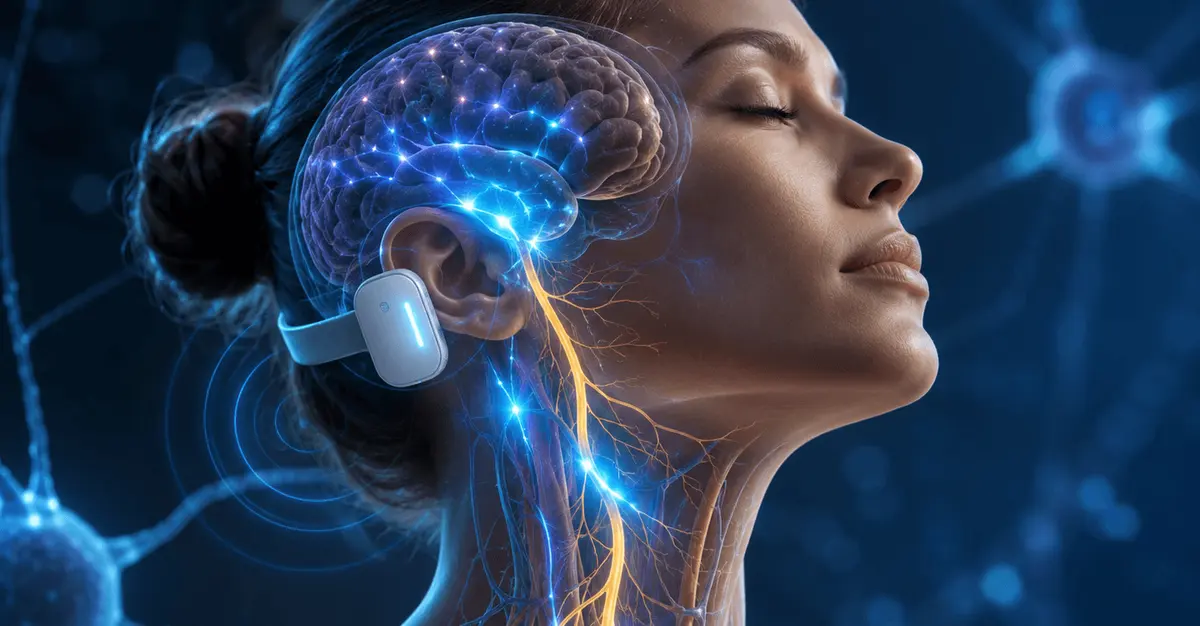
Scroll through any wellness corner of the internet and you'll bump into a bold new idea: what if stress isn't a feelings problem but a wiring problem? What if your frazzled nervous system just needs to be tuned up with a little electricity, like a guitar or a car engine?
This is the pitch behind "electric medicine." Instead of talking to a therapist, you clip a gadget to your ear, zap a nerve, and supposedly reset your whole stress system. Companies sell headbands, ear clips, and forehead pads promising calm, focus, better sleep, and freedom from burnout.
So is it real science or fancy snake oil? The honest answer is: some of both. There's genuine, fascinating biology here. There's also a marketing machine running way ahead of the evidence. Let's separate them.
Meet the Vagus Nerve, Your Body's Information Superhighway
The vagus nerve is the longest of the twelve cranial nerves. Its name comes from the Latin word for "wandering," because it wanders all over your body, connecting your brainstem to your heart, your lungs, your gut, and your immune organs.
Here's the surprising part. About 80% of its fibers carry information up to the brain (sensory), and only about 20% carry commands down to the body (motor). So it's mostly a giant reporting system, constantly texting your brain updates about what your organs are doing.
The vagus nerve is the main cable of your "rest and digest" system, the calm counterpart to your "fight or flight" panic mode. When it's active, your heart rate slows, your digestion revs up, and your body relaxes. That's exactly why it looks like such a tempting target. If you could dial up the calm nerve on demand, maybe you could dial down stress.
The Genuinely Cool Science: Calming Inflammation
The most impressive thing the vagus nerve can do isn't about mood at all. It's about turning down inflammation, and the pathway reads like a chain of dominoes:
- The vagus nerve sends a signal down toward your spleen.
- That triggers the release of a chemical (norepinephrine).
- That nudges special immune cells (T cells) to release another chemical (acetylcholine).
- That chemical lands on your inflammation-causing cells (macrophages) and basically tells them to chill out.
- The result: fewer inflammatory alarm signals like TNF-alpha, IL-1beta, and IL-6.
Scientists named this the cholinergic anti-inflammatory pathway, which is a mouthful, so just think of it as the vagus nerve's "calm down" button for your immune system. It's been shown to work in animal studies of serious inflammation, and early human trials are testing it for rheumatoid arthritis and inflammatory bowel disease.
Why does this matter for stress and mood? Because researchers increasingly think inflammation plays a role in depression and anxiety. So a nerve that can quiet inflammation and connect to mood centers in the brain is a legitimately interesting target. This part isn't hype. It's real biology.
The catch is the leap from "this pathway exists" to "therefore this $300 ear clip will fix your burnout." That leap is much bigger than the ads suggest.
FDA "Approved" vs FDA "Cleared": Learn This One Thing
If you remember nothing else, remember this, because it's the trick behind half the marketing.
FDA approved means a device had to prove it actually works through solid clinical trials. This is the hard path.
FDA cleared (through something called the 510(k) pathway) mostly means a device is similar enough to something already on the market and appears safe. It does not require proof that it treats anything effectively. This is the easy path.
Companies love to say "FDA cleared" because it sounds identical to "FDA approved" to a normal human. It is not. And a third group of devices skips all of this by calling themselves "general wellness products," which lets them make vague promises about "nervous system regulation" without proving a single thing.
So here's your decoder ring for the whole industry.
What's Actually Approved (the Real Deal)
Surgically implanted VNS devices, where a surgeon places a stimulator near the nerve in your neck, are genuinely FDA approved for:
- Hard-to-treat epilepsy
- Treatment-resistant depression (for people who've already failed four or more antidepressants)
- Obesity (a specific device)
- Rehab for arm movement after a stroke (a specific device)
Non-invasive VNS worn on the skin, like the gammaCore device on the neck, is FDA cleared for:
- Migraine
- Cluster headaches
Notice what's not on either list: anxiety, burnout, everyday stress, and "brain optimization." No non-invasive device has been approved for those in the general population. Not one. Every ear clip promising to melt your stress away is operating in that regulatory gray zone.
What Might Work (the Promising-but-Unproven Pile)
Ear VNS (taVNS). This delivers gentle stimulation to a branch of the vagus nerve at your ear, and it has the best evidence among consumer-style devices. When researchers pooled four small trials (222 people total), ear stimulation beat a fake version for both depression and anxiety scores. Other small studies found it helped anxiety and stress but not always depression.
Sounds great, right? Here's the honest asterisk: these studies are small, short, and use wildly different settings, so nobody agrees on the "right" dose. As one review bluntly put it, results are mixed, with some people getting real relief and others doing no better than a placebo. A big, rigorous trial is underway to sort this out. Until then: promising signal, not a sure thing.
Brain stimulation (tDCS). This runs a weak electrical current (1 to 2 milliamps) across your scalp. It has the most grown-up evidence of the bunch. Pooling nine trials for depression, about 31% of people responded versus about 19% on a fake device. That's a real effect, but a modest one: you'd need to treat about nine people for one extra person to benefit. There's even solid mechanism evidence, with one trial showing it calmed the brain's threat-detector (the amygdala) in anxious people.
But tDCS has sharper edges than the ear devices. In people with depression, it carries roughly a 3.3% risk of triggering mania, and the risk of a manic episode is about five times higher in people with bipolar disorder. There are case reports of a seizure and of skin burns under the electrodes. Big picture, across more than 300,000 sessions at safe settings, no serious harms have been reported. But those were supervised sessions. What happens when people run DIY kits at home with random settings is genuinely unknown.
🚫 DIY tDCS kits and "just crank it up" home use are a genuinely bad idea.
The safety record for scalp stimulation comes from supervised sessions at controlled settings — not from mail-order electrodes and a YouTube tutorial. Your brain is not a volume knob. As one ethics paper put it, stimulating the brain is like adjusting a hanging mobile: pushing on one piece swings all the others. Boosting one thing can quietly dent another. Do not build, modify, or overdrive a brain stimulator at home.
What Probably Doesn't Work (or We Honestly Can't Tell)
Cranial electrotherapy stimulation (CES). These ear-clip devices are FDA cleared (remember, the easy path) for anxiety, insomnia, and depression. But a careful review in a top medical journal found the evidence insufficient for most of those claims, with only weak evidence of a small benefit for anxiety. One recent study reported amazing results, but it had no fake-device control group and nobody was blinded, so there's no way to tell the real effect from the placebo. This is the poster child for "cleared does not mean proven."
Brain-reading headbands and neurofeedback. Consumer EEG headbands (like Muse, Emotiv, and NeuroSky) claim to read your brainwaves and train your mind. The problem starts with the hardware: signal quality varies a lot, and some popular models line up poorly with lab-grade equipment. On top of that, a review of 21 neurofeedback studies found that every single one reported positive results. That sounds amazing until you realize it's a giant red flag. In real research, some studies always come up empty. When all of them are glowing, it usually means the negative results got quietly buried (a problem called publication bias). The reviewers concluded the evidence isn't strong enough to recommend it. A burnout review found only six studies, and even those were vague and inconsistent.
The Free "Vagus Hacks" Everyone's Actually Doing
Here's the biggest part of the trend, and it usually gets skipped. Most people aren't buying $300 devices. They're doing free "vagus nerve hacks" they saw online: humming, gargling, cold showers, slow breathing, splashing icy water on the face.
The good news is these are basically harmless, and some (like slow breathing) really can help you relax. The less-hyped truth is that the evidence they meaningfully "tone" your vagus nerve in a lasting, health-changing way is thin. Slow breathing calms you down mostly because slow breathing calms anyone down, not because you've secretly upgraded a nerve. If humming makes you feel good, hum away. Just don't expect it to cure a medical condition.
You'll also see people obsessing over HRV (heart rate variability) from their smartwatch as a score for their vagal tone. It's a real measurement, but it bounces around based on sleep, caffeine, alcohol, illness, and stress. Treating one morning's number as a report card for your nervous system is a fast track to anxiety about your anxiety.
The Placebo Elephant in the Room
Here's a truth the industry really doesn't want front and center: the whole ritual of these devices is relaxing on its own. You put on a headband, sit still in a quiet room, breathe slowly, and feel a mild tingle. Of course you feel calmer. You'd feel calmer doing that with a device that wasn't even turned on.
That's not an insult, it's just science. In fair trials, fake devices produce big improvements too. So "I tried it and I feel better" is real and valid, but it does not prove the electricity did anything special. Feeling better and the gadget working are two different claims.
Are They Safe?
Mostly yes, for the non-invasive kind used sensibly.
Ear and skin VNS. A large safety review found no link to serious harm. The usual complaints are minor: ear pain, headache, and tingling. (Amusingly, more than half the studies didn't even bother reporting side effects, which is its own problem.)
tDCS. Common effects are mild skin irritation and headache, with very few people dropping out.
Surgically implanted VNS. This is real surgery, so the risks are bigger: infection, and very commonly a hoarse voice, plus cough, trouble swallowing, and breathing issues during sleep for a large share of patients. This is a serious medical treatment, not a wellness gadget.
Who Should Be Extra Careful
⚠️ Some people need a doctor's okay before any of this — not as a formality.
Talk to a doctor first if you have a pacemaker or defibrillator (stimulation can affect the heart), implanted metal or electronics near where a device would sit, epilepsy (rare seizure reports with scalp stimulation), bipolar disorder (scalp stimulation raises the odds of triggering mania), or if you're pregnant (there simply isn't enough safety data). If you have depression or bipolar disorder and notice unusually elevated mood, racing thoughts, or a sharp drop in your need for sleep after starting a device, stop and contact your prescriber. If you're in crisis or having thoughts of suicide, call or text 988.
Where This Is All Heading (the Hopeful Part)
The field is maturing, and the future actually looks promising:
- Smart, self-adjusting devices that respond to your body's signals in real time instead of blasting a one-size-fits-all setting.
- Biomarker matching to figure out which people will actually respond, instead of hoping it works for everyone.
- Combining stimulation with therapy like CBT or mindfulness, which early evidence suggests may work better together than either alone.
- Anti-inflammatory uses for conditions like rheumatoid arthritis and Crohn's disease, expanding beyond the brain entirely.
The Bottom Line
The core idea behind electric medicine is real. The vagus nerve genuinely links your brain, body, and immune system, and stimulating it can move real biological levers. For specific medical conditions like hard-to-treat epilepsy, treatment-resistant depression, migraine, and cluster headache, these devices have earned their place.
But for the everyday promises driving the trend — calming stress, curing burnout, upgrading your brain — the evidence is early and thin. A few small studies show hopeful signals, especially for ear VNS and scalp stimulation in depression and anxiety. That is a world away from proven.
So keep these five things in your pocket:
- "Cleared" is not "approved." One means proven safe-ish; the other means proven to work. Marketers blur them on purpose.
- Consumer gadgets aren't research devices. The ear clip on Amazon is not the machine used in the studies.
- Placebo is powerful. Feeling better doesn't prove the electricity did it.
- These should add to real treatment, not replace it. For actual anxiety or depression, therapy, medication, sleep, and exercise still have the strongest evidence by far.
- Some people need a doctor's okay first, especially with heart devices, epilepsy, or bipolar disorder.
The buzz around electric medicine is exciting, and honestly, some of it will probably pan out. But right now the science is still catching up to the sales pitch. Enjoy the tingle if you like it. Just keep your wallet and your expectations on a short leash.
This article is general education, not medical advice. Neurostimulation devices are not a substitute for care that works — if you're dealing with anxiety, depression, or burnout, therapy, medication, sleep, and exercise remain the strongest evidence we have, and a gadget should sit on top of that, never in place of it. If you have a mental health condition, a heart or neurological condition, or take medication, talk to a doctor before trying any device. The same evidence rules apply here as anywhere in the wellness aisle — see our pieces on melatonin and on sea moss for what "promising signal" versus "proven" actually looks like, and our walking-vs-pill piece for how ordinary interventions keep out-performing gadgets. If you're in crisis or having thoughts of suicide, call or text 988.