A tech billionaire spends $2 million a year trying to reverse aging. A podcaster sells you cold plunges and supplements. Your friend's brother is on rapamycin he got from a clinic in a strip mall. Everyone has a protocol. Everyone has a stack. Everyone is "biohacking."
Meanwhile, the science of living longer keeps quietly pointing back to the same boring stuff: lift, sleep, eat real food, see your friends.
Here's what the actual research says — including the part where the most famous biohacker on Earth just admitted his anti-aging drug was, well, aging him.
First, Some Definitions
The longevity world loves big words. Translated:
Lifespan — how many years you live.
Healthspan — how many of those years you spend in good health.
Chronological age — what your driver's license says.
Biological age — how old your body actually acts on the inside.
You don't want to just live longer. You want to live longer well. That's the whole game.
Part 1: The Stuff That Actually Works (Strong Evidence, Often Boring)
These are the moves with massive human data behind them. They're free or cheap. Nobody's getting rich selling them to you. They are, by far, the best bet.
VO2 Max: The Single Best Predictor of How Long You'll Live
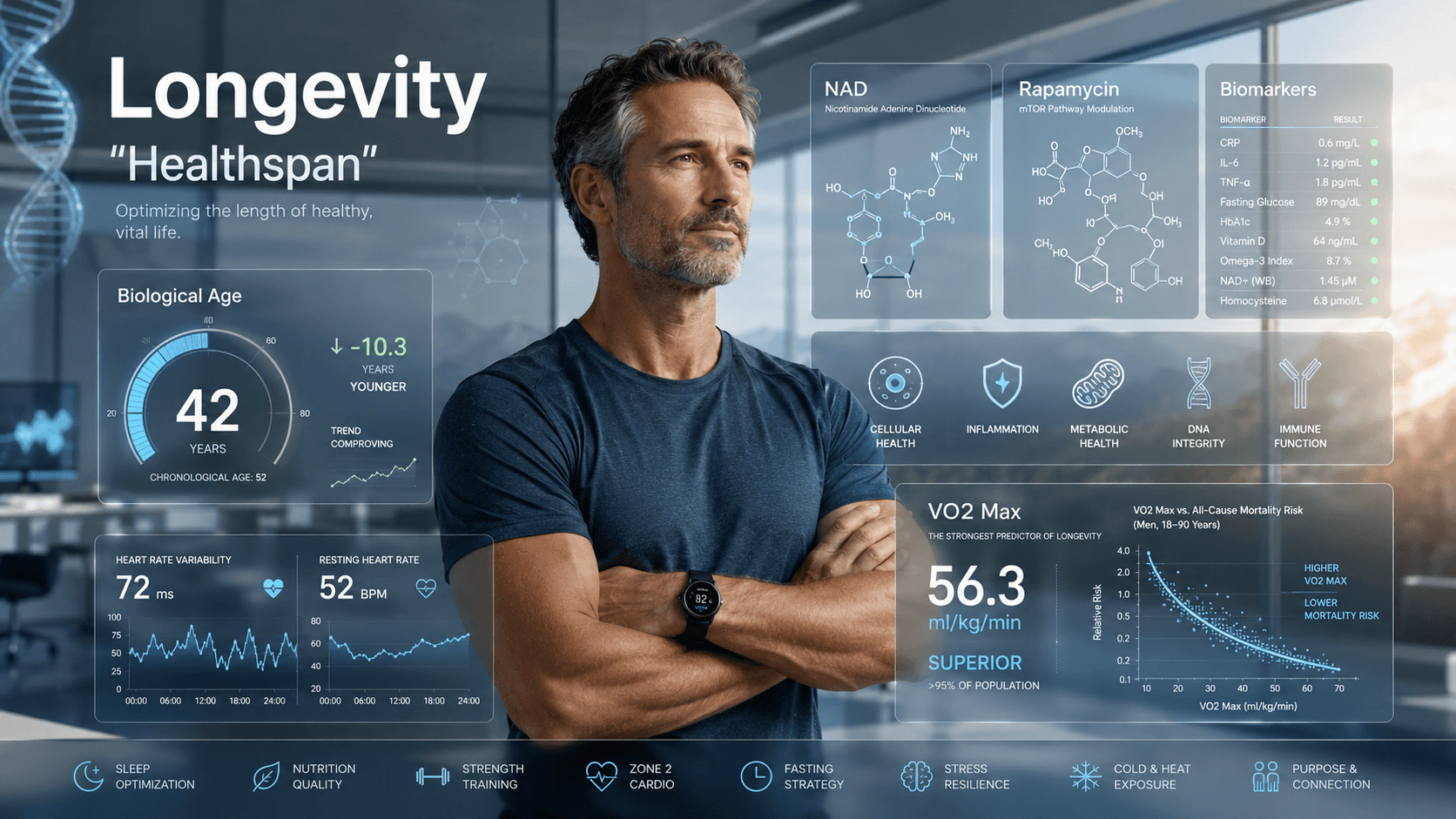
If you had to track one number, this is it. VO2 max is the most oxygen your body can use during hard exercise — basically a score for how fit your heart and lungs are.
The data are unreal:
A study of over 266,000 adults showed that every small bump in VO2 max lowered death risk — and the benefit had no ceiling. The fitter you got, the longer you lived.
A 46-year follow-up study of 5,107 men found the fittest 5% lived about 5 years longer than the least fit 5%.
VO2 max predicts your risk of dying better than cholesterol, blood pressure, or diabetes.
Good news: VO2 max is trainable at any age. Bad news: getting it up requires actual hard work — interval training and steady cardio. No supplement can do this for you.
Grip Strength and Muscle Mass: Survival Hardware
Muscle isn't just for beach pics. It's a survival organ.
A meta-analysis of nearly 2 million people found higher grip strength was linked to a 31% lower risk of death from any cause.
A 60-year-old man with grip strength even slightly below average has 3 to 4 fewer years of life expectancy than average.
Strength matters more than size. You don't need to be huge. You need to not be weak.
Translation: Lifting weights two or three times a week isn't a hobby. It's medicine.
The Mediterranean Diet Wins Again
An umbrella review pulling in data from over 12.8 million people found Mediterranean-style eating reduces death from heart disease, cancer, brain disease, and diabetes.
What it looks like:
Lots of vegetables, fruit, whole grains, beans, nuts, and olive oil
Moderate fish, poultry, yogurt, and cheese
Low red meat
Wine if you want it — one glass, not the bottle
No magic. It reduces inflammation, helps insulin work better, feeds your gut bacteria, and may literally make your DNA act younger.
Sleep: The Cheapest Anti-Aging Drug Ever Invented
7 to 9 hours a night. Consistent schedule. Sleep deprivation accelerates basically every part of aging — your hormones, your blood sugar, your brain, your immune system. Skip sleep, and no supplement on Earth can paper over the damage.
Social Connection
Loneliness raises your risk of death about as much as smoking 15 cigarettes a day. This is not a soft suggestion. Call your friends. See your kids. Have a beer with your dad.
Eating in a Window (Time-Restricted Eating)
Limiting your eating to an 8 to 10 hour window each day can drop body weight 3 to 5%, improve blood sugar control, and lower cholesterol. It's a more livable version of cutting calories. Not for everyone — skip it if you have a history of disordered eating, are underweight, or are on insulin without medical guidance.
Part 2: The Promising-But-Unproven Stuff (Where Bryan Johnson Lives)
This is where the science gets exciting and the influencers start selling you things. Lots of animal data, limited human data, and one famous cautionary tale.
Rapamycin: The Most Hyped Anti-Aging Drug — And What Just Happened to Bryan Johnson
The pitch: Rapamycin extends mouse lifespan by up to 26%. The most reliable lifespan-extending drug ever found in mammals. It quiets a protein called mTOR, flipping cells from "grow" mode to "repair and clean up" mode. Sounds amazing.
The early human data: The 2025 PEARL trial — the first year-long study of low-dose rapamycin in healthy adults — found 5 to 10 mg weekly was generally safe. Women on the higher dose gained lean tissue and reported less pain.
The Bryan Johnson story: Bryan Johnson is the tech millionaire who spends about $2 million a year trying to reverse aging. He's the Netflix-documentary guy. He called his own rapamycin protocol "the most aggressive of anyone in the industry." He took it for nearly 5 years.
In late September 2024, he quit.
⚠️ Why he stopped — side effects he couldn't shake:
Recurring skin and soft tissue infections
Bad cholesterol and triglyceride numbers
Rising blood sugar
A higher resting heart rate
He tried adjusting doses. Nothing helped. Then in October 2024, a new preprint study tested rapamycin and a handful of other "longevity drugs" across 16 different epigenetic aging clocks — the most rigorous biological-age test out there. Rapamycin came back as a drug that accelerated aging, not slowed it.
Read that again. The most famous anti-aging drug, taken by the most aggressive biohacker on Earth, may have been making him biologically older — not younger.
He stopped. He posted about it. The longevity world had to swallow it.
The takeaway isn't "rapamycin is bad." It's that the gap between mouse data and human data is huge, and that even the people running the most expensive longevity protocols on the planet can guess wrong. If Bryan Johnson — with a private lab, daily blood draws, and a full-time medical team — couldn't make it work safely, the guy buying it from a sketchy telehealth clinic should probably pause.
Bottom line: Rapamycin is real science, not snake oil. It's also not FDA-approved for anti-aging, the right dose is unknown, and the long-term safety in healthy people is unproven. Don't self-prescribe.
NAD+ Boosters (NR and NMN): Expensive Pee
The pitch: NAD+ is a key cellular molecule, levels drop as you age, supplements raise it back up, problem solved.
The reality: A 2026 review of 33 human studies found that yes, these supplements raise NAD+ levels in the blood. No, that didn't reliably translate into people feeling better, performing better, or aging slower. The animal results haven't shown up in humans yet.
You'll spend $50 to $150 a month for something that may not be doing much. Save it for a gym membership.
Metformin: The $4 Wildcard
The cheap, old diabetes drug that might slow aging. People with diabetes who take it sometimes outlive people without diabetes who don't — strange and intriguing. A massive trial called TAME is testing whether it slows aging in non-diabetics. We don't have results yet.
The catch nobody wants to talk about: Metformin may blunt the muscle and mitochondrial gains from exercise. If lifting and training are central to your health plan — and they should be — metformin might be working against you.
SGLT2 Inhibitors: The Dark Horse
Diabetes drugs that turned out to do a lot more than control blood sugar. They cut deaths from heart failure and kidney disease, even in people without diabetes. One of them — canagliflozin — extended mouse lifespan by 14%. They quietly score higher than rapamycin on some "best anti-aging drug" rankings. Still need direct longevity trials in healthy people.
Senolytics, Resveratrol, Spermidine
Killing "zombie cells" with senolytics is conceptually cool but very early. Resveratrol — yes, the red wine compound — has poor absorption and no real human longevity data. Spermidine, found in foods like mushrooms and aged cheese, is promising but unproven. Eat the food. Skip the pills until the data are in.
Part 3: Can You Actually Measure Your Biological Age?
Sort of. Companies sell "epigenetic age" tests now. The best one (called GrimAge) does a decent job at predicting health outcomes in large groups. But for you, today, a single test can swing by years depending on your sleep, stress, and what you ate last week. Useful for tracking trends over time. Not great for deciding what pill to take next.
Part 4: The Optimization Trap — When Biohacking Becomes Bioharming
This is the warning that should be tattooed on every wellness influencer's forehead.
There's a deeply seductive idea floating around: if normal is good, more must be better. Push your testosterone higher. Take more supplements. Add another drug. Optimize, optimize, optimize.
Here's what actually happens when you chase that ladder:
Supplement stacking. Some "protocols" recommend 30+ pills a day. Most supplements aren't tightly regulated. Quality varies wildly. The combinations have never been tested. You're a science experiment, and you're paying for it.
Over-testing. Get 100 biomarkers checked every quarter and you will find "abnormal" numbers — most of which mean nothing. They'll send you down rabbit holes of anxiety, more tests, more treatments, and sometimes real harm.
Off-label drugs. Taking rapamycin, metformin, peptides, or testosterone without genuine medical need exposes you to real risks for unproven benefits. See Bryan Johnson.
Ignoring the basics. The cruel joke of the longevity world: the things with the strongest evidence — exercise, sleep, food, friends — are free. The things with the weakest evidence — exotic supplements, IV drips, off-label drugs — are expensive. People skip the free stuff and pay thousands for the unproven stuff. It's exactly backward.
Psychological harm. Obsessive tracking can become its own illness. Orthorexia, health anxiety, social isolation from rigid rules — these are real outcomes for people who get too deep into "optimization." Health is supposed to make your life better, not become your whole life.
Drug Interactions to Actually Worry About
If you're going to mess with longevity drugs, know what they fight with:
Rapamycin with statins, blood pressure meds, or transplant drugs — can amplify side effects. Combined with anything that suppresses immunity, you're stacking infection risk.
Metformin with diabetes drugs — risk of low blood sugar. With alcohol — risk of a rare but serious problem called lactic acidosis.
SGLT2 inhibitors with diuretics ("water pills") — can cause dehydration. With insulin — can rarely cause a serious condition called ketoacidosis.
NAD+ precursors and resveratrol — mostly mild, but resveratrol can thin the blood when stacked with blood thinners.
Anything off-label — can throw off the prescription drugs your doctor has you on. Tell your doctor what you're taking. All of it.
Food and Lifestyle: What Moves the Needle
Helps:
Lifting weights and getting your VO2 max up
Mediterranean-style eating
7 to 9 hours of sleep
Maintaining a healthy weight
Coffee in moderation (some evidence for longevity benefits)
Strong social connections
Not smoking
Less alcohol — and yes, less. The "red wine is healthy" thing was overblown.
Hurts:
Ultra-processed food and added sugar
Chronic stress
Sleeping less than 6 hours
Sitting all day (sitting is its own risk, separate from skipping exercise)
Heavy drinking
Loneliness
The Practical Plan: A Tiered Approach
Tier 1 — Do these. The evidence is overwhelming and it's mostly free:
150+ minutes a week of moderate exercise, or 75+ minutes of vigorous, plus lifting 2 to 3 times a week
7 to 9 hours of sleep, consistent schedule
Mediterranean-style diet
Keep your body weight in a healthy range
Don't smoke
Limit alcohol
Invest in your relationships
Tier 2 — Consider these. Solid evidence, low risk:
Time-restricted eating (8 to 10 hour window)
Vitamin D if you're deficient (get tested first)
Know your numbers: blood pressure, fasting glucose / A1c, lipid panel, fitness
Tier 3 — Talk to a real doctor. Promising but unproven:
Metformin if you have prediabetes (and if you're not depending on training adaptations)
Rapamycin only under physician supervision, ideally in a clinical trial
Epigenetic age testing for trend-tracking, not treatment decisions
Tier 4 — Probably skip these:
NAD+ precursors (no proven functional benefit yet)
Resveratrol supplements (eat grapes instead)
IV vitamin drips for anti-aging (no good evidence)
20+ supplement stacks
Testosterone "optimization" with normal levels (see our T article)
Whatever your favorite podcaster is selling this month
The Bottom Line
Longevity science is real, exciting, and moving fast. Some pretty cool drugs are in serious trials right now, and the way we understand aging is genuinely improving.
But here's the uncomfortable truth the supplement industry doesn't want you to hear: the most powerful anti-aging interventions we currently have are not pills, drips, or peptides. They're exercise, sleep, real food, healthy weight, and people you love. These hit every single mechanism of aging at once, have decades of evidence behind them, and cost essentially nothing.
The longevity industry wants to sell you the future. The science says the future is already here — it's just unglamorous.
Bryan Johnson spent millions on the most aggressive anti-aging protocol on the planet. His most famous drug may have been aging him. Meanwhile, the guy in his neighborhood who lifts three times a week, sleeps eight hours, eats vegetables, walks the dog, and has dinner with his wife is quietly winning.
Be that guy.
Your body isn't a startup that needs optimizing. It's a 300,000-year-old design that works extraordinarily well when you give it what it evolved to need: movement, real food, rest, sunlight, and other humans.
Treat it accordingly.
This article is for general education and isn't medical advice. Before starting any drug, supplement, or major lifestyle change — especially if you have a health condition or take medications — talk to a qualified doctor.
HSA/FSA Eligible
Doctors Are Human.
That's Why There's Medome.
Start your free trial today. No credit card required.
Start Your Free Trial
Join thousands protecting their health with AI that never forgets

Critical details get missed when your health information is scattered. Medome connects the dots across your complete record.
Start Your Free Trial
Get In Touch
Email: service@medome.ai
Phone: (617) 319-6434
This is Dr. Steven Charlap's cell. Please text him first, explaining who you are and how he can help you. Use WhatsApp outside the US.
Hours: Mon-Fri 9:00AM - 9:00PM ET